

How Do You Differentiate a B2B SaaS Product When Competitors Look the Same?
When B2B SaaS products look the same, differentiate around the strategic choices behind the product: what you believe matters most, what you deliberately prioritize, the tradeoffs you make as a result, and why that approach is better for a particular customer.
The instinct is usually to search harder for something unique: a feature competitors do not have, a new category, a sharper tagline, or a claim nobody else has made yet.
But sometimes the reason everyone looks the same is that the products really are becoming more similar.
In a mature or commoditized B2B SaaS market, competitors often solve many of the same problems, build toward the same customer requirements, and respond to the same technological changes. Eventually, feature parity makes a feature-by-feature comparison less useful: you can produce a long list of differences that are technically true but commercially unimportant.
At that point, differentiation has to move up a level.
The goal is not to invent a difference. It is to find the most consequential difference that already exists and turn it into an argument a buyer can evaluate.
This article goes deep on the differentiation part of positioning: finding the strategic choice that gives buyers a reason to prefer your approach. For the broader process, including market diagnosis, buying context, category, message development, and testing, see the full guide to positioning a B2B SaaS product.
Why do B2B SaaS companies start to look the same?
Before changing your positioning, determine why your company looks similar to competitors.
There are two very different possibilities.
The messaging has converged, but the products have not. Competitors may use the same language(i.e. AI-powered, unified, personalized, intelligent) while solving the problem differently underneath
The products themselves have converged. Competitors may have spent years responding to the same RFP requirements, customer requests, analyst expectations, and technological shifts. Feature parity is real enough that no single capability creates a meaningful reason to choose one vendor over another.
Those situations require different responses.
If the underlying products are meaningfully different, your job is to uncover and explain those differences more clearly.
If the products themselves are converging, rewriting the value proposition will not manufacture meaningful differentiation. You need to understand the strategic choices behind the product.
That is why competitive research cannot stop at competitors' websites.
You need enough product and market understanding to ask:
What can each product actually do?
Which capabilities materially affect the customer's outcome?
Where are the meaningful differences?
Which differences are temporary feature gaps that competitors can easily close?
Where does each company appear to be making a genuinely different strategic choice?
The last question becomes increasingly important as markets mature.
What’s the difference between feature and strategic differentiation?
Feature differentiation explains what your product does differently. Strategic differentiation explains why you have made different choices about how the customer's problem should be solved.
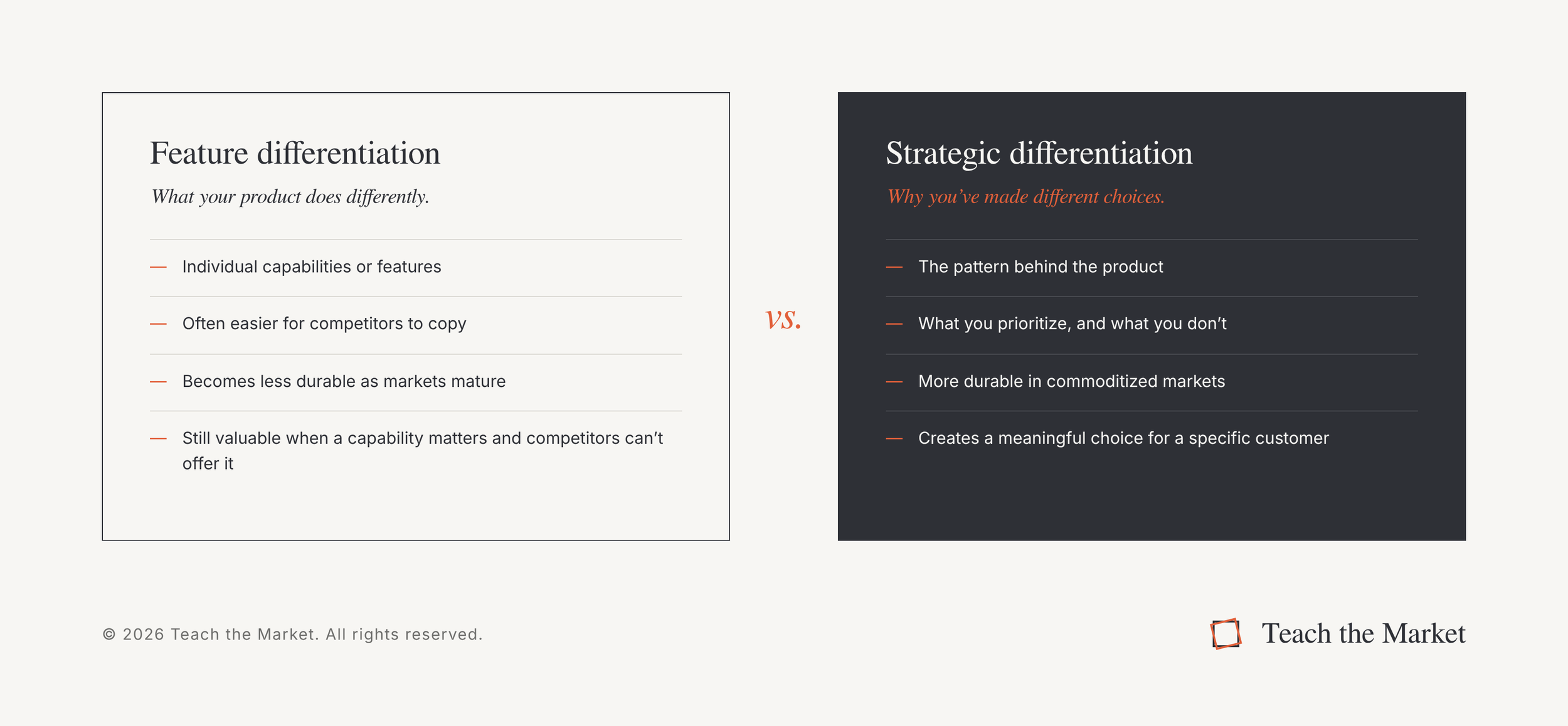
Feature differentiation remains valuable when a capability is important to buyers and competitors genuinely cannot offer it. But as products converge, individual capabilities often become less durable sources of differentiation.
Strategic differentiation looks for the pattern behind the product: what the company prioritizes, what it chooses not to optimize for, and why those choices create value for a particular customer.
Imagine three broadly comparable SaaS products.
Vendor A says:
Everything you need in one powerful platform.
Vendor B says:
Bring your entire organization together with one connected workspace.
Vendor C says:
We prioritize the workflows your frontline managers perform every day, rather than recreating every capability of a general-purpose enterprise suite.
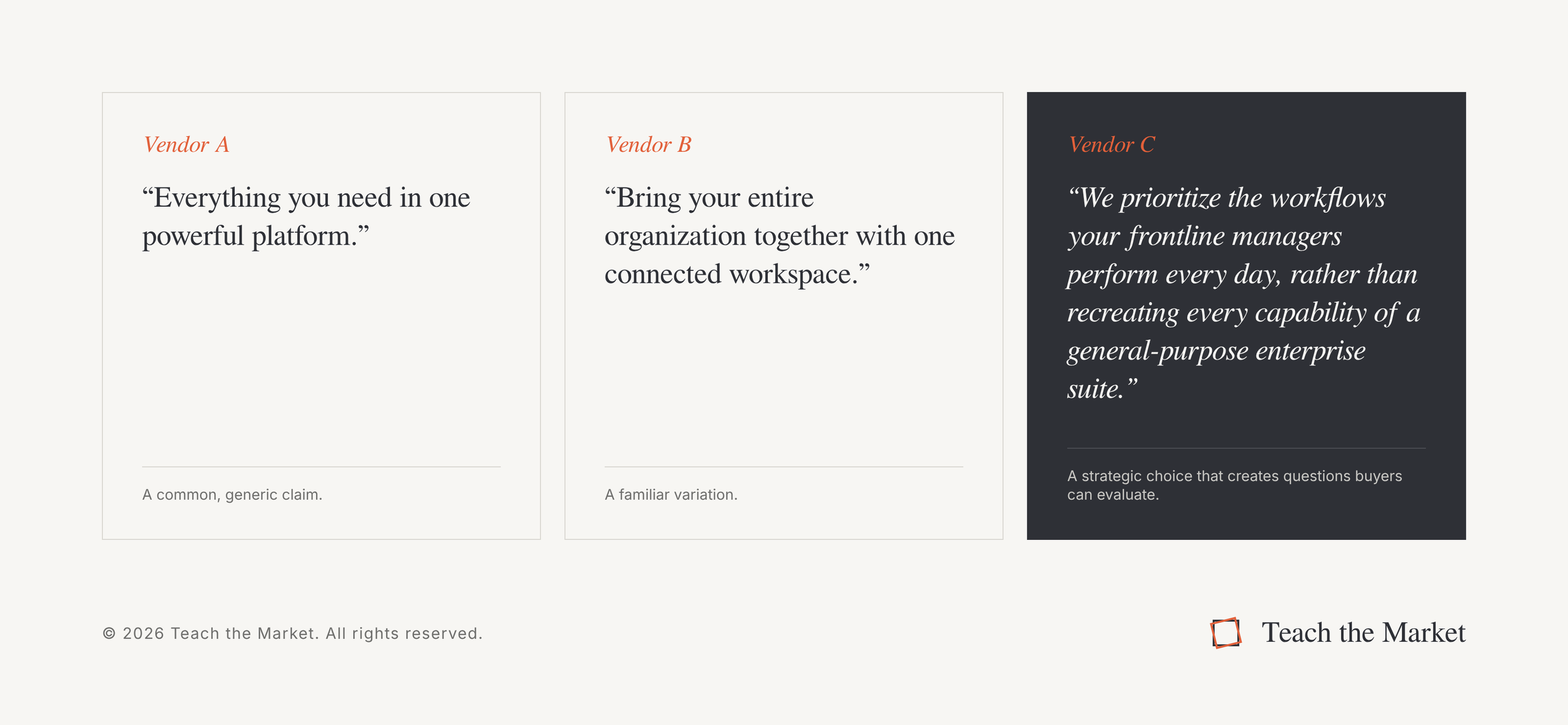
Vendor C's claim is not automatically strong positioning. But it contains the beginning of a strategic differentiation argument.
It tells the buyer what the company prioritizes. It implies a tradeoff. And, crucially, it creates questions that can be answered with the product:
What did you prioritize? What did you deprioritize? Why? And why should I prefer that choice?
That is much more defensible than searching for a new synonym for "all-in-one."
The Strategic Choice Test
When features alone no longer create enough separation, use the Strategic Choice Test to examine four things:
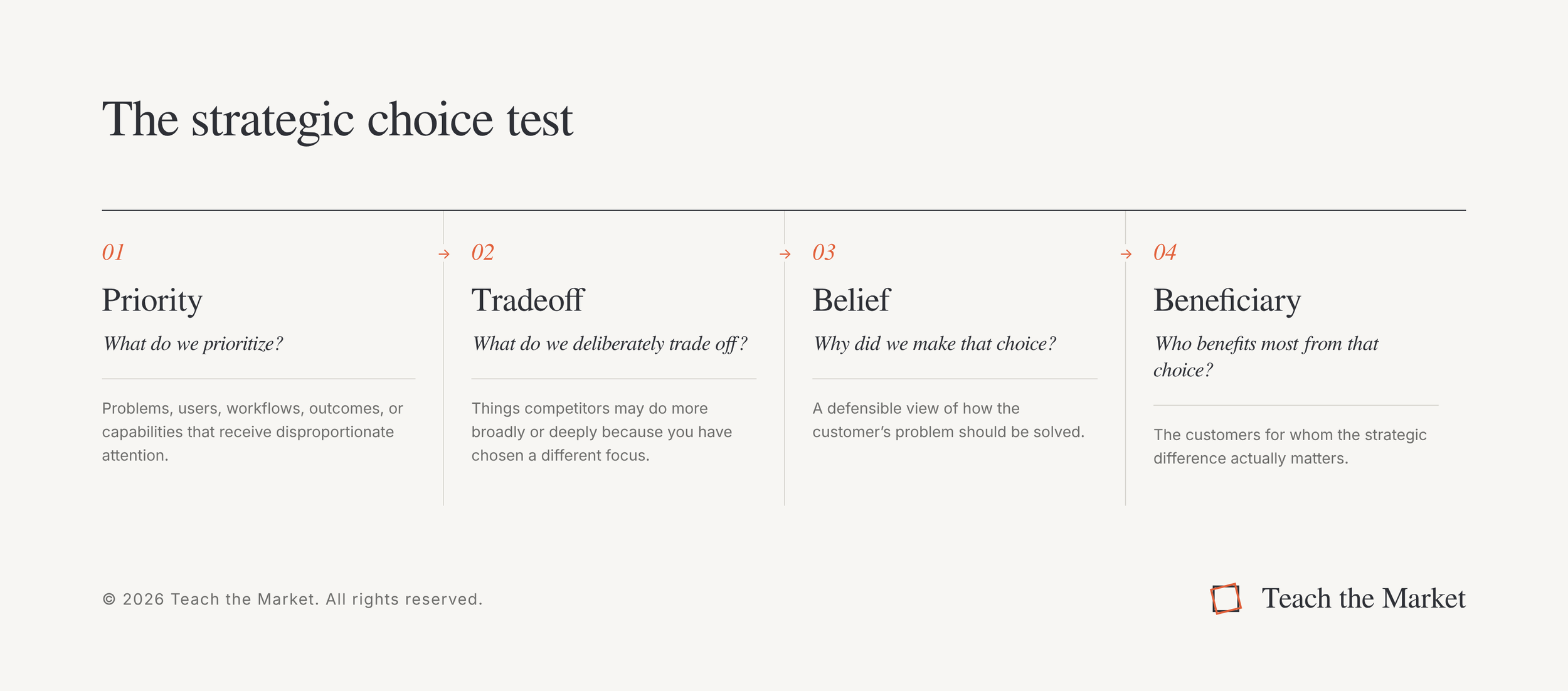
Priority: What do we prioritize? Problems, users, workflows, outcomes, or capabilities that receive disproportionate attention.
Tradeoff: What do we deliberately trade off? Things competitors may do more broadly or deeply because you have chosen a different focus.
Belief: Why did we make that choice? A defensible view of how the customer's problem should be solved
Beneficiary: Who benefits most from that choice? The customers for whom the strategic difference actually matters
The four elements of the Strategic Choice Test depend on one another.
A priority without a tradeoff often produces generic positioning because everyone can claim to prioritize everything.
A tradeoff without reasoning sounds like a product deficiency.
A belief without evidence becomes branding.
And a difference without a customer who values it is not useful differentiation.
1. Identify your priority
Start with what the company actually does, not what you would like the market to believe.
Look across product investment, customer conversations, roadmap choices, implementation, service, and go-to-market strategy.
Ask:
Where have we repeatedly chosen to go deeper than competitors?
The answer might involve a user group, a workflow, an architecture, an implementation model, a use case, or a particular definition of the problem.
Do not require the answer to be a feature.
You are looking for a pattern of choices.
2. Identify the tradeoff
This is where positioning often becomes uncomfortable.
A meaningful strategy usually means choosing something at the expense of something else.
Suppose a competitor offers substantially more functionality across a broad collection of use cases. You could try to disguise the gap:
Unlike bloated legacy platforms, our streamlined solution gives you exactly what you need.
That is only credible if the narrower scope actually creates an advantage.
Perhaps the focus makes the product easier for a particular workforce to use. Perhaps it allows greater depth in the workflows that matter most. Perhaps customers genuinely do not need the additional complexity.
If so, explain that.
If not, you have found a weakness, not a differentiation strategy.
You cannot turn every product gap into an intentional tradeoff after the fact.
3. Explain the belief behind the choice
Once you have identified the priority and tradeoff, ask why the company made that choice.
This is where a product difference becomes a positioning argument.
The structure is:
We believe [customer problem] is best solved by [approach], so we prioritize [strategic choice] rather than [alternative]. This matters because [customer consequence].
For example, imagine a hypothetical CRM company that deliberately limits how much customers can customize the product:
We believe a CRM creates the most value when sales teams actually use it consistently. So we prioritize opinionated workflows that work out of the box rather than giving every organization unlimited control over how the system is configured. That reduces the administrative burden of maintaining the CRM, makes it easier for new sellers to learn, and creates more consistent data across the sales organization. Where customers have specialized requirements, we support targeted configuration without turning every implementation into a custom software project.
A buyer can disagree with that argument.
That is a feature, not a bug.
Strong differentiation gives the customer a meaningful choice. If every reasonable competitor could adopt your positioning tomorrow without changing anything about its product or strategy, the differentiation probably is not strong enough.
4. Identify the beneficiary
Not every customer needs to value your difference.
In fact, trying to make a differentiator universally attractive often makes it less differentiated.
The beneficiary step of the Strategic Choice Test asks who receives enough value from the priority and tradeoff to prefer your approach.
A focused product might be a better fit for an organization that values simplicity and adoption, while a broader platform might be a better fit for an organization that prioritizes functional breadth.
You do not need to pretend the first approach is objectively superior.
You need to establish why it is superior under the conditions your target buyer actually faces.
That makes the positioning both more credible and more useful.
How do you turn a perceived weakness into credible differentiation?
One of the most useful positioning lessons I have learned has come from competing against products that are genuinely stronger than the one I am marketing in some areas.
The tempting response is to minimize those differences or create messaging that make your product sound equally comprehensive.
I’ve learned to take a different approach.
In one situation, I asked whether being broader was actually necessary to deliver the outcome we believed mattered most. The product was more focused in scope, but that focus also allowed for deeper concentration on the use cases we believed were most important to the problem we were trying to solve.
That gave us a much more defensible argument:
The competitor's broader functionality was real. Our narrower focus was real too. The question was which approach better matched what the customer was trying to accomplish.
This is an important distinction because you cannot simply rebrand every product weakness as a strategic choice.
If your competitor does something better and you are merely worse at it, positioning will not rescue you.
Use this test:
If we acknowledge that the competitor is stronger at X, can we make a credible argument that our strength at Y matters more for the customer we are trying to win?
If the answer is no, do not reposition the weakness. Fix it, accept it, or compete somewhere else.
If the answer is yes, you may have found the basis for meaningful differentiation.
How do you make a differentiation claim survive buyer scrutiny?
The fastest way to expose weak differentiation is to imagine a skeptical buyer asking:
"What does that actually mean?"
Suppose your positioning says:
We're the only employee platform built around the way modern organizations actually work.
What happens next?
Why?
How?
What did you build differently?
What do your competitors believe instead?
What consequence does that create for me?
If the answers become vague, the differentiation exists primarily in the copy.
Good positioning has to survive live buyer scrutiny.
For differentiation specifically, use the following chain:
Claim → reasoning → product evidence → customer consequence
The broader positioning argument explains why the buyer should change and why your solution makes sense. This chain of questions pressure-tests the narrower question: why should the buyer prefer your approach to another credible vendor's?
For example:
Claim: We take a more focused approach.
Reasoning: We believe employees should not have to navigate an increasingly complex collection of tools to accomplish a small number of frequent tasks.
Product evidence: Here are the product decisions that reflect that belief.
Customer consequence: Here is why those choices matter in your environment.
The headline gets attention. The reasoning and evidence make it credible.
Should you create a new category if your market is commoditized?
Not necessarily. A different approach does not automatically justify a different category.
If everyone in the category looks alike, declaring yourself something else can feel like an elegant escape from a commoditized market.
Sometimes it is justified. But category creation should solve a buyer-understanding problem, not a vendor-differentiation problem.
I learned this firsthand at a B2B SaaS company where we resisted the established category name for years because of its legacy associations. We believed our approach represented a more modern version of what the market could become, and we wanted language that reflected that difference.
The problem was that the established category was still what many buyers believed they were buying. It was the project they understood and, importantly, often the budget they already had.
Over time, we became more willing to position within the established category while differentiating our approach inside it.
The lesson was simple: your discomfort with a category does not make the category irrelevant to the buyer.
Trying too hard to escape an established category can force buyers to do unnecessary translation before they can even evaluate your differentiation.
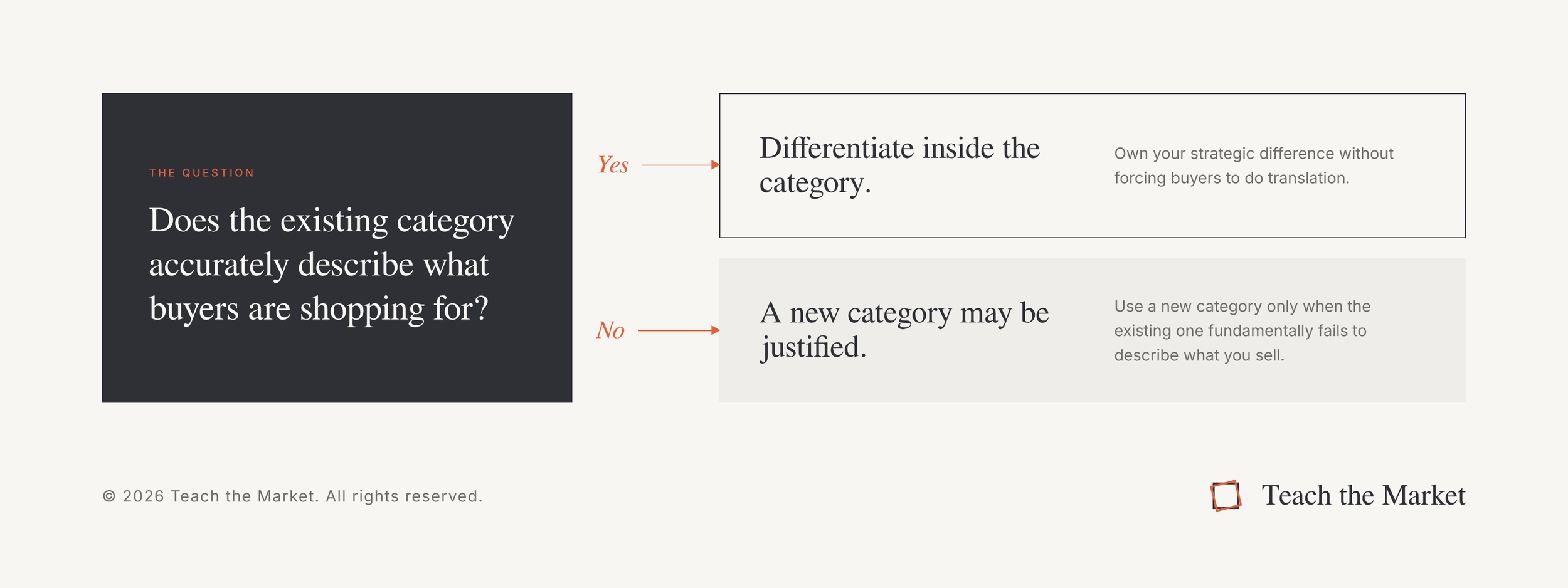
A useful test is:
Does the existing category fundamentally fail to describe what we sell, or do we simply have a different approach to solving the problem?
If the category still accurately describes what the buyer is shopping for, you may be better off owning your strategic difference inside the category.
How do you know your differentiation is too weak?
Differentiation is too weak when it sounds distinctive in marketing copy but stops being meaningful once a buyer compares products or asks follow-up questions.
Five warning signs are especially useful.
Every competitor can make the same claim without changing its product. "Easy," "intelligent," "unified," and "customer-centric" rarely differentiate by themselves.
The difference disappears when someone asks "how?" You have a tagline but not an argument.
The difference depends on an obscure feature buyers do not particularly value. Uniqueness and importance are not the same thing.
The positioning turns every product weakness into a supposed strategic decision. Credible differentiation acknowledges genuine tradeoffs rather than rewriting history.
The argument only works if the buyer accepts your claims at face value. Strong positioning becomes more convincing as the buyer investigates it, not less.
How do you find your differentiation in practice?
If your market feels commoditized, do not start by writing a new tagline.
Get product, product marketing, sales, and other relevant stakeholders in a room and work through the Strategic Choice Test.
Complete these statements:
The market is becoming similar because... Be specific about where parity actually exists and where it only appears to exist.
Most competitors appear to believe the problem should be solved by... Describe the dominant approach without turning it into a straw man.
Our priority is... Look for evidence in the product and company strategy.
The tradeoff we make is... Name what your approach does not optimize for.
We make that tradeoff because we believe... Turn the strategic choice into an argument about the customer's problem.
The customer who benefits most is... Define the conditions under which your approach wins.
Then pressure-test the result:
Our claim is...
The reasoning behind it is...
We can demonstrate it in the product by...
The consequence for this customer is...
Finally, ask:
What would a skeptical buyer challenge about this argument?
If you cannot answer that challenge convincingly, the solution is not better copy. Go back through the Strategic Choice Test until the reasoning becomes stronger.
Differentiation is not the search for something nobody else can say
That standard is increasingly unrealistic in mature B2B SaaS markets.
Competitors can copy language quickly. They can copy features eventually. And generative AI makes it easier than ever to produce polished versions of the same basic value proposition.
The more useful question is not:
What can we say that nobody else is saying?
It is:
What strategic choice have we made that matters to customers, and can we make a stronger argument for that choice than anyone else?
That shifts differentiation away from clever language and toward something much harder to imitate: a coherent relationship between your view of the problem, the choices you make, the product you build, and the customer you are best equipped to serve.
When everyone else looks the same, do not manufacture a difference.
Find the choice underneath the product, and teach the buyer why that choice matters.
About the author
Lara George spent eight years at a hypergrowth B2B SaaS company. She joined at Series B and rose from product marketing manager to VP of Product Marketing and GTM Enablement. She launched a product that now drives 40% of revenue, helped grow the portfolio from one product to more than six, and ran analyst relations from start to finish. She’s also a recognized voice in communications and a frequent speaker at communications and tech industry events. Teach the Market is where she shares what she learned. More about Lara
