

How Do You Position a B2B SaaS Product?
Positioning a B2B SaaS product means deciding what you want buyers to understand about your product, why that difference matters, and why they should choose your approach over the alternatives available to them.
Good positioning does not begin with a positioning statement, messaging framework, tagline, or list of differentiators. It begins with understanding the market: what buyers are trying to accomplish, what alternatives they have, how those alternatives differ, who has the power to buy, and what is actually preventing a purchase.
Only then can you decide what argument your product needs to make.
A practical B2B SaaS positioning process has eight steps:
Understand the market and competitive alternatives.
Diagnose the buying problem and buying power.
Identify the meaningful difference in your approach.
Choose the category that gives buyers the clearest context.
Build the positioning argument.
Pressure-test the argument against buyer scrutiny.
Develop the positioning in a real sales environment.
Codify the messaging framework last.
The output is not simply a clever sentence. Good B2B SaaS positioning is an argument that can survive a real sales conversation.
What is B2B SaaS positioning?
B2B SaaS positioning defines what your product means relative to the other choices a buyer could make.
Positioning determines the context in which a buyer understands the product: the problem it solves, the alternatives it competes against, the approach it takes, and the reasons that approach should matter to the buyer.
That makes positioning more fundamental than copy. Changing the language does not necessarily change what the market understands about the product.
If buyers cannot see why your product matters, generating 50 new headlines probably will not solve the problem. You first need to determine what buyers should understand differently.
What's the difference between positioning and messaging?
Positioning is what you want the market to understand. Messaging is how you communicate it.
A company might decide that its product should be understood as the simplest way for enterprises to govern a particular process across multiple business units. That is a positioning decision.
The homepage headline, pitch deck, sales talk track, proof points, campaign copy, and product descriptions used to communicate that idea are messaging.
This distinction is especially important as AI makes it easier to generate polished messaging. There are a million nice ways to say something. The harder work is deciding what you actually have to say.
Step 1: Understand the market and competitive alternatives
Start B2B SaaS positioning by understanding what buyers are comparing and how materially different those alternatives actually are.
You need to understand:
What alternatives does the buyer consider?
How mature is the market?
How similar have competing products become?
Which differences are meaningful to buyers?
Which differences are mostly marketing language?
What happens if the buyer does nothing?
Is the buyer comparing vendors, questioning the category, or struggling to justify the purchase at all?
This requires more than a competitive messaging audit.
Reading five competitor homepages tells you how competitors describe themselves. It does not necessarily tell you how their products differ.
That distinction becomes especially important in mature SaaS markets. As categories develop, competitors often build similar capabilities. Features that once differentiated a vendor become expected. Eventually, everyone appears to offer AI, analytics, integrations, automation, personalization, enterprise security, and some version of an "all-in-one" experience.
At that point, adding another feature to a comparison chart may not produce meaningful differentiation.
The positioning question is whether competing products merely sound similar or whether the products have actually become similar. Those two conditions require different responses.
A real example: what happens when two markets converge
Consider team messaging and project management software.
Historically, the distinction was relatively clear. A tool like Slack helped teams communicate about work. A project management platform helped teams structure that work into tasks, owners, timelines, and projects.
Over time, those boundaries have blurred.
Communication platforms have added task tracking, project templates, shared workspaces, automation, and other ways to organize work. Project management platforms have added messaging, collaborative documents, notifications, and increasingly rich ways for teams to communicate around the work itself.
The products have not become identical. But they increasingly solve overlapping parts of the same problem.
That changes the positioning challenge.
When categories are clearly separated, differentiation can rely more heavily on capabilities: we do X and they do not.
As markets converge, that argument becomes harder to sustain. Competitors can add features. Capabilities that once defined an entire category can become expected across several.
The more useful positioning questions become:
What does each company believe is the center of the problem? Where does it expect work to happen? What has it chosen to optimize for? And what tradeoffs follow from those choices?
Slack can add project management functionality without becoming the same product as a dedicated project management platform. The distinction increasingly comes from the product's center of gravity: the underlying view of how work should happen that determines what gets built, what gets prioritized, and what experience the product is ultimately designed around.
When markets converge, differentiation often moves up a level from what the product has to how the company believes the problem should be solved.
Step 2: Diagnose the buying problem and buying power
Before changing your positioning, determine what is actually preventing buyers from purchasing—and whether the people who want the product have enough power to get it approved.
Different deal patterns point toward different questions.
The Positioning Diagnosis Map
What is happening in deals? What should you investigate? There are five underlying buyer questions that correlate to common positioning perspectives:
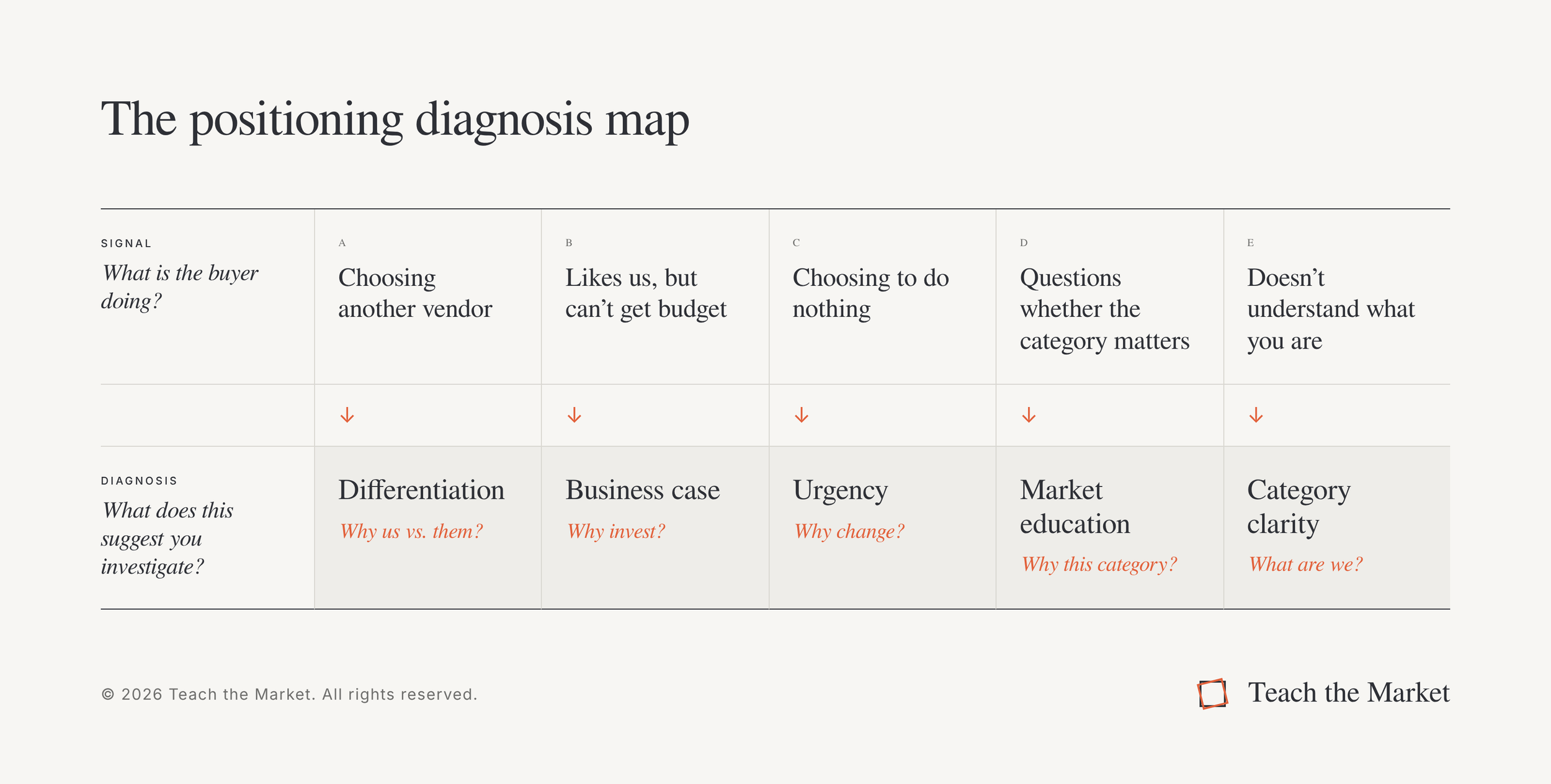
Why you instead of them? — The starting point for your positioning should be differentiation.
Why is this worth investing in? — The starting point for your positioning should be a business case.
Why change at all? — The starting point for your positioning should be urgency.
Why does this category (still) matter? — The starting point for your positioning should be market education.
What exactly are you…? — The starting point for your positioning should be category clarity.
These signals are diagnostic starting points, not automatic explanations.
A falling win rate does not prove that messaging is bad. A budget objection does not automatically mean you need a better ROI calculator. A stalled deal does not necessarily mean the buyer lacks urgency.
The purpose of diagnosis is to identify what the buyer needs to understand or believe that they do not understand or believe today.
Who actually has the power to buy?
The person who loves your product and the person with enough organizational power to get it purchased are not necessarily the same person.
That does not mean you should simply abandon your champion and start messaging to the most senior person involved. The better question is: Who needs to believe what for this purchase to happen?
I learned this at a SaaS company where we had built a very strong relationship with a particular professional audience. They understood the problem deeply, loved the product, and had become an important community around the company. For a long time, that audience also had enough influence in the buying process to help get purchases across the line.
Over time, the buying environment changed.
Other stakeholders became increasingly important to approval, budget, and the strategic case for the product. That created a difficult positioning problem. We still needed to speak meaningfully to the people who cared most deeply about the product, while making the story relevant to the people whose support was increasingly necessary to buy it.
It took us longer than it should have to respond to that shift.
And there was a very human reason for that: success with an audience can make it harder to recognize when buying power is moving elsewhere.
If you have spent years building a community, changing who you position toward can feel like abandoning the people who helped you succeed. But positioning has to reflect how the buying decision works now, not simply who historically loved you most.
Map the buying process explicitly:
Who experiences the problem?
Who champions the solution?
Who owns the budget?
Who can block the purchase?
Who has to justify it strategically?
Has the influence of any of those groups changed?
Then build positioning that helps your champion make the case to the rest of the buying group.
Message to the champion, but equip the champion to win the people whose support actually determines whether the purchase happens.
Step 3: Identify the meaningful difference in your approach
How do you differentiate when competitors have the same features?
When competing SaaS products have similar features, differentiate the strategic approach behind the product, not by inventing abstract brand language, but by explaining the choices that produce meaningful customer value.
Feature differentiation works when the feature difference actually matters.
But mature SaaS categories frequently reach a point where competitors can all produce impressive capability lists. When that happens, another feature claim may not give the buyer a useful reason to choose.
The next question is not simply:
What do we have that competitors don't?
Ask:
What do we believe this problem requires, and how has that belief shaped what we built?
That moves differentiation from a list of attributes toward a defensible approach.
The Differentiation Ladder
As markets converge, differentiation can move through several levels:
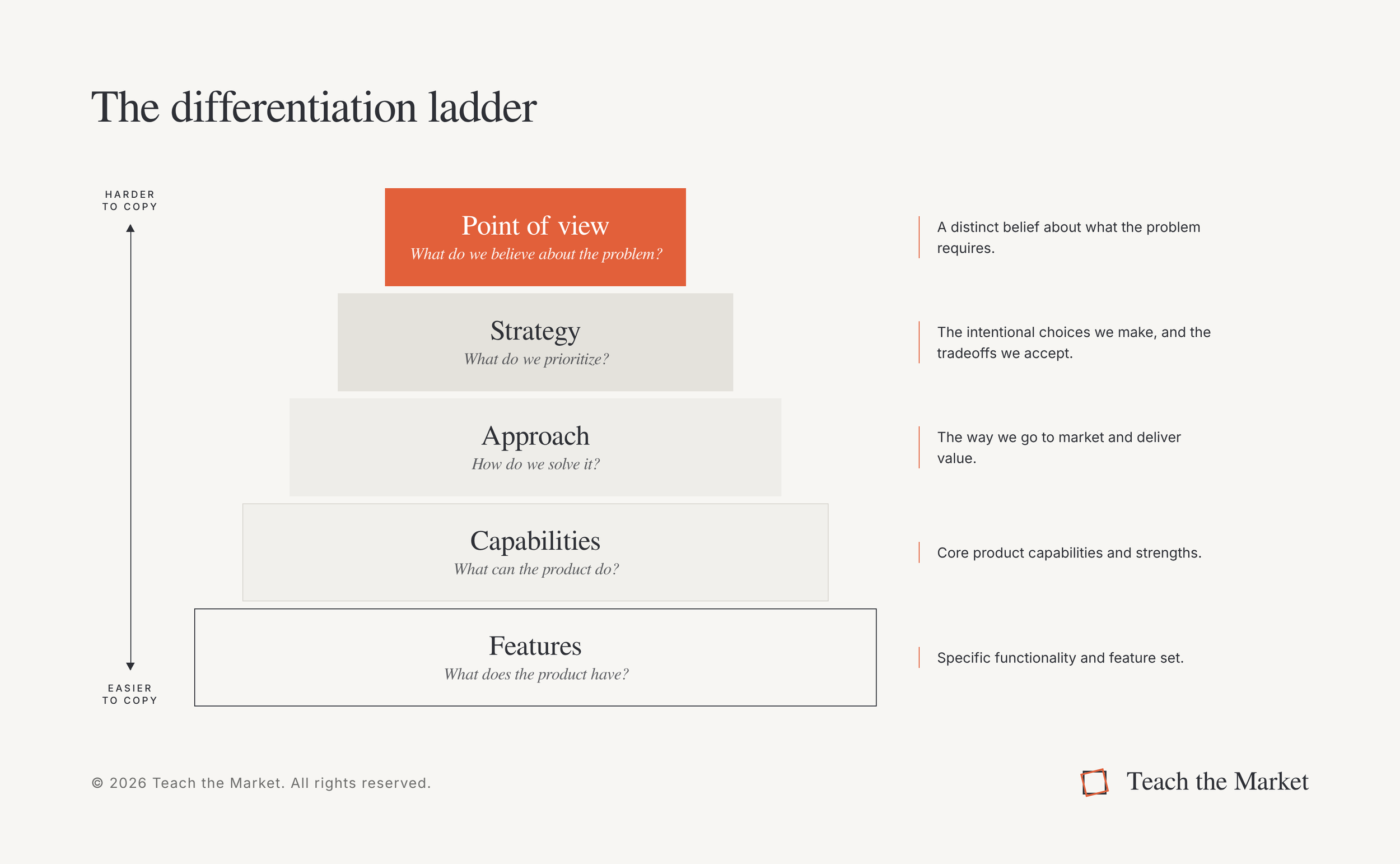
Moving higher does not mean abandoning the product and inventing a lofty point of view.
Every higher-level claim still has to connect back down.
If you say your company takes a fundamentally different approach, that difference should appear in product decisions, strengths, capabilities, or tradeoffs. Otherwise, the "strategic differentiation" is just marketing language sitting on top of an undifferentiated product.
Use this four-question test
Try completing these sentences:
The market usually assumes:
[What is the conventional approach?]
We believe the problem actually requires:
[What do you see differently?]
That is why our product prioritizes:
[What choices follow from that belief?]
This matters most for customers who:
[Who benefits from those choices, and why?]
If the belief cannot be connected to actual choices in the product, you probably have a marketing story rather than defensible positioning.
Step 4: Choose the category that gives buyers the clearest context
Should you create a new product category?
Use the category your buyer already understands unless you have a good reason not to.
A different approach does not automatically justify a different category.
I learned this at a SaaS company where we were uncomfortable with the established category buyers used to describe products like ours. The category had legacy associations we did not think reflected where the product or market was going, so we spent considerable time trying to describe ourselves as something different.
The problem was that buyers had not abandoned the category.
It was still the project they were pursuing. It was still how they described the need internally. And, importantly, it was often where the budget line item already existed.
Trying to escape the category could therefore create more work for the buyer. Before we could explain why our approach was different, we first had to explain what we were and why we were not calling ourselves the thing they had come looking for.
The lesson was not that you should always accept an established category. It was that a different approach does not automatically require a different category.
Before trying to create or rename one, use the Buyer Category Test.
The Buyer Category Test
Ask three questions:
1. Does the existing category accurately describe what we do?
If the answer is yes, abandoning it creates an additional burden of explanation.
2. Is this how buyers already think about the project and budget?
If buyers already have an established buying process for the category, forcing them to translate your terminology back into that process can create unnecessary friction.
3. Does a new category clarify the purchase or mainly make us sound different?
Category language should make the buying decision easier to understand.
If the first several minutes of every sales conversation are spent explaining why you are technically not what the buyer came looking for, even though you solve essentially that problem, the category positioning may be working against the sale.
Step 5: Build the positioning argument
A complete positioning argument connects the buyer's problem to its consequences, your belief about how the problem should be solved, your approach, the product, and credible proof.
This is the core construction model I use for thinking about positioning.
The Teach the Market Positioning Argument Chain
PROBLEM → CONSEQUENCE → BELIEF → APPROACH → PRODUCT → PROOF
Each link answers a different buyer question.
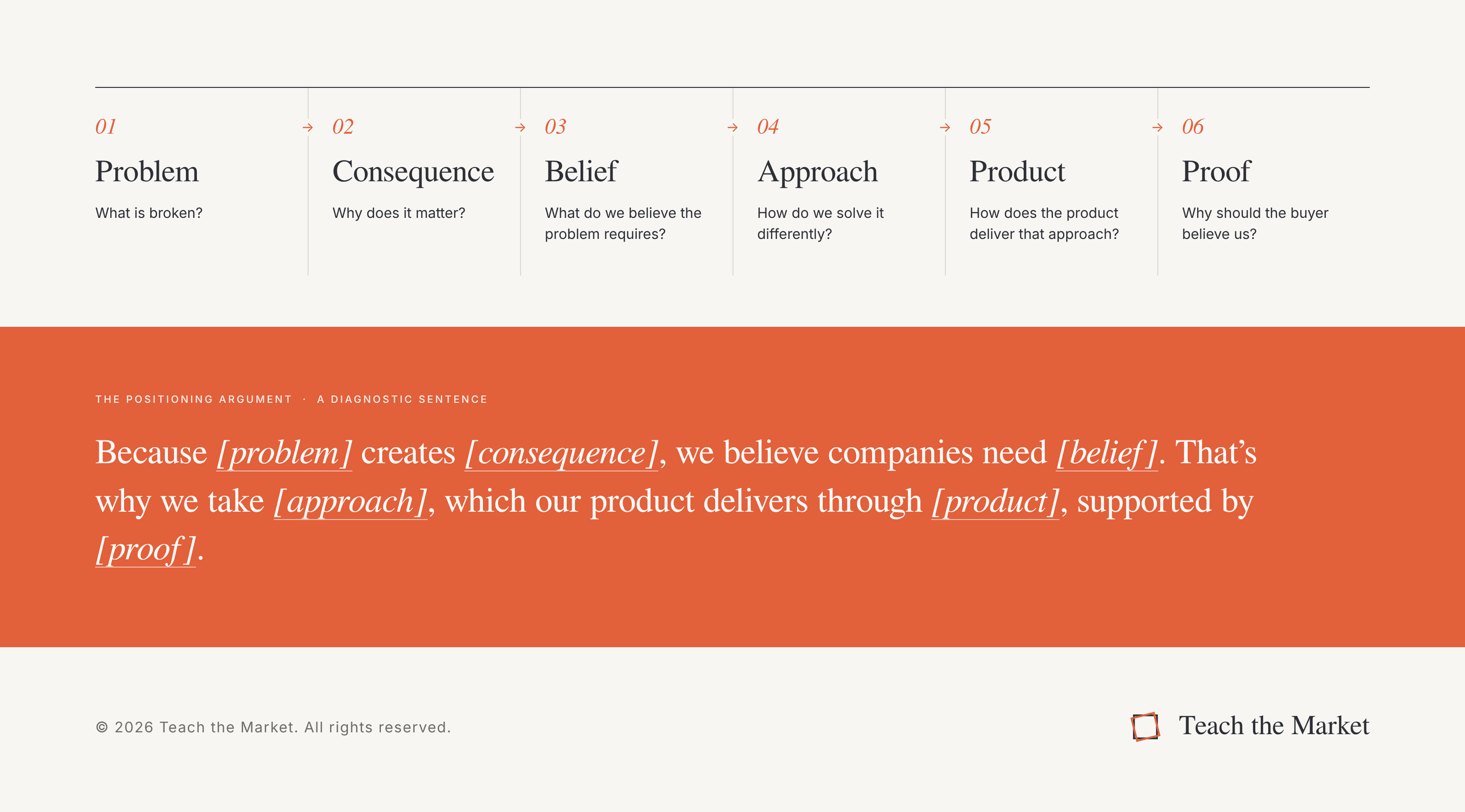
1. Problem: What is broken?
Describe the problem at the level relevant to the buying decision—not simply the task the software performs.
2. Consequence: Why does the problem matter?
Explain what happens if the problem remains unresolved.
The consequence is especially important when your biggest competitor is not another vendor but inaction.
3. Belief: What do we believe the problem requires?
This is the intellectual center of the positioning.
The belief explains your point of view about what is necessary to solve the problem.
4. Approach: How do we solve it differently?
Translate the belief into the strategic choices your company makes.
5. Product: How does the product deliver that approach?
Connect the strategic argument to actual product strengths, capabilities, and tradeoffs.
Without this link, a point of view can become a slogan detached from the software.
6. Proof: Why should the buyer believe us?
Support the argument with appropriate evidence: product evidence, customer evidence, demonstrated expertise, data, or another credible reason to believe the claim.
Use the Positioning Argument Chain as a diagnostic sentence
A simple way to test the chain is:
Because [PROBLEM] creates [CONSEQUENCE], we believe companies need [BELIEF]. That's why we take [APPROACH], which our product delivers through [PRODUCT], supported by [PROOF].
That sentence is not meant to become your homepage copy.
It is a diagnostic.
If one part is difficult to complete, you have identified a weakness in the positioning argument.
A company with a strong problem and consequence but no differentiated belief may have an urgency story without differentiation.
A company with a provocative belief but no product connection may have thought leadership rather than positioning.
A company with strong capabilities but no consequence may struggle to explain why buyers should prioritize the purchase.
The chain forces the entire argument to connect.
Step 6: Pressure-test the argument against buyer scrutiny
Good positioning should become stronger as buyers ask more specific questions; if a claim collapses after one follow-up question, it is probably copy rather than positioning.
Take every important positioning claim through the same sequence.
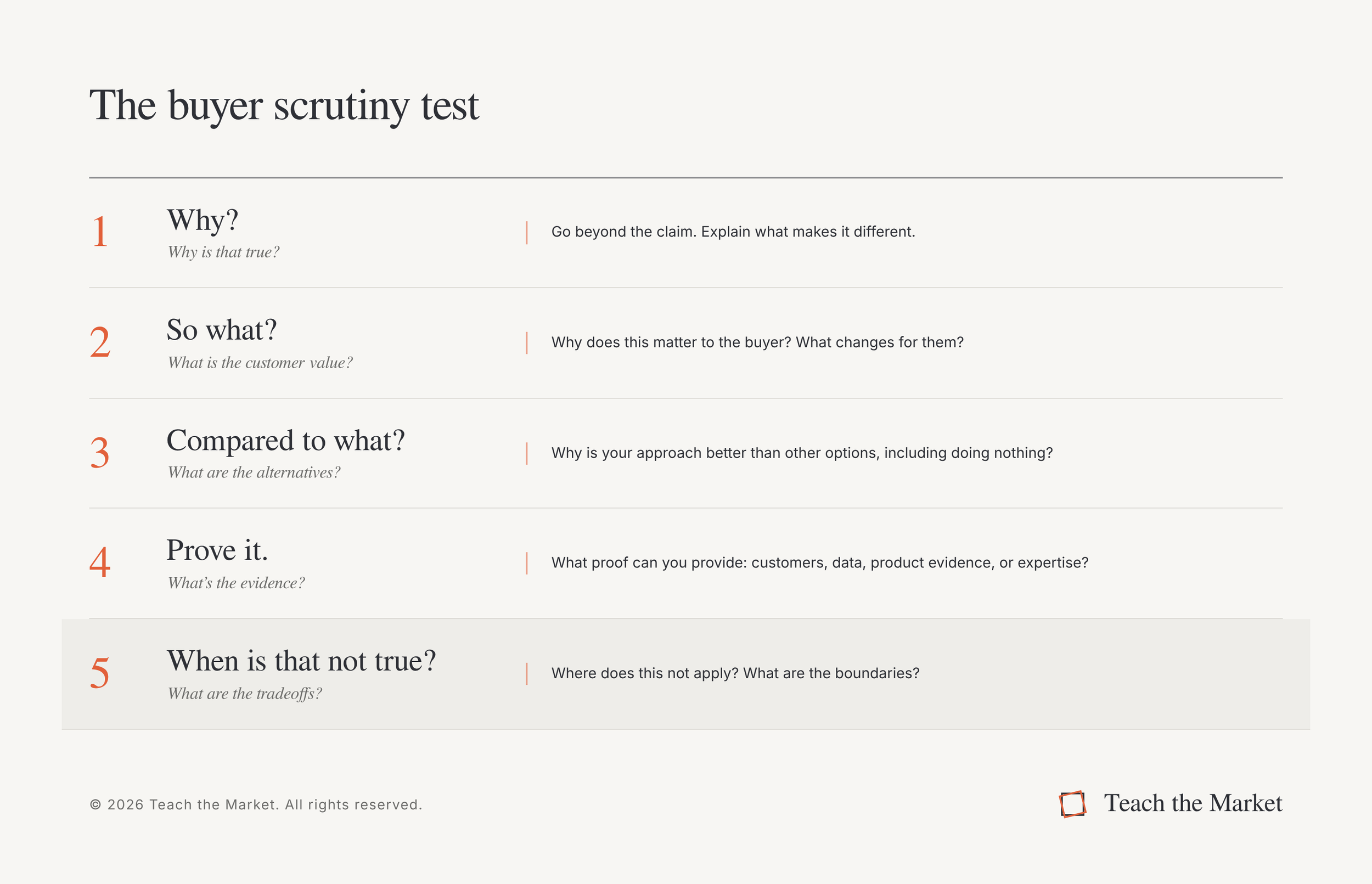
The Buyer Scrutiny Test
1. WHY?
Why is the claim true?
2. SO WHAT?
Why does the difference create value for the buyer?
3. COMPARED TO WHAT?
Why is the approach better than the alternatives—including doing nothing?
4. PROVE IT.
What evidence supports the claim?
5. WHEN IS THAT NOT TRUE?
Where are the boundaries and tradeoffs?
That final question matters.
Positioning becomes less credible when every product is presented as the best choice for every buyer, use case, and circumstance. Knowing where your argument stops can make the claim more defensible rather than less compelling.
Test positioning with people who hear buyer objections
Experienced sellers are particularly useful during this stage because they know the questions buyers actually ask.
Ask them:
Where would a buyer challenge this?
Which claim would be difficult to defend?
What are you hearing in lost deals?
Which part would you hesitate to say in a customer meeting?
Where would you need more proof?
Does this help you explain why we are different?
Partners who are close to customers can also provide useful early feedback.
But distinguish between kinds of evidence.
A seller liking the positioning means a seller likes the positioning. It does not prove buyers will.
Seller and partner feedback can expose weaknesses quickly. Direct customer evidence is more useful when you need to validate assumptions about buyer relevance or demand.
Step 7: Develop the positioning in a real sales environment
Develop positioning in a concrete buyer conversation before turning it into a formal messaging framework.
My default starting environment is often a pitch deck.
A pitch forces positioning into sequence.
You have to decide:
What does the buyer need to understand first?
What do they need to believe next?
Where will they object?
When should the product appear?
What proof is required?
What does the seller need to explain rather than simply show?
The right opening depends on the buying problem.
If buyers already understand the category and are comparing vendors, lead more quickly into: Why is our approach different?
If buyers understand the problem but cannot justify the investment, establish: Why does this problem deserve budget and priority?
If the primary competitor is doing nothing, establish: Why does the status quo need to change?
This is why a universal pitch structure rarely solves positioning.
The sequence of the pitch should reflect the sequence of beliefs required for the buyer to move forward.
The website can serve a similar function. Both environments force abstract positioning decisions to become concrete enough for a buyer to understand and challenge.
Step 8: Codify the messaging framework last
Build the messaging framework after you have developed and pressure-tested the message, not as the starting point for discovering what the message should be.
Messaging framework last.
A framework is useful when other marketers need to apply the positioning consistently. It is a scaling mechanism.
It is much less useful as a worksheet for manufacturing an argument from scratch.
A practical messaging source can capture:
The core positioning thesis
The market problem
The consequences of that problem
The company's belief
The strategic approach
Supporting arguments
Product evidence
Competitive distinctions
Important tradeoffs
Reasons to believe
Audience-specific implications
Claims that should not be made
Product and use-case boundaries
Those last elements become increasingly important when AI is helping teams execute messaging.
AI can produce dozens of headlines, campaign concepts, value-proposition variations, sales emails, and web-copy drafts very quickly.
The scarce input is not another collection of sample phrases.
The scarce input is clarity about what the company is actually trying to say, why it believes that argument, and where the argument stops.
The complete B2B SaaS positioning framework
The eight-step process can be summarized as:
1. Understand
What market are we actually competing in?
Map alternatives, maturity, convergence, and the status quo.
2. Diagnose
What is preventing the purchase?
Identify whether the obstacle is differentiation, urgency, investment, category relevance, category clarity, or buying power.
3. Differentiate
What do we believe or do meaningfully differently?
Move beyond features when feature-level differences no longer create meaningful separation.
4. Categorize
What context makes us easiest to understand and buy?
Use existing category language unless changing it genuinely improves buyer understanding.
5. Construct
Can we make a complete argument?
Use the Teach the Market Positioning Argument Chain:
Problem → Consequence → Belief → Approach → Product → Proof
6. Pressure-test
Can the argument survive buyer scrutiny?
Ask why, so what, compared to what, prove it, and when is that not true.
7. Apply
Does the positioning work in a real buying conversation?
Build the pitch and other concrete applications before abstracting the message.
8. Scale
Can other people reproduce the thinking accurately?
Codify the messaging framework last.
What are the most common B2B SaaS positioning mistakes?
Most B2B SaaS positioning mistakes happen when companies start producing language before they have diagnosed the market and built a defensible argument.
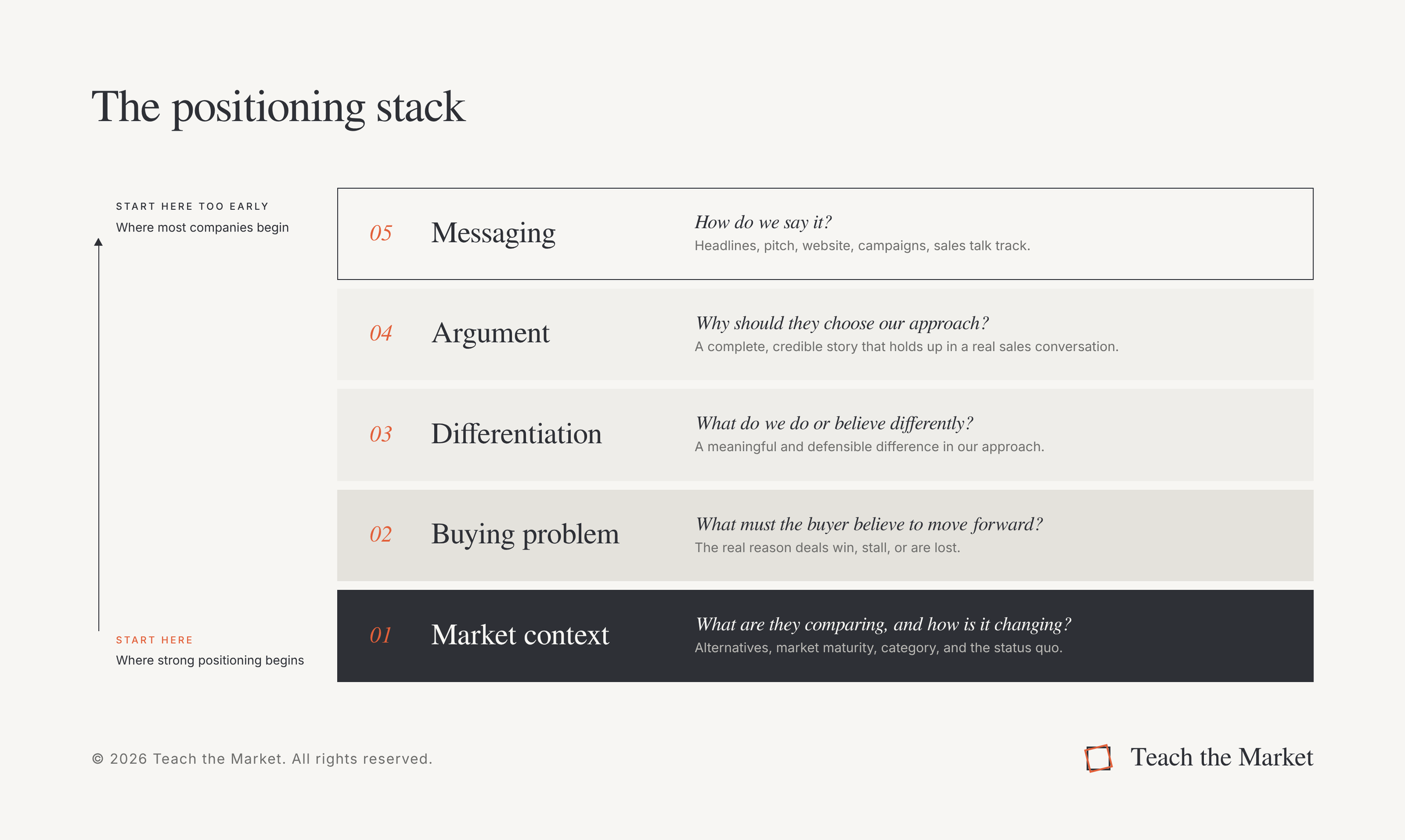
Common mistakes include:
Starting with the messaging framework. Filling in boxes creates the appearance of progress before the central argument is clear.
Confusing different language with meaningful differentiation. Saying "AI-powered," "unified," "modern," or "intelligent" differently from competitors does not necessarily give the buyer a reason to choose you.
Treating every feature gap as intentional strategy. A credible strategic tradeoff requires a corresponding strength. A weakness does not become differentiation merely because you explain it creatively.
Trying to be better at everything. Positioning becomes more believable when the company can explain what it prioritizes and why.
Ignoring the status quo. In many B2B SaaS purchases, the most important competitor is no purchase at all.
Positioning only for the champion. Enthusiasm does not necessarily translate into budget authority.
Inventing a category because the existing one sounds boring. Familiar category language can make a product easier to understand and buy.
Testing whether people like the language instead of whether the argument survives scrutiny. Positive reactions to a headline are weaker evidence than the ability to defend the underlying argument through a real conversation.
How do you know when B2B SaaS positioning is working?
B2B SaaS positioning is working when buyers and sellers can understand, repeat, and defend the intended value—not simply when the new copy sounds better.
Useful signals include whether:
Buyers can explain the value back in their own words.
Sellers can defend the differentiation under questioning.
The positioning addresses objections actually appearing in deals.
Champions can carry the argument to approvers.
Competitive claims remain credible when buyers investigate them.
Marketing, sales, and product can explain the same strategic approach without simply memorizing identical language.
Commercial measures such as win rate, sales velocity, and conversion can matter too, but positioning is rarely the only variable affecting them. Treat changes in those outcomes as evidence to investigate rather than automatic proof of causation.
B2B SaaS positioning starts with the argument, not the words
The goal of B2B SaaS positioning is to give buyers a useful way to understand what problem you solve, how you believe it should be solved, why your approach is meaningfully different, and why that difference should affect their decision.
Start with the market.
Diagnose the buying problem and where buying power sits. Find the level at which you have a meaningful difference. Use category language that helps the buyer understand the purchase. Build the complete argument. Pressure-test it until it can survive scrutiny. Make it work in a real pitch.
Then build the messaging framework.
There are a million nice ways to say something.
The harder, and more valuable, work is figuring out what you have to say.
About the author
Lara George spent eight years at a hypergrowth B2B SaaS company. She joined at Series B and rose from product marketing manager to VP of Product Marketing and GTM Enablement. She launched a product that now drives 40% of revenue, helped grow the portfolio from one product to more than six, and ran analyst relations from start to finish. She’s also a recognized voice in communications and a frequent speaker at communications and tech industry events. Teach the Market is where she shares what she learned. More about Lara
