

The Startup Guide to Gartner and Analyst Relations
For a startup, analyst relations can feel unnecessarily mysterious.
When should you start talking to Gartner? Do you need to pay Gartner? What exactly happens in a Vendor Briefing? What should you put in the deck? And how do you eventually get considered for something like a Gartner Magic Quadrant?
Start analyst relations before you need something from the analyst. You do not need to be a Gartner client to request a Vendor Briefing or to be included in Gartner research. What you do need is a clear understanding of your market, a defensible point of view, evidence of what you are seeing, and something relevant to contribute to the analyst’s research agenda.
I learned this by building analyst relations from the ground up inside a hypergrowth B2B SaaS scale-up and scaling the program as the company, product portfolio, and category evolved. The job changed as we grew: from introducing analysts to a relatively unknown company, to helping them understand our place in an evolving market, to running major evaluations and preparing executives for increasingly consequential analyst conversations.
This is the guide I wish I had when I started: how to begin building analyst relationships before you have a formal AR function, how to brief analysts well, how to communicate differentiation, and how to prepare for research like the Gartner Magic Quadrant without treating analyst relations as a rankings game.
What is analyst relations?
Analyst relations, or AR, is the practice of building relationships with industry analysts who research markets, advise technology buyers, and develop frameworks for understanding vendors and categories.
For startups, analyst relations can help you:
help analysts understand your company and strategy;
learn how analysts understand your market;
identify gaps between your positioning and the way the broader market sees the problem;
contribute evidence about changing customer requirements or buying patterns;
gather feedback when you have access to advisory interactions;
and participate in relevant research and formal vendor evaluations.
The mistake is reducing analyst relations to rankings.
A Magic Quadrant may eventually matter enormously to your company. But if the only time Gartner hears from you is when you want to be included in one, you have skipped much of the work that makes analyst relations useful in the first place.
When should a startup start talking to Gartner?
A startup should start talking to Gartner when it has something substantive to contribute to a conversation about the market, not only when it thinks it is big enough to appear in a Magic Quadrant.
That does not necessarily mean starting an elaborate analyst relations program in your earliest days.
A useful test is whether you can answer four questions:
What market do we believe we compete in?
What is changing in that market?
What have we learned from customers that might be useful to someone studying it?
What is meaningfully different about our approach?
If you cannot answer those questions yet, your priority is probably understanding your market and customers more deeply.
If you can, you have the beginnings of an analyst conversation.
Do I need to pay Gartner to talk to Gartner?
No. You do not need to pay Gartner or be a Gartner client to request a Vendor Briefing or to be considered for Gartner research.
Gartner allows both clients and non-clients to request Vendor Briefings. Non-clients complete a one-time registration and can then submit Gartner’s Vendor Briefing request form. Gartner says analysts decide whether to accept a briefing based on its relevance to their research agenda, not whether the vendor has a commercial relationship with Gartner.
That is different from paying for access to Gartner’s strategic advice.
Gartner vendor clients can access advisory interactions designed to provide strategic guidance. Gartner describes these as separate from evaluative research and says client status does not determine whether a company is included in research such as a Magic Quadrant.
The easiest way to think about the distinction is:
Vendor Briefing: No. You provide Gartner analysts with information relevant to their research.
Gartner research coverage: No. Gartner researches markets and relevant vendors.
Strategic/advisory interaction: Yes, generally a client service. You receive Gartner analyst advice.
Magic Quadrant participation: No. Gartner evaluates qualifying vendors against its methodology
So a startup should not approach Gartner asking, “How much do we need to spend before Gartner will cover us?”
The more useful question is: Do we have something relevant enough to the analyst’s research agenda that they should want to hear from us?
What is the difference between a Gartner Vendor Briefing and an advisory interaction?
A Vendor Briefing is primarily for the vendor to give Gartner information. Strategic advisory interactions are for Gartner clients seeking analyst advice.
Gartner describes Vendor Briefings as research tools in which the flow of information predominantly runs from the vendor to the analyst. Analysts can ask clarifying questions, but analyst feedback is not the purpose of the meeting.
That distinction matters for startups.
If you are a non-client, do not request a Vendor Briefing expecting 45 minutes of free consulting on your strategy or roadmap. Gartner also states that analysts are prohibited from providing feedback on Vendor Briefing materials or discussing specific scores or proprietary methodologies.
If you are a Gartner vendor client with access to strategic advisory services, you may have other ways to seek analyst feedback. But the briefing itself still has a different job.
Do not try to turn a Vendor Briefing into a strategy workshop.
Your objective is to help the analyst understand something relevant about your company, product, customers, or market.
What should a Gartner briefing accomplish?
Before you build a deck, decide what you want the analyst to understand differently when the meeting ends.
Start with the analyst’s existing perception:
What do they already think about us?
What do they value in this market?
Where are they skeptical?
What do they misunderstand?
What do we want them to reinforce or reconsider?
Only then should you decide what slides belong in the presentation.
Gartner itself recommends that vendors establish their major points quickly and address questions such as what the company does, why customers buy, what problems the product solves, what differentiates it, where it fits relative to competitors, and what major milestones are coming.
This is why taking your standard sales pitch and presenting it to Gartner rarely works well.
Your sales deck was designed to help a prospect make a buying decision.
An analyst is trying to understand your company in the context of an entire market.
Those are different jobs.
What should be in a Gartner briefing deck?
Most guidance on analyst briefing decks will tell you to include three things:
Business progress: What has changed in the company?
Product and innovation: What have you built?
Future direction: Where are you going?
Those three things belong in the deck. I recommend adding a fourth: Market Observations.
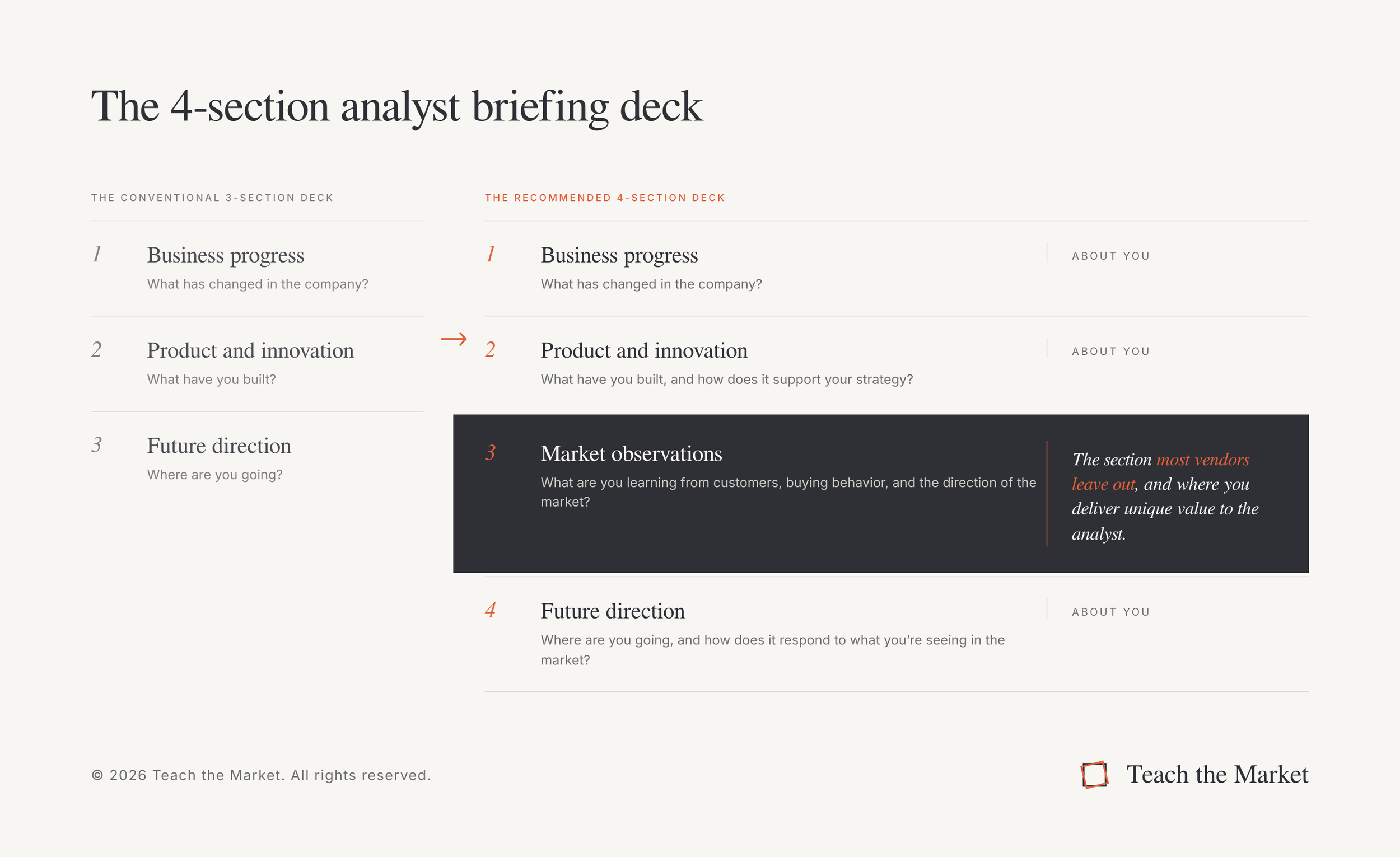
I recommend actually sharing what you are learning about customers, buying behavior, requirements, and the direction of the market.
Why I add Market Observations to every briefing
The first, second, and fourth sections are fundamentally about you: your business, your product, and your plans.
But the analyst's job is to understand the market.
That creates an opportunity. Your company is sitting on information the analyst may find genuinely useful: what customers are asking for, how buying groups are changing, which requirements are becoming more important, what objections are emerging, and where you are seeing patterns across deals.
A Market Observations section turns those signals into something useful.
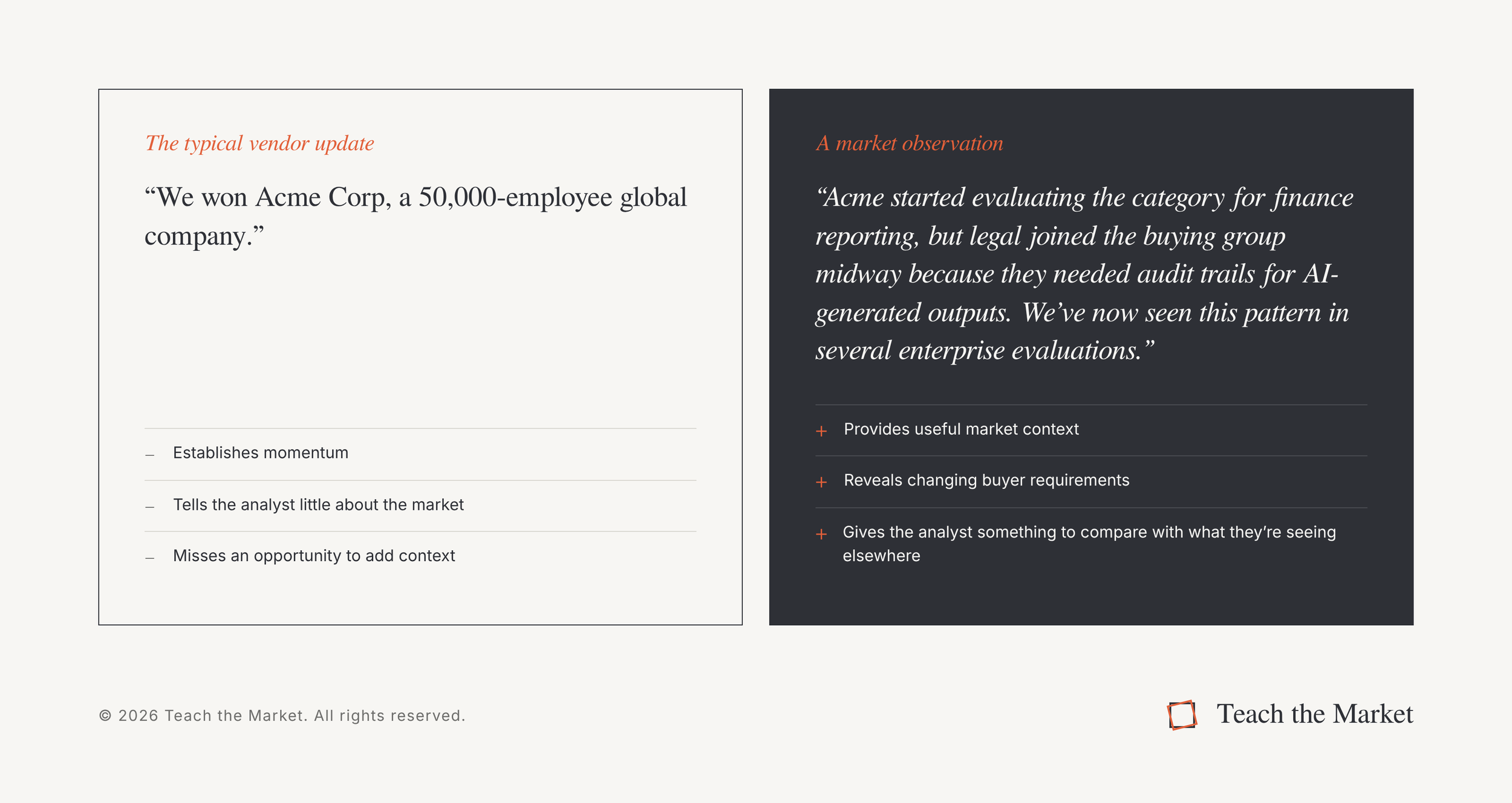
For example, suppose you recently won a significant enterprise customer.
You could tell the analyst:
We won Acme Corp, a 50,000-employee global company.
That is a business update.
Or you could explain that the buying group expanded during the evaluation because a new business division became involved, that something new became a critical requirement, and that you have seen a similar pattern in several recent enterprise evaluations.
Now you have given the analyst something they can interrogate against what they are seeing elsewhere.
The important discipline is not to turn anecdotes into trends. A single customer does not establish a market shift. Be precise about what you have observed and how frequently you have observed it.
The purpose of Market Observations is different: bring the analyst evidence from your corner of the market that they can compare with evidence from everyone else's.
That is why I recommend four sections rather than three:
What has changed in our business → What have we built → What are we learning from the market → Where are we going next
The first three give the analyst evidence. The fourth gives them your interpretation of where that evidence leads.
How much product detail should you include?
Include enough product detail to substantiate your strategy.
A long product demo is not automatically evidence of differentiation. But a strategic claim with no product substance behind it is not particularly useful either.
A simple chain can help:
Market change → strategic choice → product proof → customer consequence
Start with what is changing in the market. Explain the strategic choice your company has made in response. Show how the product makes that choice real. Then explain why the difference matters to the customer.
That chain should work beyond analyst relations. It is the same basic test your positioning should survive with buyers: can someone trace the argument from what is happening in the market to a tangible reason your approach matters?
If one connection is missing, the differentiation is likely to feel like marketing language rather than a substantive argument.
How do Gartner analysts evaluate vendors?
For a Gartner Magic Quadrant specifically, vendors are evaluated across two major dimensions: Ability to Execute and Completeness of Vision.
Gartner says those dimensions can include up to 15 weighted criteria. Ability to Execute can encompass areas such as product or service, viability, sales execution, market responsiveness, marketing execution, customer experience and operations. Completeness of Vision can encompass market understanding, marketing and sales strategy, product strategy, business model, industry strategy, innovation and geographic strategy.
That is considerably broader than whether an analyst likes your messaging.
The analyst is trying to understand your company in the context of a market: what you offer, how successfully you execute, where your strategy is going, how your approach compares with alternatives, and whether the evidence supports your claims.
That means being memorable is not enough.
You need to be understandable.
One of the biggest mistakes companies make in analyst conversations is assuming their product occupies the same central position in the market that it occupies inside their own company.
The analyst sees the ecosystem around you.
Explain your boundaries. What do you do natively? What belongs in another system? Where do you integrate? Where do technologies overlap?
Sometimes an architecture or ecosystem slide will explain your company better than another positioning slide.
How do you communicate differentiation to Gartner?
Translate your differentiation into the analyst’s model of the market.
Do not assume that repeating your positioning more forcefully will make it clearer.
I once learned this first hand through a disagreement with an analyst about a core positioning idea.
The language made sense inside the company, but the analyst interpreted it as a much broader claim about the role our product should play in the technology ecosystem. That was not what we intended.
My first instinct could have been to explain the positioning again. Instead, I tried to understand the model behind the objection.
I mapped our product into the analyst’s broader view of the market: what we delivered ourselves, where other systems played a role, how the technologies connected, and what part of the ecosystem we were actually trying to own.
That exercise led us to a different way of explaining the same strategy. One that made sense inside the analyst’s model without changing the underlying position.
The lesson was not to find a better metaphor. It was to translate the argument.
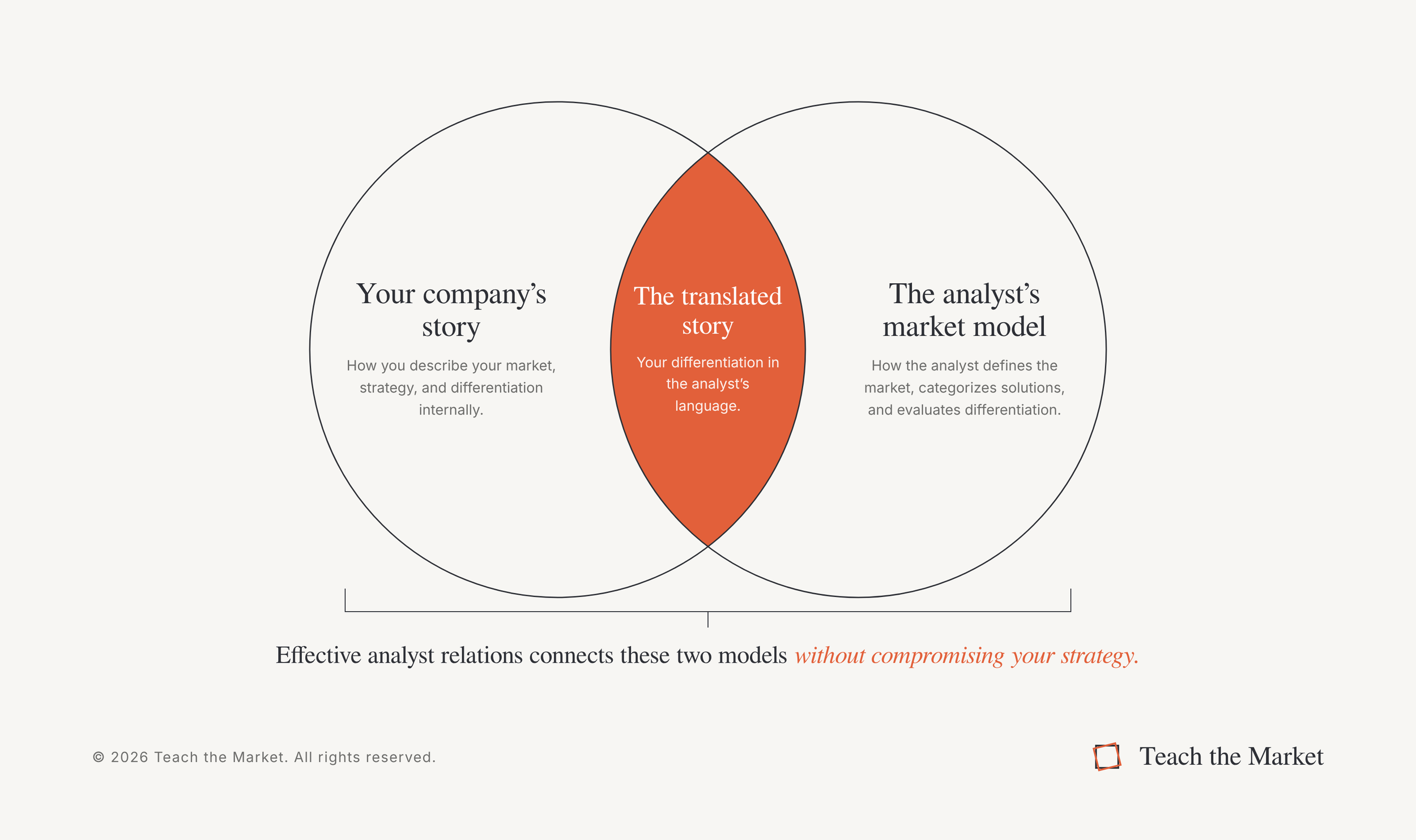
Your positioning has been developed from inside your company. The analyst has developed a model of the market from across many companies.
Effective analyst relations requires connecting those two models.
What if the Gartner analyst disagrees with your positioning?
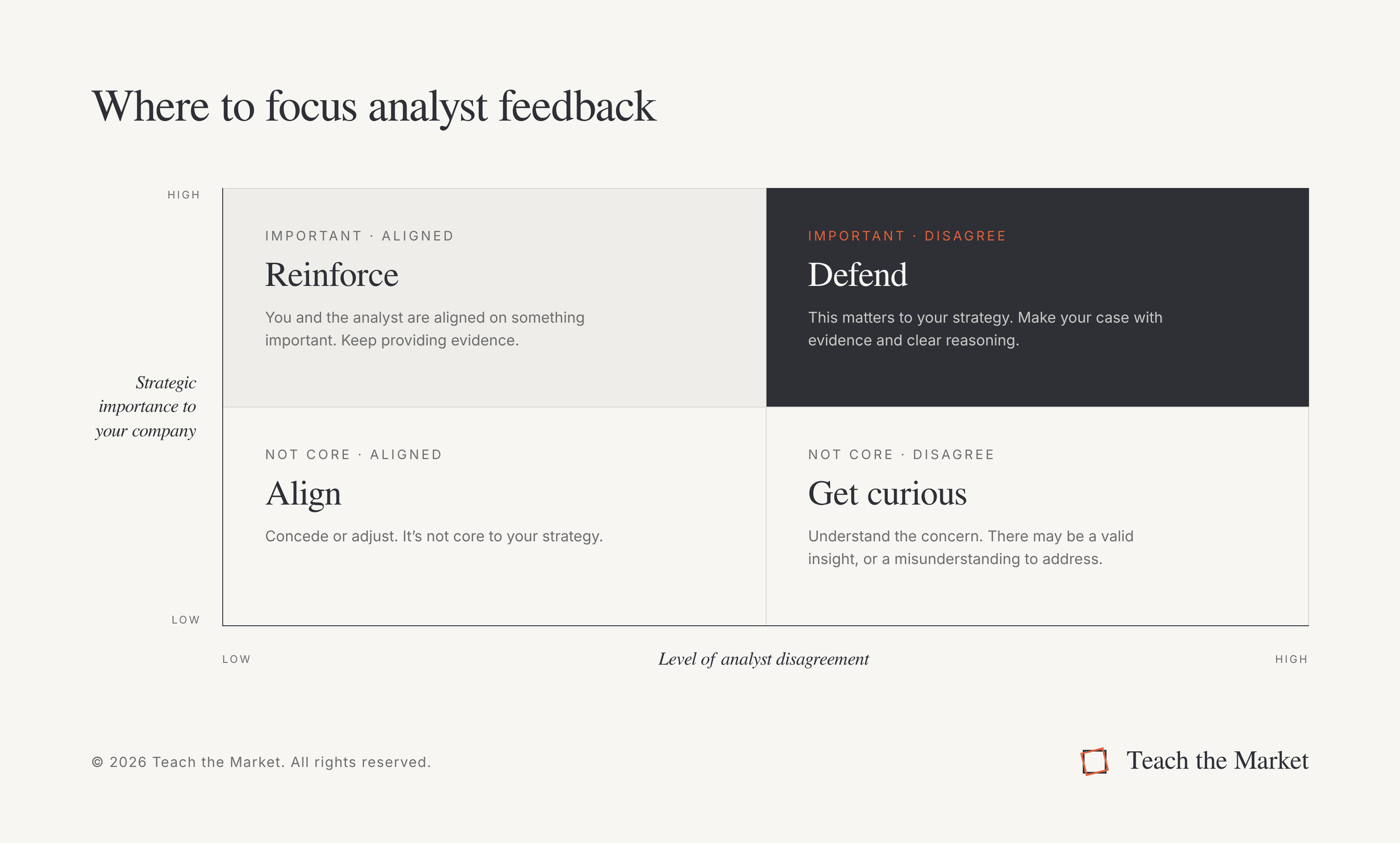
Analyst disagreement should trigger curiosity before defensiveness.
Ask what is behind the objection. What are they seeing elsewhere in the market? What assumption are they challenging? How are they defining the problem differently?
Then decide whether the disagreement actually matters.
My rule is to choose the battles that matter to your strategy.
If an analyst makes a legitimate point on something relatively small, concede it. You do not build credibility by fighting every criticism.
If the disagreement concerns something fundamental to your strategy, defend the position. But defend it with reasoning and evidence rather than simply restating your messaging.
Analyst relations works better when the objective is not to win every argument. The objective is to build enough mutual understanding that the important arguments can become substantive.
How should you prepare executives for a Gartner briefing?
Never put an executive into an analyst conversation with nothing more than the deck and a calendar invitation.
Brief them on:
who the analyst is;
how the analyst currently views the market;
relevant history from previous conversations;
what the analyst has challenged before;
what you are trying to communicate;
how you want to explain contentious topics;
and what language is likely to create confusion.
The last point is not about giving executives a list of forbidden phrases.
Executives need to understand why a particular framing causes a problem.
If they understand the reasoning, they can answer follow-up questions naturally. If they have simply memorized approved language, the conversation becomes fragile as soon as the analyst asks something unexpected.
What Gartner research can a startup appear in before a Magic Quadrant?
A Magic Quadrant is not the only Gartner research in which a startup or emerging vendor can appear.
Depending on the market and Gartner's research agenda, startups may encounter several other forms of Gartner coverage.
Cool Vendors research highlights vendors Gartner considers interesting or innovative within particular areas. For a startup, being relevant to the analyst's research and giving analysts a clear understanding of what is genuinely different about the company matters more than simply asking to be named a Cool Vendor.
Market Guides cover markets where buyers need help understanding the landscape and available providers. Gartner's current market-coverage model specifically includes Market Guides among the formats used for dynamic and emerging markets.
Hype Cycles examine technologies and innovations as they move through stages of expectations and adoption. Individual Hype Cycle entries can include sample vendors, making them another way an emerging company may enter an analyst's market map.
Gartner Peer Insights is different because it is a peer review and ratings platform rather than analyst-authored vendor evaluation. Gartner says Peer Insights markets can align to Magic Quadrant or Market Guide markets, while some Peer Insights markets can also be opened independently.
The practical lesson for startups is to stop thinking of Gartner visibility as a binary state where you are either “in the Magic Quadrant” or invisible.
Your first objective is to become relevant to the analysts researching your market.
How do I become a Gartner Cool Vendor?
You do not apply for a Cool Vendor designation in the same way you submit an application for an award.
The more useful goal is to make sure the analysts covering your space understand what is meaningfully new about your approach and why it matters to the market.
That brings the startup back to the same fundamentals required for a strong Vendor Briefing:
What has changed in the market?
What are you doing differently because of that change?
What evidence suggests the difference matters?
Why should an analyst studying this market care?
Do not turn “become a Cool Vendor” into the strategy.
Make the company interesting and relevant enough to the research agenda that the analyst has a reason to study it.
How do you get into a Gartner Magic Quadrant?
You get into a Gartner Magic Quadrant by meeting the inclusion criteria for that specific Magic Quadrant, not by buying Gartner services or persuading an analyst to include you.
Gartner states that inclusion in its evaluative research is determined by whether the vendor meets the research's inclusion criteria, and both Gartner clients and non-clients can be included.
Those criteria are specific to the market and research.
They may assess factors such as market presence, product capabilities, customer relevance and other requirements appropriate to that Magic Quadrant. Gartner's public Magic Quadrant FAQ notes that market presence, product features and customer interest can contribute to decisions about which vendors are relevant to the research.
So if your startup wants to understand its chances of inclusion, find the most recent Magic Quadrant for your category and read its market definition and inclusion criteria closely.
Then evaluate yourself against them.
Do not wait until the next research cycle begins to discover that Gartner defines the category differently from your company, or that you do not satisfy a threshold required for inclusion.
What should you do if you're not in the Magic Quadrant?
Do not make “get into the Magic Quadrant” your entire analyst relations strategy.
If you are excluded, understand why.
Perhaps you do not meet the current inclusion requirements. Perhaps Gartner defines the market differently than you do. Perhaps your company is genuinely operating adjacent to the category.
Those are strategically different situations.
The useful question is not simply:
How do we get included next year?
It is:
What does this tell us about how the market is being defined, and what, if anything, should we do about it?
Sometimes the answer will be to work toward eligibility.
Sometimes the answer will be to clarify your story.
And sometimes the correct strategic decision may be not to optimize your company around an analyst framework that does not match where you believe the market is going.
Analyst recommendations are inputs into strategy. They are not substitutes for strategy.
Should you change your roadmap because Gartner says so?
No. An analyst recommendation should be treated as a strategic input, not an automatic roadmap instruction.
Analysts have an unusually broad perspective on markets. That makes their recommendations valuable inputs.
But product leadership still owns the investment decision.
The useful discipline is to translate analyst feedback into a concrete strategic question.
Instead of:
Gartner says we need X.
Ask:
What market change does the analyst believe makes X important? Are we seeing the same change in customer conversations? How well does it fit our strategy? What would investing in it enable us to do?
That creates a decision the business can actually evaluate.
And if the company decides not to follow the recommendation, be prepared to explain the real reason.
Analysts will not necessarily agree with the decision. Agreement is not the standard.
A reasoned decision is.
Does this advice apply to Forrester too?
Much of the same preparation applies to Forrester analyst relations and participation in a Forrester Wave.
The specific methodologies, research formats, terminology and interaction policies differ, so do not assume Gartner's processes apply directly to Forrester.
But the underlying AR discipline carries across both: understand the analyst's market model, bring substantive evidence, translate your differentiation into that context, prepare executives for scrutiny, and understand the evaluation methodology before the formal process begins.
How should a startup build an analyst relations program?
You do not need to begin with a giant AR calendar.
A simple program can follow five stages.
1. Map the analyst landscape
Identify the analysts who actually cover your market and understand how they frame it.
Do not start with a list of famous analyst firms and try to get meetings with all of them.
Start with relevance.
2. Establish your market argument
Be able to explain what is changing in the market, what strategic choice your company has made in response, how the product proves that choice, and what consequence that creates for the customer.
Use the same chain consistently:
Market change → strategic choice → product proof → customer consequence
Your product positioning should fit inside that argument—not replace it.
3. Brief analysts when you have something worth briefing
Use Vendor Briefings to keep relevant analysts informed about meaningful changes in the company, product, market observations, and direction.
Do not manufacture updates simply to maintain a meeting cadence.
4. Learn from the relationship
Pay attention to analyst questions and challenges as market intelligence.
Where do analysts disagree with you? What do they think you are missing? What trends are they seeing that you are not?
If you have access to Gartner advisory interactions, use those appropriately to seek advice. If you do not, do not try to turn a Vendor Briefing into one.
Bring useful analyst feedback back into company planning rather than leaving it trapped inside the AR function.
5. Prepare for evaluations before they arrive
Understand the analyst's framework, definitions, research, and historical perspective before a formal evaluation starts.
An evaluation should not be the first time you seriously investigate how the analyst sees your market.
A Gartner Vendor Briefing checklist
Before your next Gartner Vendor Briefing, you should be able to answer:
About the analyst
What is this analyst's view of our market?
What have they said about us before?
Where do we agree?
Where do we disagree?
About the objective
What should they understand by the end of this briefing?
Is there anything we specifically want them to reconsider?
Are we mistakenly expecting feedback that belongs in a different type of interaction?
About the evidence
What has materially changed?
What customer evidence can we share?
What market observations are genuinely useful?
Which claims require more proof?
About the story
Can we explain our strategy without relying on slogans?
Can we connect market change → strategic choice → product proof → customer consequence?
Can we explain where our product starts and stops?
Can we describe our differentiation in the analyst's market model?
About the presenters
Does everyone understand the analyst's perspective?
Have we discussed likely objections?
Can presenters explain the reasoning behind our position rather than simply repeat approved language?
If you cannot answer those questions, fix those gaps before spending time polishing the slides.
Common analyst relations mistakes startups make
Several analyst relations mistakes come from the same misconception: treating analysts primarily as people who need to be persuaded.
Using the sales deck. A buyer pitch and an analyst briefing solve different problems.
Expecting free consulting from a Vendor Briefing. The briefing exists primarily for Gartner to gather information relevant to its research; analyst feedback is not its purpose.
Talking only about your company. Analysts are studying the market. Give them useful market observations, not just company updates.
Leading with features instead of strategy. Features matter, but analysts also need to understand the strategic choices connecting those features.
Assuming disagreement means misunderstanding. Sometimes it does. Sometimes the analyst has identified a weakness in your argument.
Fighting every point. Conceding a legitimate criticism can make your defense of an important strategic difference more credible.
Treating analyst language as semantics. Definitions and frameworks matter because they reveal how the analyst understands the market.
Only showing up for evaluations. The worst time to start understanding an analyst's worldview is when your formal evaluation has already begun.
Assuming you have to pay for coverage. Gartner explicitly separates commercial relationships from research inclusion and says client status does not determine whether a vendor is included in evaluative research.
The most important rule of analyst relations
If you remember one thing, make it this:
Treat analysts as serious contributors to the market, not as judges you need to charm.
Learn how they think. Bring them useful evidence. Ask questions when they challenge you. Concede points when they are right. Defend the strategic differences that actually matter.
And learn to translate.
Your normal company messaging may be perfectly good and still be inadequate for an analyst conversation. Analysts operate with their own definitions, frameworks, historical context, and view across the competitive landscape.
Your job is not to abandon your strategy to fit that model.
It is to understand the model well enough to explain where you fit inside it—and where, for good reason, you do not.
That work is useful long before you ever appear in a Magic Quadrant.
About the author
Lara George spent eight years at a hypergrowth B2B SaaS company. She joined at Series B and rose from product marketing manager to VP of Product Marketing and GTM Enablement. She launched a product that now drives 40% of revenue, helped grow the portfolio from one product to more than six, and ran analyst relations from start to finish. She’s also a recognized voice in communications and a frequent speaker at communications and tech industry events. Teach the Market is where she shares what she learned. More about Lara
