

Repositioning a Growing SaaS Company: When and How to Change Your Positioning
A growing SaaS company should reposition when the way the market understands it no longer matches the business it has become. The signal isn’t that the positioning feels old, but that it’s creating commercial friction.
Common signs include:
declining win rates or weaker differentiation;
deals stalling because buyers do not see enough urgency;
buying power moving to different stakeholders;
a growing product portfolio that no longer fits the original story;
a widening gap between where the company is going and what customers think it does.
Growth creates a positioning problem almost by definition.
A company that begins with one product, one buyer, and one clearly defined problem can accumulate new products, use cases, customer segments, competitors, and buying stakeholders. Eventually, the positioning that helped establish the company can become too small for it.
But repositioning carries its own risk. Move too slowly and the old position constrains the business. Move too aggressively and the company starts describing a future customers cannot yet buy.
The goal is not to keep rewriting the story as the company grows. It is to recognize when the strategic reality of the business has changed enough that the market needs a new way to understand it.
When should a SaaS company reposition?
Do not start with the positioning. Start with what is happening in the business.
A leadership team saying, “We’ve outgrown our positioning,” is a hypothesis. Before rewriting the website, determine what the old positioning is actually preventing you from doing.
Four types of change are particularly useful to investigate.
The market: Competitors converge, the category changes, new alternatives emerge. Does our old differentiation still matter?
The buyer: Champions lose influence, new stakeholders enter deals, budgets move. Are we speaking to the people who can still move the purchase forward?
The product: One product becomes several, use cases expand, the portfolio becomes harder to explain. Does our positioning explain the company or only the product we started with?
The business: Win rates decline, deals stall, urgency weakens, expansion becomes strategically important. How can the story help buyers understand why they should act and why they should choose us?
These are diagnostic signals, not proof of a positioning problem.
A declining win rate might reflect product gaps, pricing, competition, execution, or positioning. A delayed budget might reflect economic pressure rather than weak messaging.
The job is to diagnose the change before prescribing repositioning.
What does “we’ve outgrown our positioning” actually mean?
A company has outgrown its positioning when the old story remains understandable but no longer explains enough of the business to guide how customers should think about it.
That often happens gradually.
The company launches another product. It moves upmarket. The original champion gains or loses organizational power. A new competitor changes the buying criteria. The category consolidates. The company expands from solving one problem to several connected problems.
None of those events automatically requires repositioning. But eventually the accumulated change can create a mismatch between what the company says it is and what the company needs the market to understand.
To diagnose that mismatch, ask three questions.
What does our current positioning still make easy to understand?
Do not discard the existing position before understanding what it still does well.
Perhaps it gives the company strong recognition in a category. Perhaps it resonates deeply with an existing champion. Perhaps it clearly communicates the original product.
The market understanding created by the existing position is an asset, even when the position itself needs to evolve.
What has become difficult to explain because of the current position?
This is usually where the actual repositioning problem appears.
Can you explain the second and third products without making them sound bolted on?
Can you speak credibly to a new executive buyer?
Can sellers explain why the company matters beyond the original use case?
Can customers understand where the company is heading without thinking you have abandoned the problem they bought you to solve?
What has changed underneath the story?
The strongest reason to reposition is not that the language has become stale.
Something substantive has changed: the product, buyer, market, business strategy, or some combination of them.
If nothing underneath the positioning has changed, you may need better messaging rather than new positioning.
What’s the difference between repositioning and rebranding?
Repositioning changes how the market should understand the company’s value and place in the market; rebranding changes how the company expresses its identity.
The two can happen together, but they solve different problems.
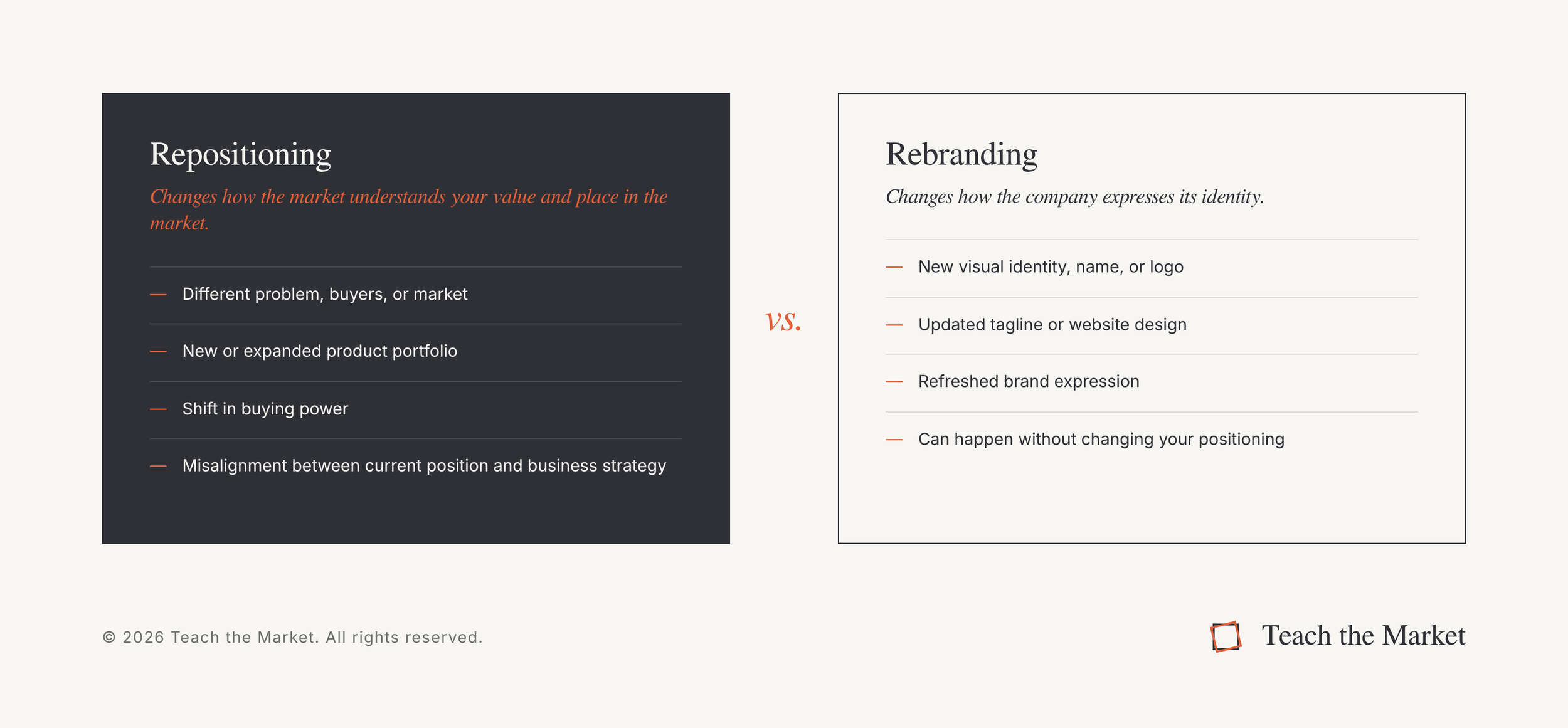
A new visual identity, name, tagline, or website design does not fix positioning that no longer matches the business.
Likewise, a company can reposition without replacing its brand identity at all.
If the problem is that buyers misunderstand what you sell, who it is for, why it matters, or how your products fit together, start with positioning.
If the strategic position is still right but the way the company looks or expresses itself no longer represents it, the problem may be primarily one of branding.
Changing both at once can make sense. But do not use a rebrand to disguise an unresolved positioning problem.
How do you diagnose what needs to change?
One of the easiest mistakes in repositioning is treating every commercial problem as a messaging problem.
Start with the pattern of friction.
If win rates are falling specifically against similar competitors, investigate whether your differentiation has weakened.
If buyers agree they have the problem but deals repeatedly lose priority or budget, investigate whether the urgency and investment argument are strong enough.
If enthusiastic users cannot get purchases approved, investigate whether buying power has shifted.
If prospects understand individual products but cannot understand why they belong together, investigate the portfolio story.
If buyers continue to associate the company exclusively with the product it launched years ago, investigate whether the company-level position has become too narrow.
The important distinction is:
Business signals tell you where to investigate. They do not tell you the answer.
Talk to sellers and sales managers. Examine win-loss patterns. Listen to customer language. Look at which stakeholders appear in successful and unsuccessful deals. Compare what customers think you sell with what the company is actually trying to become.
Then decide what positioning problem you are solving.
How do you reposition when the buying center changes?
One of the hardest repositioning decisions happens when the people who made the company successful are no longer the only, or most powerful, buyers.
A change in buying power does not necessarily mean abandoning the original champion. It means understanding the role that champion now plays in getting a purchase approved.
A champion who owns the budget but needs a CFO signature is different from an enthusiastic user who has little influence over the purchase. A new executive stakeholder entering the deal does not automatically mean your existing champion no longer matters.
The useful questions are:
Who creates momentum for this purchase? Who can stop it? What does each person need to believe?
I experienced this at a growing SaaS company where we had built a strong position and community around a particular functional buyer. That audience had helped the company grow, which made it emotionally and strategically difficult to question whether it should remain the center of the positioning.
Over time, there were signals that other functions were becoming more important to the buying decision. In retrospect, I think we remained centered on the original audience longer than we should have because moving away from something that had worked felt risky.
The lesson is not that growing SaaS companies should abandon their original champions when new executives enter the buying process.
It is that positioning has to reflect where buying power actually sits, not where the company is most comfortable having the conversation.
How do you position a multi-product SaaS company?
A multi-product SaaS company needs a company-level argument that explains why its products belong together. Stacking several product value propositions underneath one logo does not create a portfolio position.
Imagine a company that started with one employee scheduling product. Over time, it adds workforce communication, shift swapping, and operational task management.
It could describe the portfolio like this:
Schedule employees. Communicate with your workforce. Manage shift changes. Assign operational tasks.
That explains four capabilities.
It still leaves the buyer to figure out why one company should provide all of them.
The better question is:
What larger problem makes this portfolio coherent?
Perhaps the company is ultimately trying to help distributed businesses coordinate the daily work of hourly employees. Scheduling, communication, shift management, and task execution can then be understood as different parts of that larger problem.
The company position should explain the larger problem and approach. Individual product positioning should explain the specific role each product plays within it.
That is what separates a coherent multi-product portfolio from a collection of products that happen to share a company name.
The Portfolio Coherence framework
Use Portfolio Coherence to test whether company-level positioning actually explains a multi-product business.
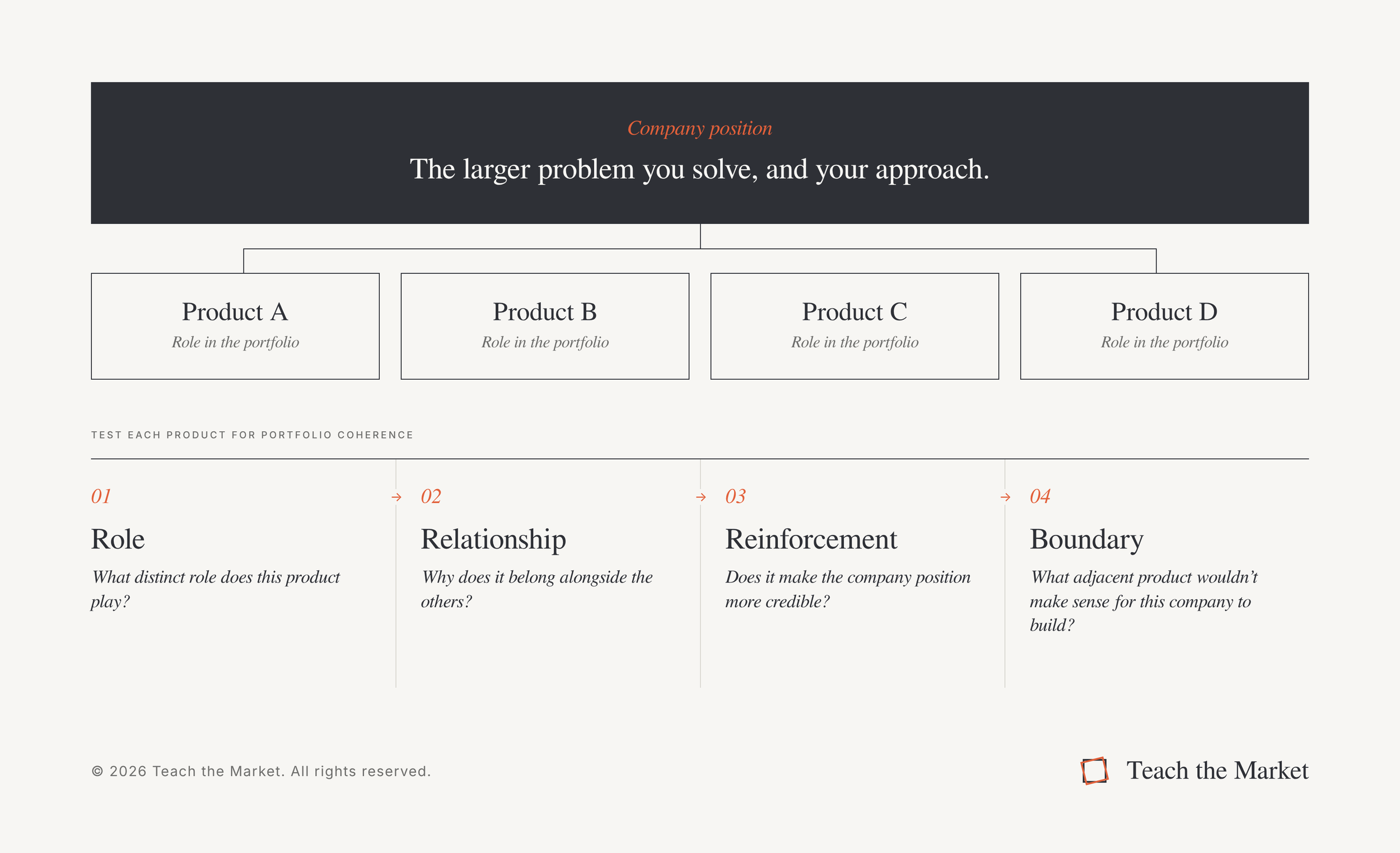
For every product, evaluate four things:
Role: What distinct role does this product play in the larger company argument?
Relationship: Why does this product logically belong alongside the others?
Reinforcement: Does this product make the company-level position more credible?
Boundary: What adjacent product would not make sense for this company to build?
The boundary question is especially important.
If the company positioning can justify almost any adjacent SaaS product, it is probably describing a market rather than establishing a position.
Statements such as “transform work,” “unlock human potential,” or “power the future of business” can accommodate an enormous portfolio precisely because they make so few strategic choices.
Good portfolio positioning creates both coherence and boundaries.
How do you reposition without confusing existing customers?
Preserve the truth customers already understand while changing the context around it.
Repositioning does not require pretending the previous company never existed.
This is especially important when the existing position has created real market recognition. Customers may already associate you with a problem, category, or capability. Trying to erase that association creates unnecessary cognitive work and can make a growing company sound less credible rather than more ambitious.
Consider the hypothetical workforce software company above.
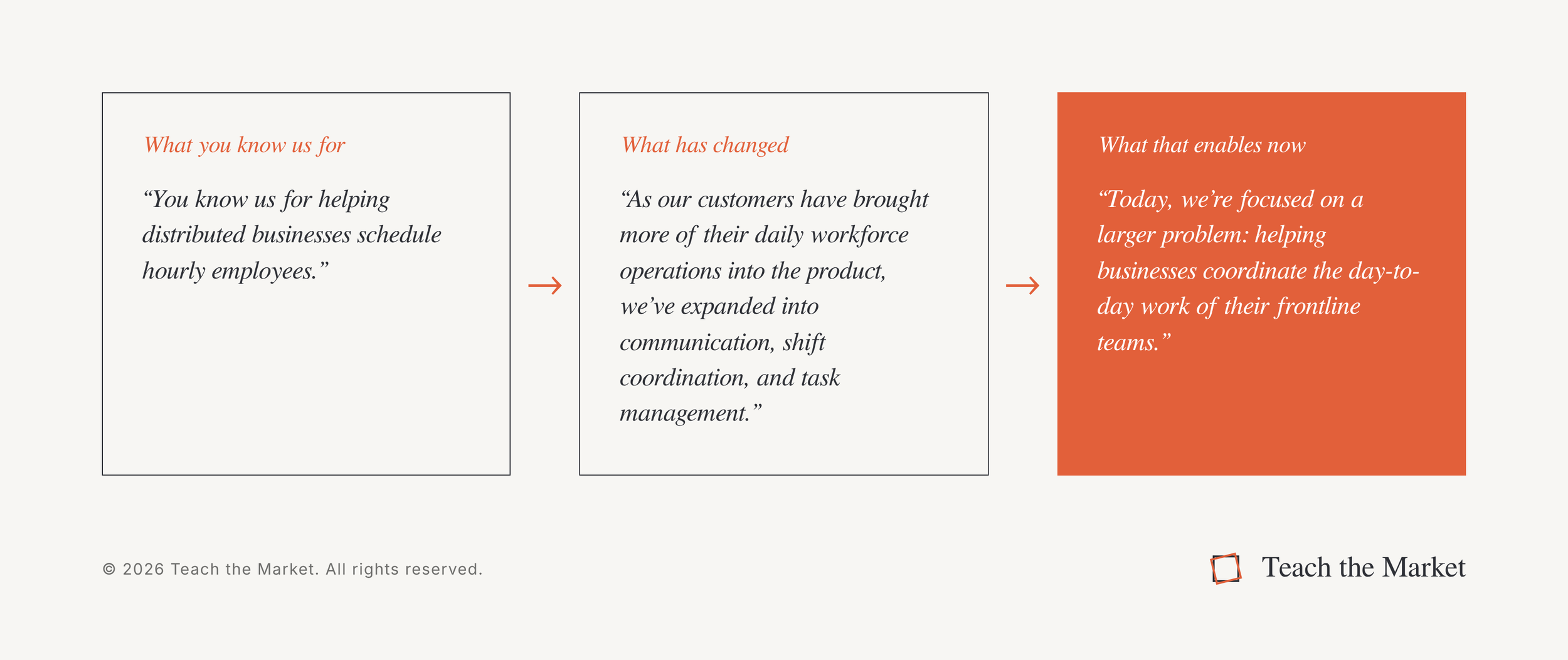
Existing customers might know it primarily for employee scheduling. The company should not suddenly announce that it is an “operational workforce orchestration platform” and expect customers to understand what happened.
It could instead explain the evolution more concretely:
You know us for helping distributed businesses schedule hourly employees. As our customers have brought more of their daily workforce operations into the product, we’ve expanded into communication, shift coordination, and task management. Today, we’re focused on a larger problem: helping businesses coordinate the day-to-day work of their frontline teams.
The original value has not disappeared.
Its context has expanded.
That is the job of the repositioning bridge: help customers understand how the company they already know connects logically to the company it is becoming.
Preserve, Reframe, or Replace
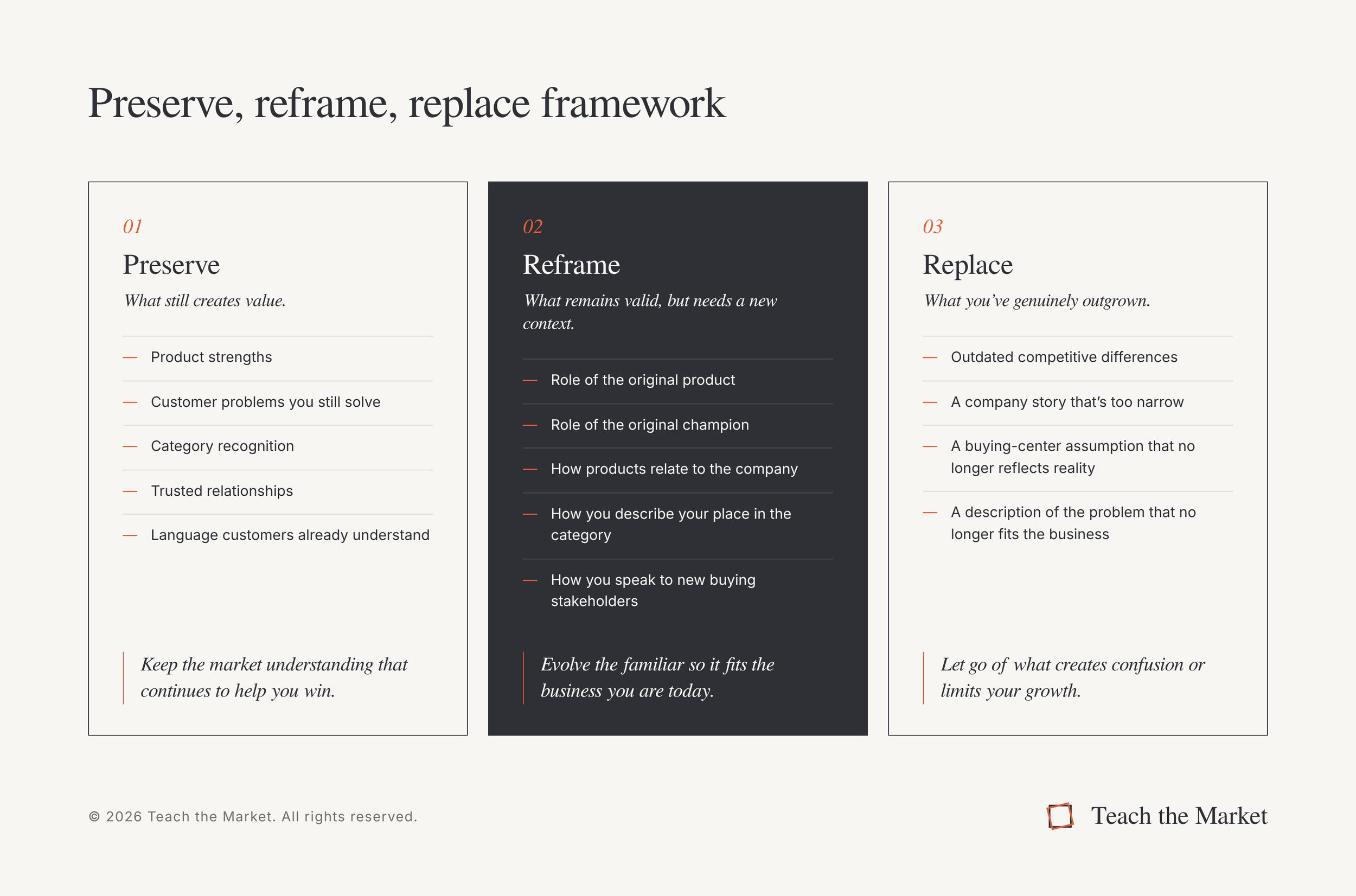
The Preserve–Reframe–Replace framework helps determine how much of the existing position should survive a repositioning.
Preserve
Preserve the truths that still create value: product strengths, customer problems you still solve, category recognition, trusted relationships, and language customers already understand.
Do not throw away useful market understanding simply because the company has grown.
Reframe
Reframe truths that remain valid but need a different context.
The original product may still matter, but it now plays one role in a broader portfolio.
The original champion may still matter, but now needs to build support from IT, operations, finance, or another stakeholder.
The existing category may still accurately describe what buyers purchase, while the company's approach within that category has evolved.
Replace
Replace assumptions the business has actually outgrown.
That might include an outdated competitive difference, a company story that cannot accommodate the portfolio, a buying-center assumption that no longer reflects the purchase, or a description of the problem that has become too narrow.
Preserve–Reframe–Replace keeps repositioning from becoming a wholesale rewrite. The objective is not to make the company sound new. It is to make the company’s story accurate again.
How do you position where the company is going versus what it sells today?
A growth-stage SaaS position should be credible enough to prove with today's product and broad enough to accommodate the company’s actual strategic direction.
Position too heavily around today's product and the company can look smaller than its strategy.
Position too heavily around the future and the story can outrun what customers can actually buy.
The company-level position can express the larger problem the business intends to solve and the strategic role it wants to play. But the product story still needs to answer a much more immediate question:
What can I buy from you now?
A future vision cannot substitute for current product evidence.
If sellers repeatedly need to explain that the capabilities implied by the positioning are “coming soon,” the position has probably moved too far ahead.
A useful pressure test is simply to ask:
Can we substantiate the core position with products customers can buy today?
Do our actual product and business priorities make the position increasingly true?
Is the position broad enough to accommodate the direction we have genuinely committed to?
Would a buyer feel misled after seeing the product?
Are we clearly distinguishing current capability from future direction?
The goal is not to find an arbitrary balance between present and future.
It is to make the future believable because of what exists today.
How far ahead should SaaS positioning go?
There is no universal percentage of future state that positioning should represent.
The better test is buyer credibility.
You can lead customers toward a future they have not fully articulated yet. Product marketing should not be limited to repeating today's customer requests back to the market.
But future-oriented positioning still needs evidence underneath it.
Customers may tell you an idea is helpful and interesting but too early for them. That is useful information about readiness. It is not immediate demand, and it is not proof the idea will eventually succeed.
The same discipline applies to positioning.
Show buyers where you are going without asking them to pretend you are already there.
How should you roll out repositioning?
A repositioning is not finished when the messaging document is approved.
The new position has to survive real conversations.
Experienced sellers are particularly useful during this stage because they can anticipate objections, identify language that will be difficult to defend, and expose gaps between the positioning and the product.
Bring influential sellers into the process before the company-wide rollout. Let them use the new argument in concrete sales materials and conversations. Then listen for the points where sellers struggle to explain it, buyers challenge it, or teams instinctively revert to the old story.
That field use gives you something an enablement presentation cannot: evidence about whether people can actually carry the argument.
Once the position is working in concrete applications, codify it for broader use.
That is why I treat the messaging framework as the last mile rather than the starting point. The framework should scale an argument you have already developed and pressure-tested, not create the illusion that the argument is finished because the boxes are filled in.
For a deeper process for developing and testing the underlying position, link this section to the full B2B SaaS positioning guide rather than duplicating that process here.
A practical process for repositioning a growing SaaS company
A repositioning process should move from diagnosis to strategic choice before it moves to messaging.
1. Identify what changed
Determine whether the substantive shift is in the market, buyer, product, business strategy, or several of them.
2. Find the commercial friction
Examine win-loss patterns, sales conversations, buying stakeholders, customer understanding, portfolio complexity, and category perception.
3. Diagnose the positioning problem
Determine whether the issue is differentiation, urgency, buying power, portfolio coherence, category understanding, or a position that has become too narrow for the company.
4. Apply Preserve–Reframe–Replace
Identify what existing market understanding deserves to survive, what needs new context, and what the company has genuinely outgrown.
5. Establish portfolio coherence
For a multi-product company, make sure every product has a logical role in the company-level argument and that the position has meaningful boundaries.
6. Define the company-level position
Explain the larger problem the company solves, its approach, and why the portfolio belongs together.
7. Map the buying group
Understand who creates momentum, who approves the purchase, who can stop it, and what each stakeholder needs to believe.
8. Check the position against the present and future
Make sure today's product can substantiate the argument while leaving room for the strategic direction the company is actually pursuing.
9. Pressure-test the argument in real applications
Use the position in a pitch, website, competitive conversation, or other concrete environment. Involve experienced sellers who can expose objections.
10. Codify and roll out the messaging
Once the argument works, translate it into the materials, guidance, and messaging system other teams need to use it consistently.
Repositioning is a business diagnosis before it is a messaging exercise
The most visible part of repositioning is usually the new language.
That is also the easiest part to change.
The harder questions come first:
Has the market changed?
Has buying power moved?
Has the portfolio outgrown the company story?
Does your existing category still help buyers understand what they are buying?
How much of the future can you credibly claim today?
What part of the old position still deserves to survive?
Those questions determine whether you need new positioning and what kind of repositioning you actually need.
Do not reposition because the old words feel tired. Reposition when the old story no longer explains the business buyers need to understand.
About the author
Lara George spent eight years at a hypergrowth B2B SaaS company. She joined at Series B and rose from product marketing manager to VP of Product Marketing and GTM Enablement. She launched a product that now drives 40% of revenue, helped grow the portfolio from one product to more than six, and ran analyst relations from start to finish. She’s also a recognized voice in communications and a frequent speaker at communications and tech industry events. Teach the Market is where she shares what she learned. More about Lara
