

Competitive Alternatives: The First Step in B2B SaaS Positioning
The short answer: The first step in B2B SaaS positioning is mapping your competitive alternatives: everything a buyer would do if your product didn't exist, including doing nothing. Then assess how mature your market is and whether competing products are genuinely different or converging. Only after that should you decide what your company stands for and write any messaging.
If your team can describe everything the product does but can't explain why a buyer should choose it, the usual reaction is to rewrite the message. That's the wrong starting point. This guide explains why positioning starts with competitive alternatives and walks through how to map them. It's part of the practical guide to B2B SaaS positioning.
What are competitive alternatives?
Competitive alternatives are the options a buyer would realistically choose if your product didn't exist. They include direct competitors, but also doing nothing, keeping a workaround, using a tool the buyer already owns, or building something in-house. In B2B SaaS, the strongest competitor is often not another vendor. It's the status quo.
Competitive alternatives matter because a position is always relative. "Why choose us?" always has a hidden second half: instead of what? A product story written without that comparison tends to list strengths that are real but don't decide anything, because every serious alternative has them too.
Why should positioning start with the market instead of the product?
Positioning should start with the market because you can't tell whether you're different by looking at your own product. Teams that start with the product describe its features and benefits, and so does every competitor. Teams that start with the market first learn what buyers compare them against, which differences buyers can actually see, and which claims would decide anything.
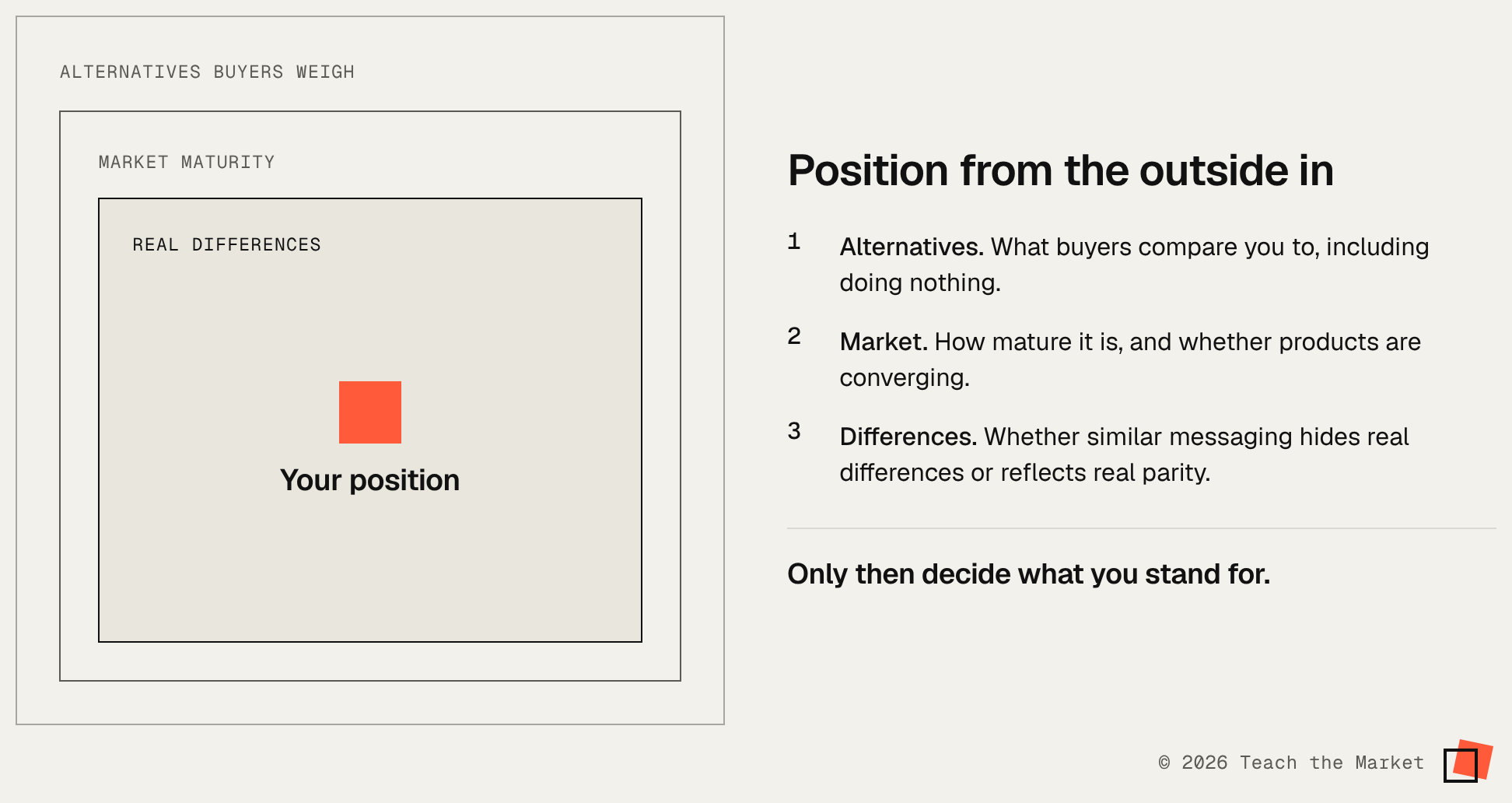
Starting with the market also exposes the most important question in a crowded category: are you genuinely different, or does it only feel that way from the inside?
How do you map competitive alternatives?
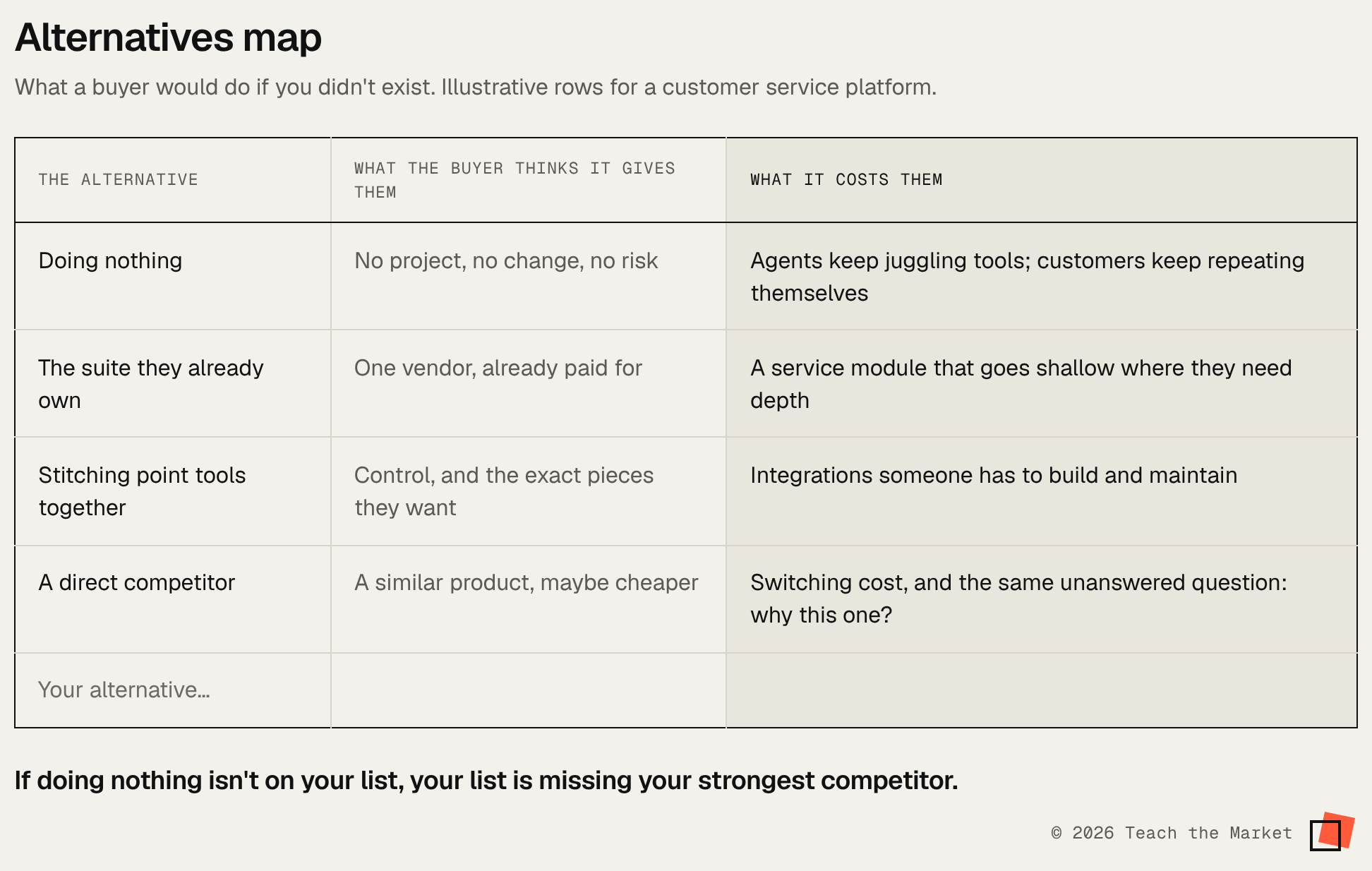
Map competitive alternatives from the buyer's point of view, not from your battlecard list:
List every realistic option. Include doing nothing, a workaround, a tool the buyer already owns (such as a broader suite with a module that overlaps with you), building in-house, and direct competitors.
Write down what the buyer believes each option gives them. Usually this is about effort, risk, cost, or what they already have, not features.
Write down what each option costs them. This is where your opportunity usually sits: the problem the alternative leaves unsolved.
Rank the alternatives by how often they actually win. Use win-loss data and seller conversations. "No decision" often ranks first.
Check the list with sellers. They hear the real comparison in every first call.
How do you assess market maturity for positioning?
Market maturity tells you what kind of argument buyers are ready for. Ask three questions:
Do buyers already understand the category and have a budget line for it?
Are new vendors entering, or is the market consolidating?
Are buyers comparing similar vendors, or questioning whether they need a separate tool at all?
In a young market, positioning often has to explain the problem itself. In a mature market, buyers know the problem and want to know why your approach to solving it is better. In a consolidating market, the most dangerous alternative is often the suite the buyer already owns.
How do you know whether product differences are real?
Similar marketing can mean two very different things: competitors' messaging hides real product differences, or the products have genuinely converged. You need to know which one you're dealing with, and you can't tell from websites, because everyone's marketing already sounds alike.
If differences are real but hidden, your job is to surface the difference and the customer reason behind it.
If products have converged, feature claims won't create a meaningful choice. Differentiate on your strategic approach instead: what you believe the problem requires and the product choices you made because of that belief. See how to differentiate a B2B SaaS product when competitors look the same.
To find out, combine three sources: what sellers hear in competitive deals, win-loss reasons, and product experts comparing how the products actually behave, not just their feature lists.
What does this look like in practice?
Consider a customer service platform in a market where help desks and customer messaging tools have grown toward each other until their feature lists look nearly the same. A product-first team writes about its inbox, automation, and integrations, just like every competitor.
A market-first team notices three things before writing a word. Buyers increasingly compare it to the suite they already own, not only to other specialists. The market is consolidating. And products have genuinely converged on features. That team knows its position has to come from its approach, and that its main competitive alternative is "the suite we already have."
What are the most common mistakes at this stage?
Treating the competitor list as the alternatives list. Doing nothing and existing tools rarely appear on battlecards, but they decide many deals.
Judging differences from marketing copy. Websites tell you how competitors want to be seen, not how their products differ.
Writing a tagline first. A good line on top of an unexamined market is the most common way positioning fails in front of buyers.
Treating feature parity as a dead end. Parity tells you where differentiation has to come from. It's information, not failure.
Key takeaways
B2B SaaS positioning starts with competitive alternatives, not with the product.
Competitive alternatives include doing nothing and tools the buyer already owns.
Market maturity determines what kind of argument buyers are ready to hear.
Find out whether product differences are real or converged before choosing a position.
Frequently asked questions
What is the difference between competitive alternatives and competitors?
Competitors are other vendors selling a similar product. Competitive alternatives are every option a buyer might choose instead of your product, including competitors but also doing nothing, keeping a manual workaround, building in-house, or expanding a tool they already own. Positioning should be built against competitive alternatives, because those are what buyers actually weigh.
Is "doing nothing" really a competitive alternative?
Yes. In many B2B SaaS deals, "no decision" is the most common outcome. Buyers stay with the status quo when the cost of change looks higher than the cost of the problem. Positioning that ignores the status quo often wins comparisons against competitors and still loses the deal to inaction.
How many competitive alternatives should a positioning exercise include?
Most positioning exercises need three to five competitive alternatives: the status quo, an existing tool the buyer could stretch, a build-it-yourself option where relevant, and the one or two direct competitors that appear most often in deals. Listing every vendor in the market adds noise without changing the position.
Who should be involved in mapping competitive alternatives?
Mapping competitive alternatives works best with several perspectives: product experts who know how the products really differ, experienced sellers who hear buyer comparisons firsthand, people who understand regional market differences, and product marketing to bring the views together. No single team sees every alternative buyers consider.
Your next step
Fill in the alternatives map for your own market, then decide honestly whether your differences are hidden or whether your market has converged. That decision tells you what kind of position you can credibly take. For the rest of the process, see the practical guide to B2B SaaS positioning.
About the author
Lara George spent eight years at a hypergrowth B2B SaaS company. She joined at Series B and rose from product marketing manager to VP of Product Marketing and GTM Enablement. She launched a product that now drives 40% of revenue, helped grow the portfolio from one product to more than six, and ran analyst relations from start to finish. She’s also a recognized voice in communications and a frequent speaker at communications and tech industry events. Teach the Market is where she shares what she learned. More about Lara
