

Category Creation vs. an Existing Category: How B2B SaaS Companies Should Decide
The short answer: Most B2B SaaS companies should compete in an existing category with a clearly different point of view rather than create a new category. The existing category is usually the name of the buyer's project and the line in their budget. Category creation makes sense only when no existing category can describe what you do and the new name genuinely helps buyers, and it requires a long-term commitment to market education.
This guide explains how to make the category decision, what category creation really costs, and how to stand out inside an existing category. It's part of the practical guide to B2B SaaS positioning.
What is a product category in B2B SaaS?
A product category is the shared name buyers use for a type of software and the problem it solves, such as "help desk," "CRM," or "data warehouse." For buyers, a category does three practical jobs:
It names the project. Buyers search for, request budget for, and get approval for a category of software.
It sets the comparison. The category tells buyers which vendors to evaluate.
It signals what you replace. It answers "where does this fit in what we already have?"
When a vendor steps outside the category buyers use, all three jobs fall to its sales team, in every deal.
What is category creation?
Category creation is the strategy of defining a new market category, with a new name and a new problem framing, so that your company becomes its reference point. It's sometimes called category design. When it works, buyers adopt the new category, budget for it, and see the creator as its leader.
The appeal is real. But category creation means buyers start with no project, no budget line, and no mental slot for what you sell, so you have to create all three before you can win deals.
Why is category creation so tempting?
Category labels age. A term that once described an exciting new market can start to sound dated or crowded, or to suggest the oldest vendors in it. When your product works differently from those vendors, the label can feel like it's holding you back, and a new category promises a clean start where you lead by definition.
That instinct is often right about the problem and wrong about the solution. A dated label really can drag down how buyers see you. Leaving the category usually creates a bigger problem: buyers can't find you, fund you, or compare you.
How do you decide between a new category and an existing one?
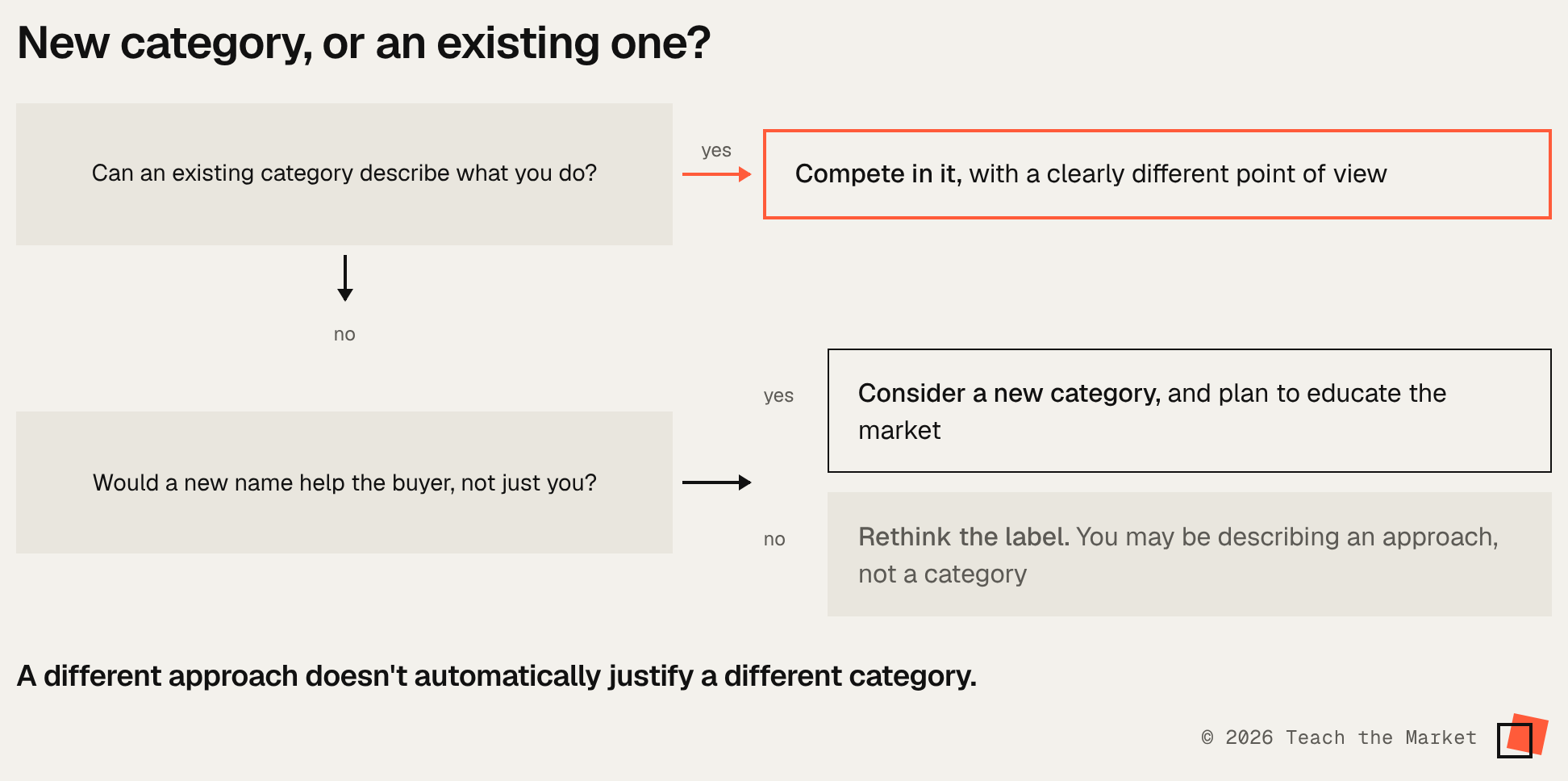
Two questions settle most category decisions:
Can an existing category describe what you do, even imperfectly? If yes, compete in it with a clearly different point of view.
If not, would a new category name help the buyer, not just you? If yes, consider a new category and plan to educate the market. If no, you're probably describing an approach, not a category, so rethink the label.
What are the signs your category choice is creating friction?
Category friction shows up in the sales process before it shows up in strategy reviews. Watch for these signs:
Sellers spend the first call explaining what you're not.
Buyers run a project with the existing category's name on it, and you're not sure you belong in it.
Buyers like the product but can't find a budget line to fund it.
Buyers searching for the category don't find you, or don't shortlist you.
Consider a customer service vendor that avoids calling itself a help desk because the term feels dated, while its buyers run "help desk replacement" projects with a help desk budget. Nothing about the product changes, but every deal starts with confusion about what the vendor is.
How do you stand out inside an existing category?
Stand out inside an existing category by making your approach the difference, not the label. You keep the buyer's project, budget, and comparison set, and put all your effort into one argument: why your way of solving this familiar problem is better.
Use the category name buyers search for, then explain the strategic choices that make you different.
Give your approach a memorable name if it helps, but as a description inside the category, not a replacement for it.
Show the difference in the product and in proof buyers can check, not only in copy.
When is creating a new category worth it?
A new category is worth it when buyers genuinely can't place your product in any existing project and a new name gives them a clearer way to understand a problem they already feel. Even then, plan for the work: a new category means teaching the market why it matters before you can sell into it. That takes consistent communication over years, and usually help from customers and analysts who explain the category in their own words.
Key takeaways
Most B2B SaaS companies should compete in an existing category with a different point of view.
The category is the buyer's project name, budget line, and comparison set.
Create a new category only if no existing one fits and the new name helps the buyer.
Category creation is a multi-year market education commitment, not a messaging change.
Frequently asked questions
What is the difference between category creation and category design?
Category creation and category design describe the same strategy: defining a new market category so your company becomes its reference point. "Category design" is the term popularized in marketing books and by consultants, and often emphasizes a deliberate, company-wide program to define and evangelize the category rather than just naming it.
How long does it take to create a new software category?
Creating a new software category typically takes years, not quarters. Buyers have to recognize the problem, accept the new name, and create budget for it, and analysts and customers usually need to repeat the category before it feels real. Companies should treat category creation as a long-term market education commitment.
Can you rename your category without leaving it?
Yes. Many B2B SaaS companies keep the category name buyers search for while describing their approach in their own terms, for example "a conversation-first help desk." This keeps the buyer's project and budget line intact while still signaling a clear difference. It's usually safer than replacing the category name entirely.
What should you do if your category feels outdated?
If your category feels outdated, change how you talk about the category rather than leaving it. Acknowledge the old associations, explain what's changed, and position your approach as the modern way to solve the problem buyers already budget for. Leaving the category usually costs more in buyer confusion than the dated label costs in perception.
Your next step
Ask your sellers how much of a typical first call goes to explaining what you're not, and check whether buyers have a budget line with the existing category's name on it. If the answers are "a lot" and "yes," your category choice is probably creating friction. For the full process, see the practical guide to B2B SaaS positioning.
About the author
Lara George spent eight years at a hypergrowth B2B SaaS company. She joined at Series B and rose from product marketing manager to VP of Product Marketing and GTM Enablement. She launched a product that now drives 40% of revenue, helped grow the portfolio from one product to more than six, and ran analyst relations from start to finish. She’s also a recognized voice in communications and a frequent speaker at communications and tech industry events. Teach the Market is where she shares what she learned. More about Lara
