

How to Test Your Positioning Before You Roll It Out
The short answer: Test B2B positioning in conversation, not in a review meeting. A position is ready when a seller can state the main claim, explain why it's true, compare it honestly to the alternatives, and point to proof the buyer can check, without reaching for a slide. Run that test with experienced sellers and partners first, then watch whether customers and analysts start explaining your value back in their own words.
This guide gives you a practical positioning test you can run this week, a worked example, and the limits of each testing method. It's part of the practical guide to B2B SaaS positioning.
What does it mean to test positioning?
Testing positioning means checking whether the argument behind your position holds up when a skeptical buyer pushes on it, before you invest in messaging, campaigns, and sales enablement built on it. It's different from testing copy. A headline test tells you which words get attention. A positioning test tells you whether the argument survives the conversation that follows.
Why isn't a strong headline enough?
A claim can sound compelling on a stage and still fall apart at the first follow-up question. B2B buyers are more discerning than companies often assume. They've heard every version of "faster," "smarter," and "all-in-one," and they ask what's behind it.
Sellers feel this first, because they have to use the claim live, answer objections, and explain the substance. When the argument underneath is thin, polished wording makes the problem harder to spot, not easier. This matters even more now that AI makes fluent copy cheap: well-written messaging is no longer a sign that the thinking behind it is sound.
How do you test positioning against buyer scrutiny?
Use the follow-up ladder: every main positioning claim should survive four rungs.
The claim. One clear sentence about what you want the buyer to believe.
"Why is that true?" The reasoning, in the buyer's terms.
"Compared to what?" The alternatives, and an honest description of the difference.
"Show me." Proof the buyer can check: a demo, a reference customer, a number they can verify.
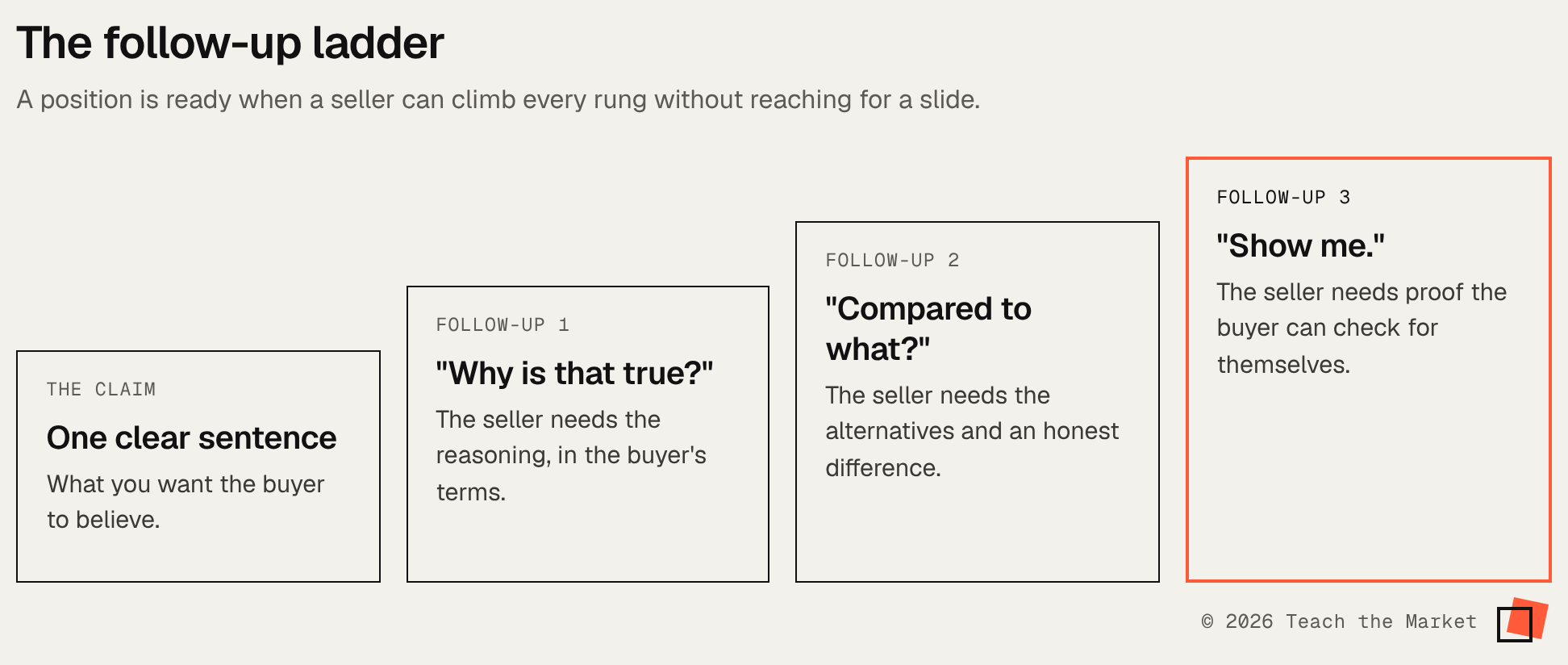
If a seller gets stuck on a rung, that's the part of the position to fix. Usually the fix is in the argument, not in the wording.
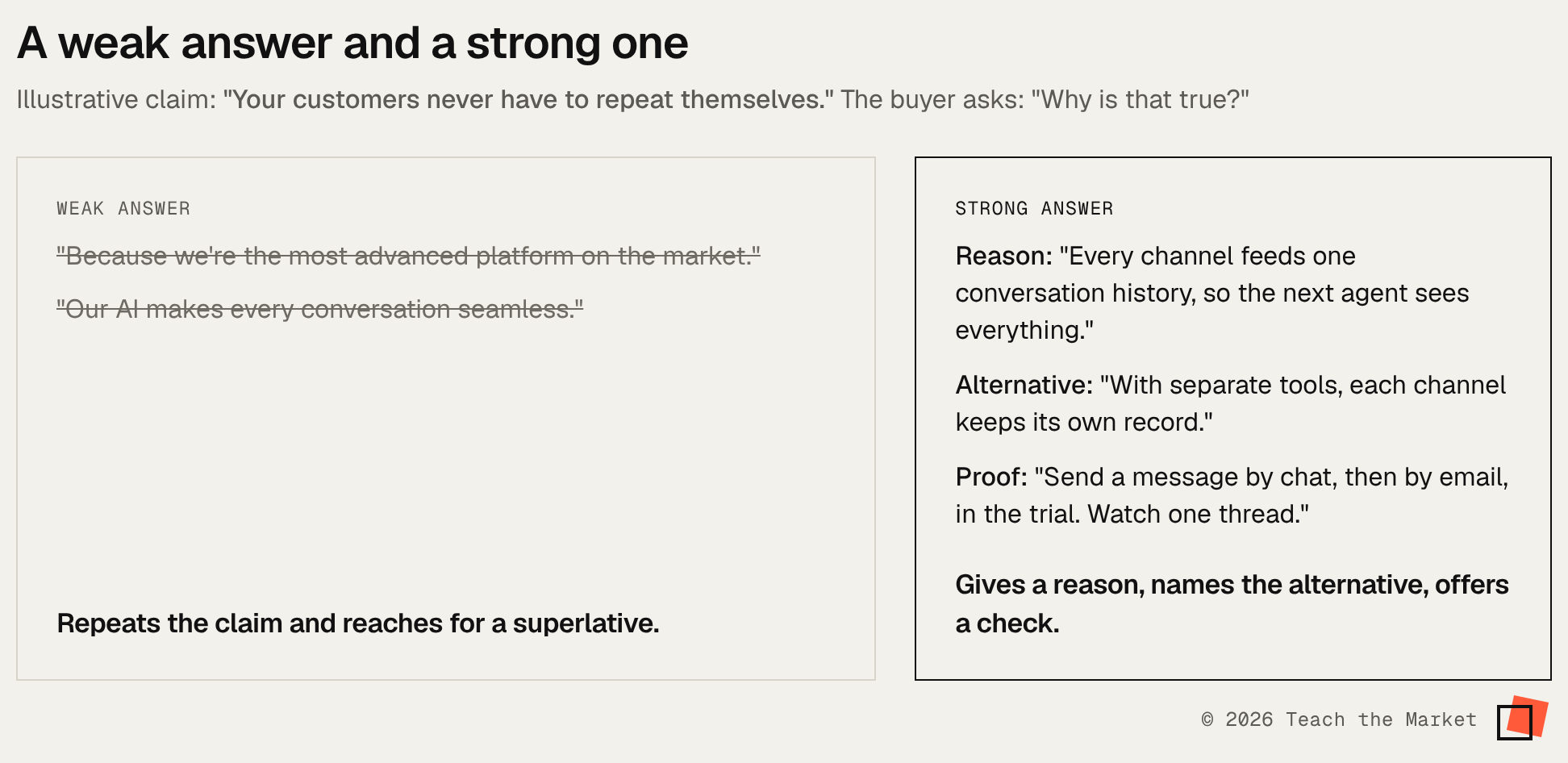
What does a weak answer look like compared to a strong one?
A weak answer repeats the claim with a superlative. A strong answer gives a reason, names the alternative, and offers a check. Here's an illustrative example from a customer service platform claiming "your customers never have to repeat themselves."
Who should you test positioning with?
You don't need a large research project to pressure-test positioning. Three groups tell you most of what you need, as long as you're clear about the limits of each:
Experienced sellers. They've heard every objection and find weak spots fast. Ask them to play the skeptical buyer, not to approve the message. Their buy-in is a promising signal, not proof that buyers agree.
Partners close to your customers. Partners can react to an idea before you take it to customers, without creating expectations or implying a product commitment. Treat their feedback as useful input, not as customer validation.
Outsiders explaining it back. One of the clearest signs a position has landed is when a customer, analyst, or partner describes your value in their own words. If they repeat your tagline, it hasn't landed yet.
Direct customer testing is still valuable. Just don't wait for the perfect customer conversation before you start, and don't present indirect feedback as customer validation.
How long does it take to test positioning?
A first round of positioning testing takes days, not months. Two or three sessions with experienced sellers can expose the weakest rungs within a week. Partner conversations add another week or two. The "explaining it back" signal takes longer, because it only appears once the position is in market, so treat it as an ongoing check rather than a launch gate.
What are the most common positioning testing mistakes?
Testing the wording instead of the argument. "Do you like this line?" tells you little. "What would a skeptical buyer ask next?" tells you a lot.
Testing with people who want it to work. The executives who commissioned the positioning are the least useful test audience.
Stopping at the first rung. Most claims survive "why is that true?" Weak ones fail at "compared to what?" or "show me."
Treating seller enthusiasm as proof. It's a good sign, not evidence that buyers will agree.
Key takeaways
Test the argument behind your positioning, not the wording.
Every main claim should survive the follow-up ladder: why, compared to what, show me.
Experienced sellers and partners are fast, useful test audiences, with clear limits.
The strongest sign of landed positioning is outsiders explaining it back in their own words.
Frequently asked questions
What is the difference between positioning testing and message testing?
Positioning testing checks whether the underlying argument holds up: who the product is for, what it's compared against, and why it wins. Message testing compares specific wording, such as headlines or taglines, to see which performs better. Test positioning first, because good wording can't rescue a weak argument.
Can you test positioning with surveys?
Surveys can help with message testing, such as which headline is clearer, but they're weak for positioning testing. Surveys capture reactions to statements, not whether an argument survives follow-up questions. Live conversations with experienced sellers, partners, and buyers reveal far more about where a position breaks.
How do you know when positioning is ready to roll out?
Positioning is ready to roll out when experienced sellers can defend the main claim through all four rungs of the follow-up ladder without a slide, the claims are backed by proof buyers can check, and the remaining objections have honest answers. It doesn't need to be perfect, because positioning keeps improving in the field.
Should customers be part of positioning testing?
Customers are valuable in positioning testing, especially for checking whether the problem framing matches their experience. But waiting for the ideal customer conversations can stall the work. Start with sellers and partners, bring in customers where you have rapport, and keep their feedback separate from indirect signals.
Your next step
Take your main positioning claim and ask two experienced sellers to climb the follow-up ladder with it, out loud, while one plays the buyer. Write down where they get stuck: that's your to-do list. If they stall at "compared to what?", read competitive positioning and battlecards buyers actually trust. For the full process, see the practical guide to B2B SaaS positioning.
About the author
Lara George spent eight years at a hypergrowth B2B SaaS company. She joined at Series B and rose from product marketing manager to VP of Product Marketing and GTM Enablement. She launched a product that now drives 40% of revenue, helped grow the portfolio from one product to more than six, and ran analyst relations from start to finish. She’s also a recognized voice in communications and a frequent speaker at communications and tech industry events. Teach the Market is where she shares what she learned. More about Lara
