

Positioning for the Buying Committee: The Champion vs. the Economic Buyer
The short answer: In B2B SaaS, position for the champion and equip them to win over the rest of the buying committee, especially the economic buyer who signs. The core argument stays the same; what changes is which part you lead with for each approver and what proof the champion carries into the room. Because buying power shifts over time, check regularly who actually approves your deals.
This guide explains how to position for a buying committee instead of a single persona, what each approver needs to hear, and how to notice when buying power moves. It's part of the practical guide to B2B SaaS positioning.
What is a B2B buying committee?
A B2B buying committee is the group of people who influence or approve a software purchase. It usually includes a champion who wants the product, an economic buyer who controls the budget, and other approvers such as IT, security, operations, procurement, or an executive sponsor. The exact makeup varies by company, deal size, and how budgets are owned.
What is the difference between a champion and an economic buyer?
The champion is the person inside the buying company who wants your product and advocates for it. The economic buyer is the person who controls the budget and signs. Sometimes they're the same person, but in most B2B SaaS deals of any size they aren't.
The champion lives with the problem every day and cares about how the product works and what it fixes for their team.
The economic buyer sees the decision from a distance and cares about cost, risk, fit with existing tools, and return compared to everything else competing for budget.
A champion who owns a budget but needs a CFO's signature is in a very different position from an enthusiastic user with no buying influence at all.
Who should your positioning speak to?
Your positioning should speak to the champion, and give the champion an argument for each person who approves the purchase. Writing only for the champion's day-to-day experience leaves them alone in the meeting where the decision is actually made. Writing separately for every approver splits your story into pieces that don't add up. The practical middle: one position, centered on the champion's problem, with a prepared answer for each approver's question.
What does each member of the buying committee need to hear?
The approvers vary by organization, so map them for your own deals. These are the most common questions to prepare the champion for:
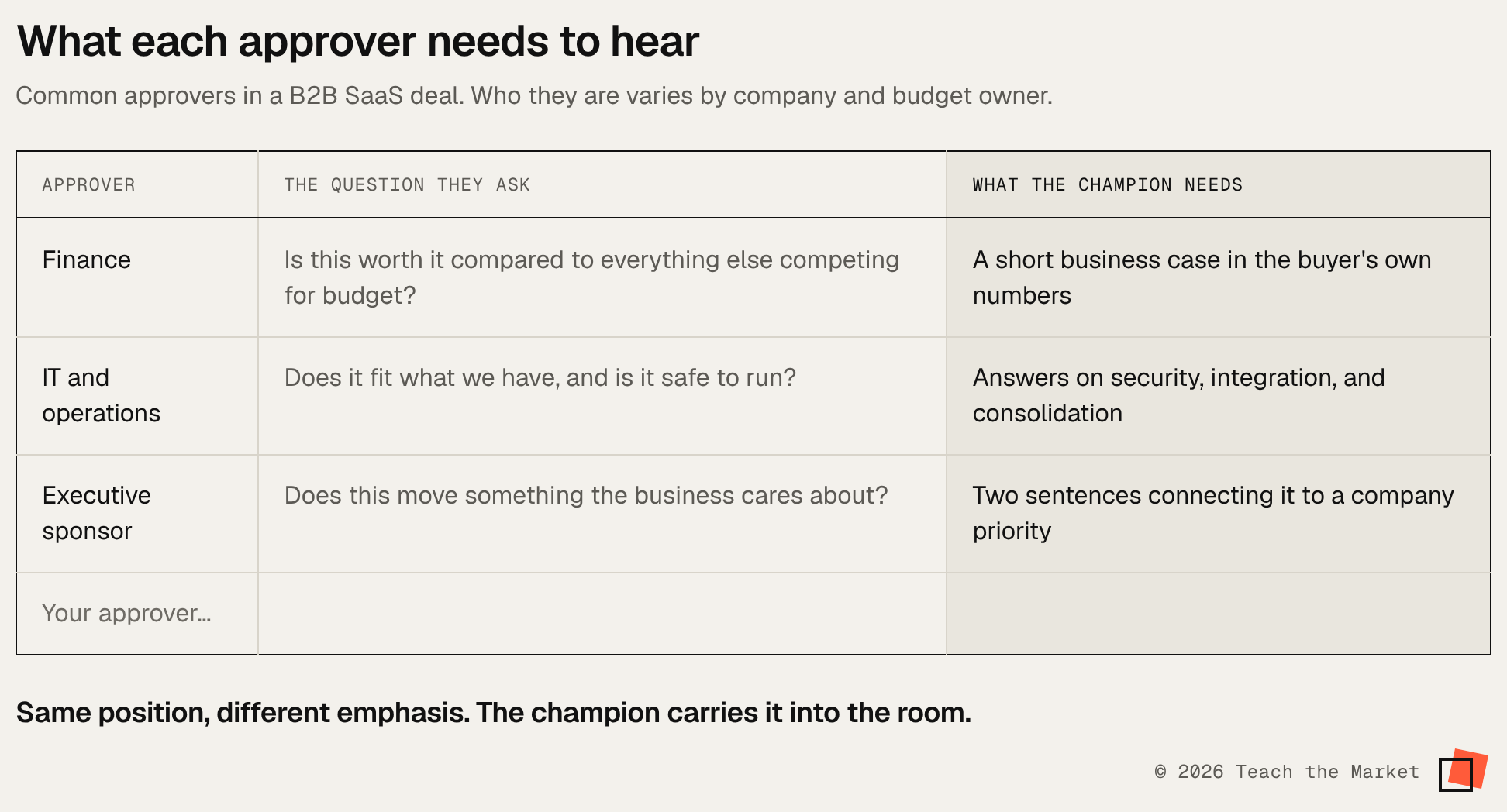
Finance: Is this worth it compared to everything else competing for budget? The champion needs a short business case in the buyer's own numbers.
IT and operations: Does it fit what we have, and is it safe to run? The champion needs answers on security, integration, and tool consolidation.
Executive sponsor: Does this move something the business cares about? The champion needs two sentences connecting it to a company priority.
How do you equip a champion to sell internally?
Give them the argument in two or three sentences. A champion can't retell a 20-slide pitch, but can retell a short argument to a manager.
Arm them for each approver's question. Prepare answers for finance, IT, and executive questions before the champion is asked.
Make the business case portable. A one-page summary, a calculator, or a short comparison the champion can forward does more than another demo.
Tell them where the risks are. Champions trust vendors who prepare them for hard questions rather than pretending there aren't any.
How do you know when buying power is shifting?
Buying power shifts when budgets move, companies consolidate tools, or new stakeholders gain a say. A champion who could carry deals alone a few years ago may now need much more help, or may no longer be at the center of the decision. Watch your deals for these signals:
Approval takes longer, and deals your champion used to close alone need more sign-off.
New stakeholders appear late in the deal.
Deals stall at budget, even when the champion is convinced.
Buyers ask more about consolidation, cost, and fit than about features.
Consider a customer service platform whose champions were support team leaders. The company built strong messaging and a strong community around them. Over time, IT and operations gained more say as companies consolidated tools, but the company stayed focused on support leaders longer than it should have, partly to avoid alienating its community. It eventually shifted its positioning toward IT and operations. The early read on that shift is positive, though it's too soon to show results.
A successful community can make it emotionally hard to see that the buying center has moved, which is exactly why it's worth checking regularly.
Key takeaways
Position for the champion, and equip them for every approver in the buying committee.
The champion and the economic buyer usually want different things from the same decision.
Keep one core position; change the emphasis and the proof for each approver.
Buying power shifts over time, so check who actually signs your deals.
Frequently asked questions
How many people are on a typical B2B buying committee?
The size of a B2B buying committee varies widely by deal size and company. Small purchases may involve two or three people, while larger enterprise software purchases often involve many stakeholders across functions such as finance, IT, security, procurement, and the business team that will use the product. Map the committee for your own deals rather than relying on averages.
Should you message directly to the economic buyer?
Yes, when you can reach them, but your positioning should still have one center of gravity. Give the economic buyer the parts of the argument they care about, such as cost, risk, and business impact, without creating a separate story. In most deals, the champion carries that argument to the economic buyer, so equip the champion first.
What happens when the champion has no budget authority?
When the champion has no budget authority, the deal depends on how well the champion can persuade the people who do. Positioning should give that champion a short, repeatable argument, a portable business case, and answers to each approver's questions. Deals with a powerless champion and no access to the economic buyer usually stall.
How often should you review who is in your buying committee?
Review your buying committee at least once or twice a year, and whenever win rates or deal cycles change noticeably. Look at who actually approved recent won and lost deals, not at who you designed your messaging for. Buying power often shifts gradually, so regular reviews catch it before it costs deals.
Your next step
Pull your last ten closed deals, won and lost, and list who actually approved each one. If the names and titles have changed over the past year or two, your positioning may need to change with them. To decide whether that calls for a bigger shift, read repositioning a growing SaaS company. For the full process, see the practical guide to B2B SaaS positioning.
About the author
Lara George spent eight years at a hypergrowth B2B SaaS company. She joined at Series B and rose from product marketing manager to VP of Product Marketing and GTM Enablement. She launched a product that now drives 40% of revenue, helped grow the portfolio from one product to more than six, and ran analyst relations from start to finish. She’s also a recognized voice in communications and a frequent speaker at communications and tech industry events. Teach the Market is where she shares what she learned. More about Lara
