

Competitive Positioning and Battlecards Buyers Actually Trust
The short answer: Competitive positioning that buyers trust explains the differences that genuinely matter, backs every claim with something the buyer can check, and is honest about where a competitor is a reasonable choice. In a noisy market, being the trusted advisor beats being the loudest voice: overstated claims win attention but lose credibility the moment a buyer investigates.
This guide explains how to build competitive positioning and battlecards on that standard, including a simple test for every claim. It's part of the practical guide to B2B SaaS positioning.
What is competitive positioning?
Competitive positioning is how a company explains why buyers should choose it over the specific alternatives they're considering. It covers which competitors and alternatives you compare yourself to, the differences you emphasize, and the evidence behind them. In B2B SaaS, competitive positioning usually shows up in sales conversations, battlecards, comparison pages, and analyst briefings.
What is a sales battlecard?
A sales battlecard is a short internal reference that helps sellers handle a specific competitor in a deal: where you're different, the objections to expect, how to answer them, and the proof to use. A good battlecard is short, honest, and built from what sellers actually hear, not from competitors' marketing.
Why does aggressive competitive positioning backfire?
Aggressive competitive positioning backfires because buyers check, and one overstated claim makes them discount everything else you say. Buyers already struggle to tell truth from assertion. When your competitive story exaggerates, you're not standing out from the noise; you're adding to it.
The cost shows up later in the deal. Buyers become skeptical, and sellers who have to defend claims they don't believe lose confidence, which buyers notice. Winning attention at the expense of credibility is a poor trade.
How do you write competitive positioning buyers trust?
Use a consultative structure in every competitive conversation and battlecard:
Where you're genuinely different. Name the one or two differences that matter most to this buyer, not every feature.
Why that difference matters for them. Connect it to the buyer's situation and outcome.
Where a competitor is a good fit. Say when the alternative genuinely fits better. This is the move that earns trust.
How the buyer can check. Point to proof they can verify: a trial, a reference customer, a side-by-side test.
Conviction still matters. But conviction comes with reasons, and it starts from understanding the alternatives deeply enough to explain real tradeoffs.
How do you test a competitive claim?
Test every competitive claim by asking whether a buyer can check it, and what happens when they do.
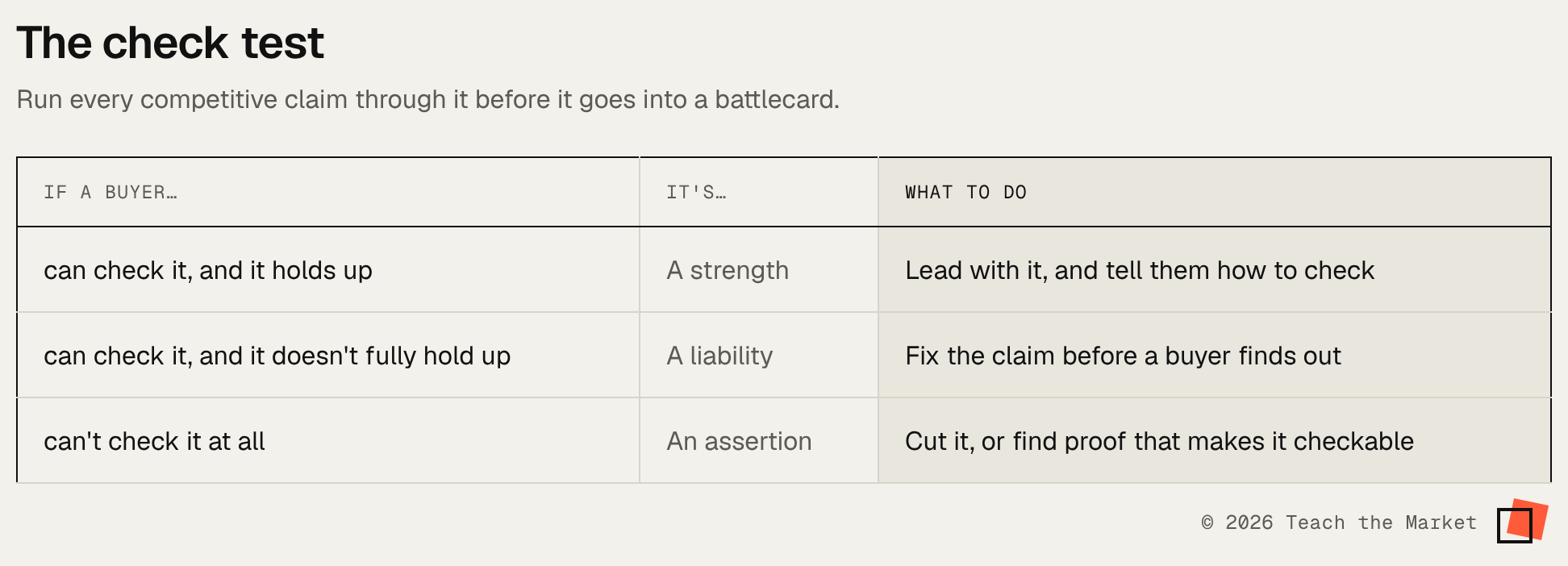
If a buyer can check the claim and it holds up, it's a strength: lead with it and tell them how to check.
If a buyer can check it and it doesn't fully hold up, it's a liability: fix it before a buyer finds out.
If a buyer can't check it at all, it's an assertion: cut it, or find proof that makes it checkable.
Should you acknowledge a competitor's strengths?
Yes. Acknowledging a competitor's real strengths usually increases trust instead of weakening your position. It shows the buyer you understand the market, makes your other claims more believable, and lets you frame the tradeoff on your terms. Pair the acknowledgment with the choice behind it: "They go deeper on traditional case management. We chose to focus on live conversations, because that's where your customers are." That's not a concession; it's a position.
What should a battlecard include?
A battlecard buyers would trust, if they saw it, includes:
The competitor's real strengths, stated plainly.
Your one or two genuine differences and why they matter.
When the competitor is a better fit (so sellers can qualify honestly).
The three to five objections sellers hear most, with honest answers.
Proof points a buyer can verify.
What are the most common competitive positioning mistakes?
Claiming to win on every dimension. No product does, and buyers know it.
Building claims from competitors' marketing. Websites show how competitors want to be seen, not how their products perform.
Saving honesty for when you're losing. Acknowledging tradeoffs early builds the trust you need later.
Writing battlecards sellers won't use. If sellers don't believe a claim, they won't say it convincingly.
Key takeaways
In a noisy market, the trusted advisor beats the loudest voice.
Lead with the one or two differences that matter, and say where competitors fit.
Run every competitive claim through the check test before it goes into a battlecard.
Acknowledging a competitor's strength, paired with your choice, is a position, not a concession.
Frequently asked questions
How often should competitive battlecards be updated?
Competitive battlecards should be updated whenever a competitor makes a meaningful product, pricing, or positioning change, and reviewed at least quarterly. The best signal for an update is what sellers hear in deals: if new objections or comparisons keep appearing, the battlecard is out of date.
Should B2B SaaS companies publish competitor comparison pages?
Competitor comparison pages can help buyers who are actively evaluating options, as long as they meet the same trust standard as a battlecard: accurate, specific, checkable, and honest about where the competitor fits. Comparison pages that exaggerate tend to damage credibility, because buyers read them skeptically and check the claims.
Who should own competitive positioning?
No single function should own competitive positioning alone. It works best when product experts who understand how products really differ, experienced sellers who hear objections in deals, and product marketing work together. Product marketing typically coordinates the work and keeps battlecards current, with input from sales and product.
How do you handle a competitor that is cheaper?
When a competitor is cheaper, don't pretend price doesn't matter. Acknowledge the difference, then explain what the buyer gets for the higher price in terms of outcomes, risk, and total cost, and point to proof they can check. If the cheaper competitor genuinely fits the buyer's needs, say so and qualify honestly.
Your next step
Take your current battlecard and run every claim through the check test. Keep what a buyer can verify, fix what doesn't fully hold up, and cut the assertions. Then add one honest line about where your main competitor is a good fit. To test the result in real conversations, see how to test your positioning before you roll it out. For the full process, see the practical guide to B2B SaaS positioning.
About the author
Lara George spent eight years at a hypergrowth B2B SaaS company. She joined at Series B and rose from product marketing manager to VP of Product Marketing and GTM Enablement. She launched a product that now drives 40% of revenue, helped grow the portfolio from one product to more than six, and ran analyst relations from start to finish. She’s also a recognized voice in communications and a frequent speaker at communications and tech industry events. Teach the Market is where she shares what she learned. More about Lara
