

How to Handle a Product Gap in Competitive Deals (Without Spin)
The short answer: Reframe a product gap only when it means doubling down on a genuine strength. If you're lighter on breadth than a competitor, argue for focus, but only if you're clearly better where you focus. Name the tradeoff honestly, explain the customer value of your choice, and never claim every missing feature was a deliberate strategy. If there's no strength behind the gap, close it or stop leading with that comparison.
This guide explains when reframing a product weakness is credible, how to say it, and how to check a reframe before sellers use it. It's part of the practical guide to B2B SaaS positioning.
What does it mean to reframe a product weakness?
Reframing a product weakness means presenting a gap as the consequence of a choice that benefits the buyer, so the conversation shifts from "you don't have X" to "here's why we built it this way, and what you get because of it." Done well, reframing is one of the most persuasive moves in B2B positioning. Done badly, it's spin, and buyers recognize spin quickly.
When is reframing a weakness credible?
Reframing is credible only when a genuine strength sits behind the gap. Compare your breadth with the competitor's, and your strength in your focus area:
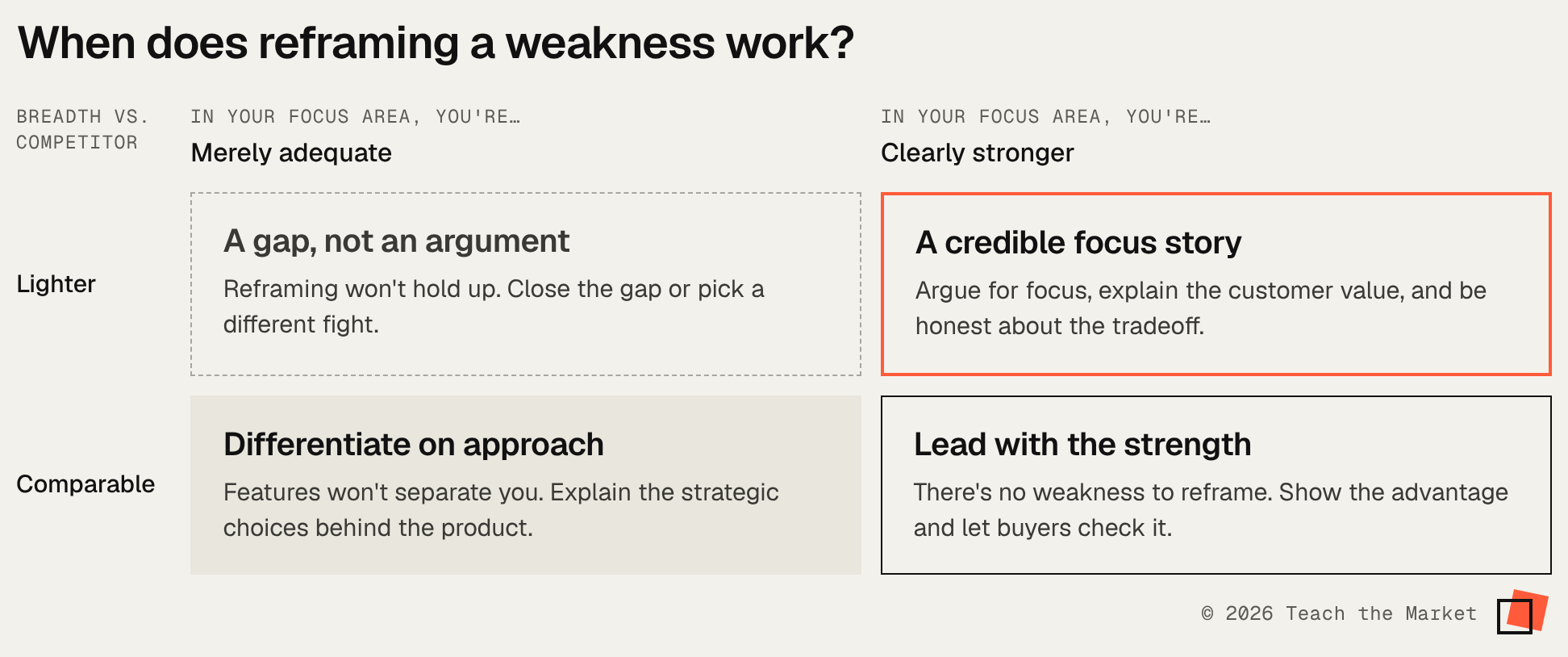
Lighter on breadth, clearly stronger where you focus: a credible focus story. Argue for focus, explain the customer value, and be honest about the tradeoff.
Lighter on breadth, merely adequate where you focus: a gap, not an argument. Reframing won't hold up. Close the gap or pick a different fight.
Comparable breadth, comparable strength: differentiate on your approach instead. There's nothing to reframe.
Comparable breadth, clearly stronger: lead with the strength.
How do you reframe a product gap in a sales conversation?
Acknowledge the gap plainly. "They go deeper on X." Buyers trust vendors who say it first.
Explain the choice behind it. Why you built the product the way you did, in terms of the buyer's problem.
Point to the strength the choice created. Something the buyer can verify in a demo or with a reference.
Check the gap against this buyer's needs. If the missing capability is essential for them, say so and qualify honestly.
What does a credible reframe sound like?
A weak reframe pretends the gap doesn't matter. A credible reframe names the tradeoff, explains the reason, and points to a verifiable strength.
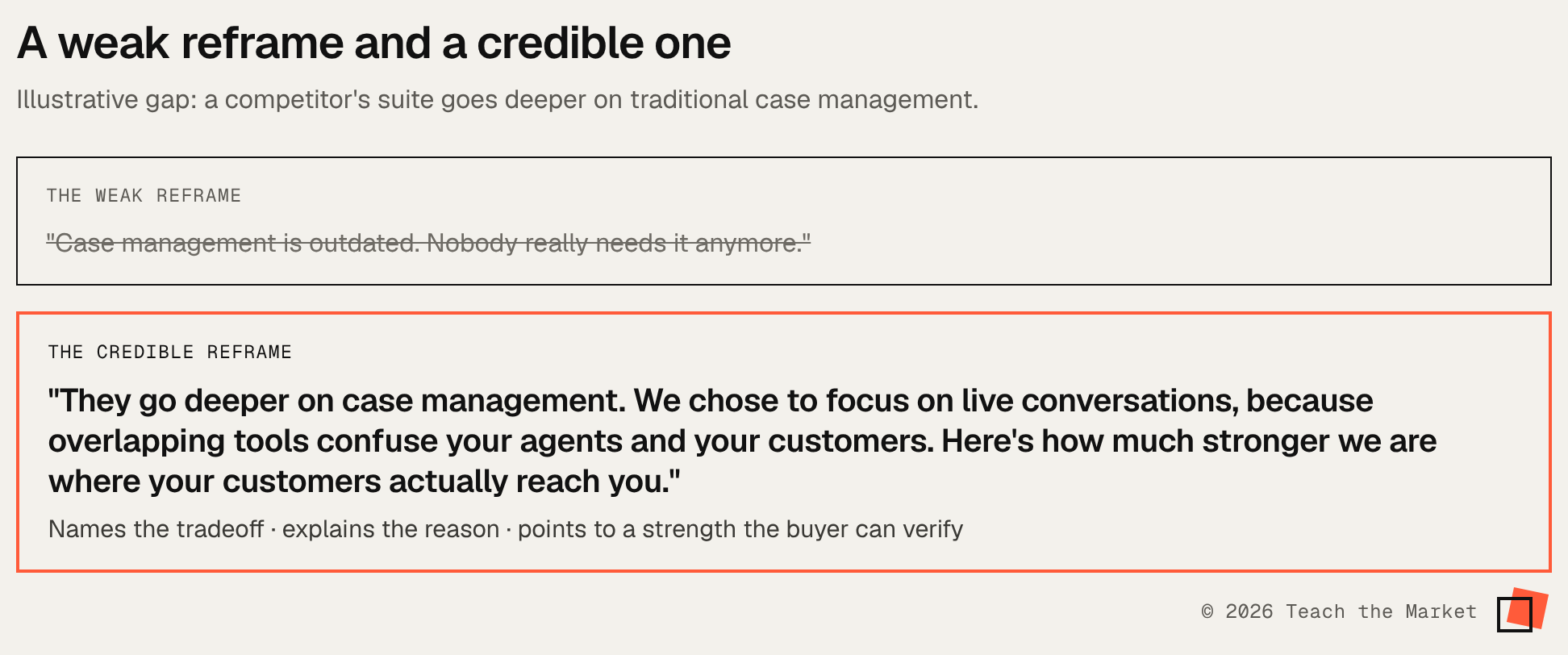
Consider a focused, messaging-first customer service platform competing with CRM suites whose service modules go deeper on traditional case management. It argued that overlapping tools confuse agents and customers, and staked out a focused role in conversational support, where it was clearly stronger. The argument held only because the platform really was stronger there. Without that strength, the same words would have been an excuse.
How do you check a reframe before sellers use it?
Run every reframe through three questions, in order. If the answer to any of them is no, don't use the reframe yet:
Is there a genuine strength behind it? One a buyer could verify, not one you claim.
Does the buyer value that strength? It has to matter for the outcome they're buying for.
Can you name the tradeoff honestly? The buyer should hear what they give up, and why it's worth it, from you first.
Then test the reframe with your most experienced sellers. They'll know whether it holds up in a live conversation.
What should you do when there's no strength behind the gap?
When there's no genuine strength behind a product gap, don't reframe it. Instead:
Close the gap on the roadmap, if it matters to the buyers you want.
Stop leading with the comparison that exposes it, and compete where you're genuinely strong.
Qualify out of deals where the missing capability is essential. Losing those deals honestly protects your credibility in the rest.
What are the most common mistakes when handling product weaknesses?
Claiming every gap was intentional. Some features are missing because they haven't been built yet. Saying otherwise makes your real choices less believable.
Reframing without the strength. "We're focused" only works if you're demonstrably better at what you focus on.
Hiding the tradeoff. If a buyer discovers the gap alone, your reframe looks like spin in hindsight.
Reframing a gap the buyer genuinely needs filled. No framing fixes a missing essential capability.
Key takeaways
Reframe a product gap only when it doubles down on a genuine strength.
Acknowledge the gap first, explain the choice, then point to a verifiable strength.
Run every reframe through three questions before sellers use it.
When there's no strength behind the gap, close it, change the comparison, or qualify out.
Frequently asked questions
How should sellers respond when a buyer asks about a missing feature?
Sellers should acknowledge the missing feature directly, explain whether and why the product was built differently, and connect that choice to the buyer's needs. If the feature is on the roadmap, say so only if it's committed. If the feature is essential for the buyer, honest qualification protects trust better than a reframe.
Is it ever okay to say a missing feature is on the roadmap?
Only when it's genuinely committed and you can share a realistic timeframe. Vague roadmap promises used to win deals tend to backfire, because buyers remember them. If a feature is only being considered, say that, and focus the conversation on what the product does well today.
What is the difference between reframing and spin?
Reframing presents a real tradeoff honestly: it names the gap, explains the choice behind it, and points to a strength the buyer can verify. Spin hides or minimizes the gap without a genuine strength behind it. Buyers can usually tell the difference, especially once they check the claims.
Should product gaps go on a battlecard?
Yes. A good battlecard lists the competitor's real strengths, including gaps in your own product, along with the credible reframe for each and guidance on when to qualify out. Sellers handle gaps better when they're prepared for them than when they discover them mid-deal.
Your next step
List the two or three product gaps that come up most in competitive deals. Place each on the grid, run the three questions, and keep only the reframes that pass. For the rest, decide whether to close the gap or stop leading with that comparison. For the broader question of standing apart, read how to differentiate a B2B SaaS product when competitors look the same. For the full process, see the practical guide to B2B SaaS positioning.
About the author
Lara George spent eight years at a hypergrowth B2B SaaS company. She joined at Series B and rose from product marketing manager to VP of Product Marketing and GTM Enablement. She launched a product that now drives 40% of revenue, helped grow the portfolio from one product to more than six, and ran analyst relations from start to finish. She’s also a recognized voice in communications and a frequent speaker at communications and tech industry events. Teach the Market is where she shares what she learned. More about Lara
