

What Is a Strategic Narrative? (And How It's Different from Positioning and Messaging)
The short answer: A strategic narrative is a company's interpretation of what's changing in its world, what it believes about that change, and the role it intends to play. It comes before positioning and messaging: narrative explains what's happening, positioning explains where the company fits given that context, and messaging puts both into words. Positioning is mainly a go-to-market discipline. Narrative can be an enterprise-wide one.
This guide explains what a strategic narrative is, how it relates to positioning, messaging and communications, and where it does the most work. It's part of the practical guide to strategic narrative for B2B SaaS.
What is a strategic narrative?
A strategic narrative is the shared interpretation a company wants people to hold about where it is, what's changing around it, what it believes, where it's going, and why. It isn't a slogan or a story about the product. It's an argument about the market, written so that leaders, employees, customers, investors and analysts can all repeat it in their own words.
A good narrative answers three questions:
What is changing? The forces reshaping your customers, your industry or your company.
What do we believe about it? Your distinctive interpretation, the conviction others don't share yet.
What role do we play? The stance you take in where this is heading.
How is a narrative different from a story?
A story is specific. A narrative is the pattern many stories add up to. A story has particular people, a particular situation and a particular outcome: one customer's rollout, one launch, one deal. A narrative is the general conclusion an audience draws from all of them about how the world works and where a company fits.
In a narrative, characters become types. It's not "Maria, the support director at a retailer"; it's "service teams being judged on moments they were never staffed for." Audiences don't remember every story they hear. They remember the narrative the stories formed. That's why a company with many good but unconnected stories can still leave people with no clear idea of what it stands for.
How do narrative, positioning, messaging and communications relate?
Each layer answers a different question, and each depends on the one before it:
Narrative: How should people understand what's happening?
Positioning: Given that context, how should they understand us?
Messaging: What do we say to make those ideas clear and compelling?
Communications: How do we carry those ideas consistently to different audiences and contexts?
The order matters. Positioning without a narrative argues for a product in a market the buyer doesn't yet see the way you do. Messaging without either polishes words that have nothing underneath them.
Is narrative a marketing discipline?
Positioning is primarily a go-to-market discipline. Narrative can be an enterprise-wide one. Positioning decides how a company or product occupies a distinct place in the market, so it gets put into practice through marketing, product marketing, sales, brand, analyst relations, competitive strategy, and pricing and packaging.
Narrative has a potentially much larger job: establishing a shared understanding of where the company is, what's changing, what it believes and where it's going. That understanding travels outward to customers, investors and analysts, and inward to employees and candidates. It's why a strategic narrative needs real leadership involvement, not just a marketing brief.
Where do narrative and positioning show up?
Both show up almost everywhere. What changes is which one carries the load.
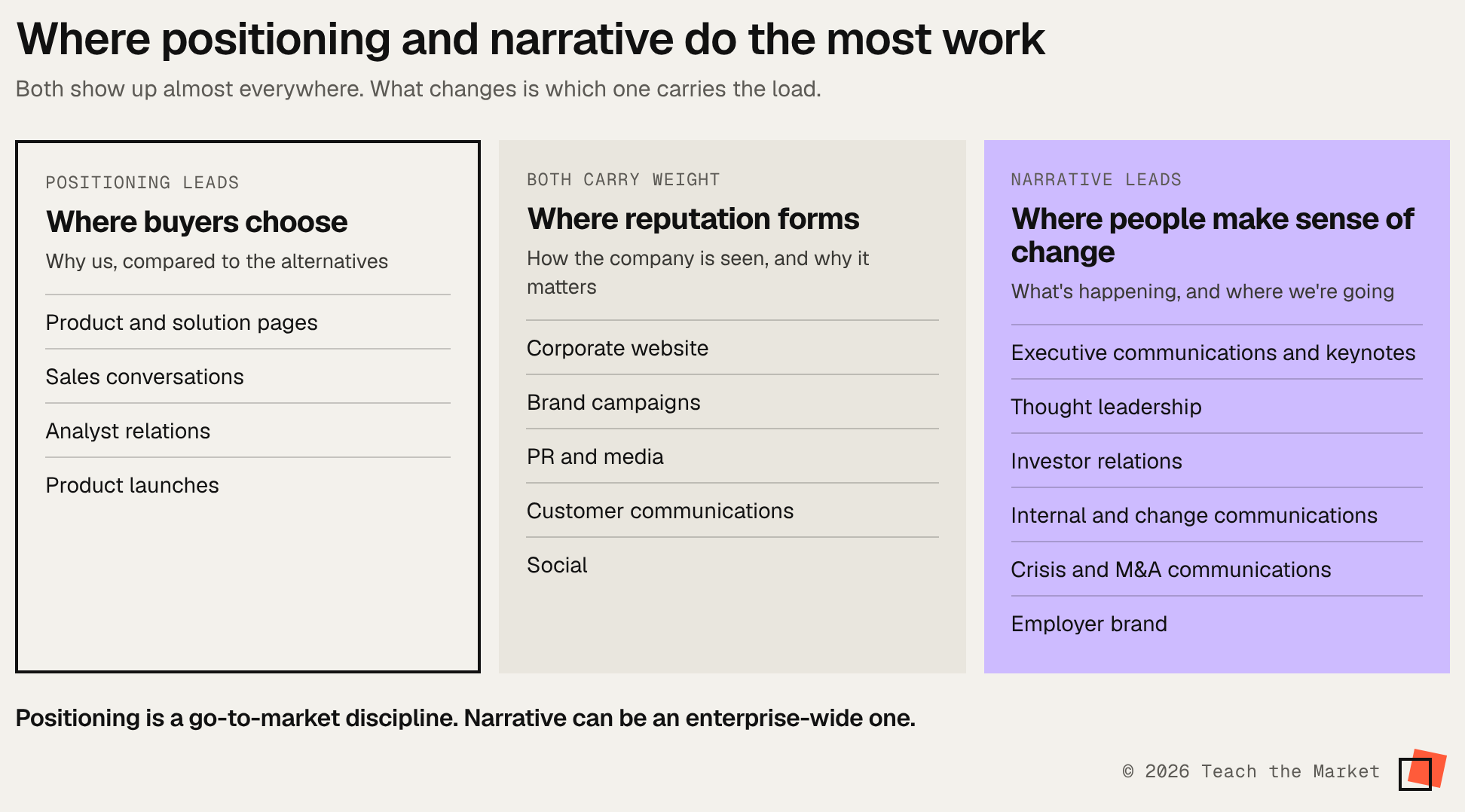
Positioning leads where buyers choose: product and solution pages, sales conversations, analyst relations and product launches. The question is "why us, compared to the alternatives?"
Both carry weight where reputation forms: the corporate website, brand campaigns, PR and media, customer communications and social.
Narrative leads where people make sense of change: executive communications and keynotes, thought leadership, investor relations, internal and change communications, crisis and M&A communications, and the employer brand. The question is "what's happening, and where are we going?"
Why does a B2B SaaS company need a narrative?
Because reputation forms whether you shape it or not. Buyers form a view of your company from many encounters: a sales call, an analyst's comment, a review, a launch, a conversation with a peer. If those encounters don't add up to a consistent conclusion, no clear reputation forms, or the wrong one does.
Reputation research makes the same point. RepTrak, which studies how companies are perceived, notes that people judge a company across several dimensions and fill gaps with whatever fragments of information they have. Staying quiet doesn't leave a blank. It leaves someone else's version, usually the narrative status quo your market already tells.
Narrative also matters most when the category itself is in question. When buyers stop asking "which vendor?" and start asking "do we need this at all?", positioning can't help. Only an argument about the market can.
What does a strategic narrative look like in practice?
A short illustrative example, from a customer service software company (not a real company):
What is changing: AI now answers the routine questions in seconds, so the conversations that still reach a person are the hard ones: the billing dispute, the cancelled trip, the customer who's about to leave.
What we believe: Most companies are using AI to make service cheaper. That's the wrong bet. When everyone can answer instantly, the advantage is remembering who the customer is.
Our role: We're on the side of the service team, not the cost-cutters.
Notice what's missing: features. The product shows up only as the role the company plays. For the full walkthrough, see how to write a strategic narrative: a worked example.
What are the most common narrative mistakes?
Writing a product story and calling it a narrative. If the subject is your software, it's messaging.
Starting with positioning. Without a view of what's changing, positioning has no context to sit in.
Treating it as a marketing project. A narrative leadership doesn't own won't survive the first strategy meeting.
Making it generic. If a competitor could say it word for word, it isn't a point of view.
Key takeaways
A strategic narrative is your interpretation of what's changing, what you believe about it, and your role in it.
Narrative comes first: narrative, then positioning, then messaging, then communications.
Positioning is a go-to-market discipline; narrative can be an enterprise-wide one.
If you don't tell your story, the market assembles one from fragments.
Frequently asked questions
What is the difference between a strategic narrative and positioning?
A strategic narrative explains what's changing in the market and what a company believes about it. Positioning explains where the company fits, given that context: who it's for, what it's compared against, and why it's the better choice. Narrative sets the context; positioning makes the case for the company within it. Positioning is mainly a go-to-market discipline, while narrative can guide the whole company.
Is a strategic narrative the same as a brand story?
Not quite. A brand story usually describes the company: its origin, values and personality. A strategic narrative describes the market: what's changing, why it matters, and what role the company plays in where it's heading. A good brand story can carry the narrative, but the narrative is the argument underneath, and it should hold up even without the brand's voice.
Who should write a company's strategic narrative?
The narrative needs leadership involvement, because it reflects what the company believes and where it's going. In practice, a small group usually drafts it: leaders who own strategy, plus people with strong communications and market perspectives, such as product marketing or corporate communications. The test is whether leaders recognize it as their own view, not a marketing document.
How long should a strategic narrative be?
The core narrative should fit on a few pages, and the heart of it in a single paragraph a leader could say out loud in under a minute. Supporting material, such as proof, audience notes and language guidance, can sit alongside it. If the core can't be stated briefly, the thinking usually isn't finished yet.
Your next step
Write one sentence for each of the three questions: what is changing, what do we believe about it, what role do we play. If any sentence mentions your product's features, rewrite it one level higher. Then read how to write a strategic narrative: a worked example. For the full process, see the practical guide to strategic narrative.
About the author
Lara George spent eight years at a hypergrowth B2B SaaS company. She joined at Series B and rose from product marketing manager to VP of Product Marketing and GTM Enablement. She launched a product that now drives 40% of revenue, helped grow the portfolio from one product to more than six, and ran analyst relations from start to finish. She’s also a recognized voice in communications and a frequent speaker at communications and tech industry events. Teach the Market is where she shares what she learned. More about Lara
