

How to Write a Strategic Narrative: A Worked Example
The short answer: Write a strategic narrative by answering three questions in order: what is changing, what do we believe about it, and what role do we play. Keep it one level above your product, make it specific enough that only your market would recognize it, and include a belief someone could disagree with. Then check it against five tests from reputation research: is it visible, distinctive, authentic, transparent and consistent?
This guide walks through one strategic narrative from blank page to finished paragraph, using an illustrative example. It's part of the practical guide to strategic narrative for B2B SaaS.
What does a strategic narrative need to include?
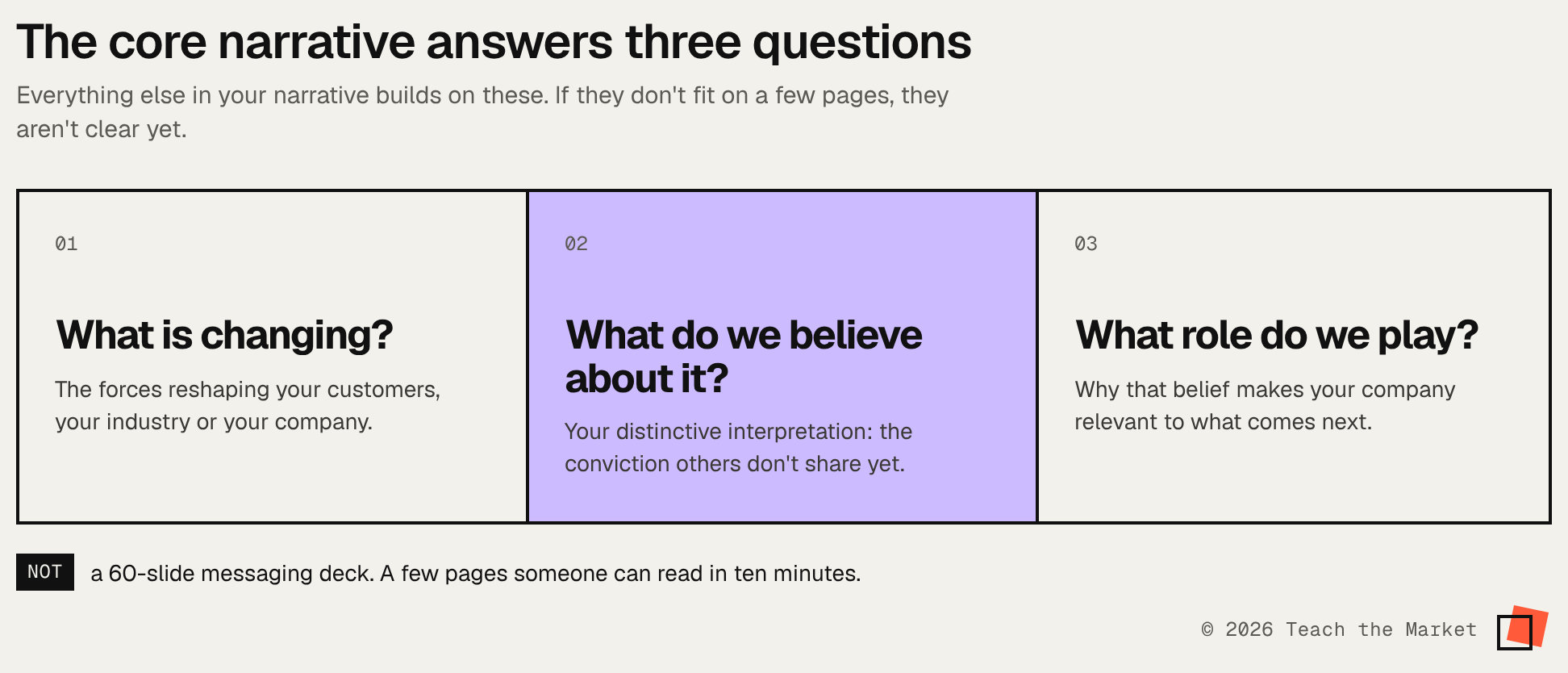
A strategic narrative needs three answers: what is changing, what you believe about it, and the role you play. Everything else builds on these: the stories you tell, the proof you collect, the way each audience hears it. If you're new to the idea, start with what a strategic narrative is.
The example: a customer service software company
To make this concrete, here's an illustrative company. It isn't a real company, but the situation is a realistic one. It sells customer service software to companies whose service teams handle questions across chat, email and phone. Its market is crowded, AI is changing what service teams do, and every vendor says roughly the same thing about speed and efficiency.
Step 1: What is changing?
Describe the shift in the customer's world, not your product.
First draft (too generic): "Customer expectations are rising, and AI is transforming customer service."
Every vendor in the category could say that. It's true and forgettable.
Better: "For twenty years, service was measured in handle time and tickets closed. Now AI answers the password resets and order-status questions in seconds, so the conversations that still reach a person are the hard ones: the billing dispute, the cancelled trip, the customer who's about to leave. Service teams are being judged on the moments they were never staffed for."
What changed: concrete details only this market would recognize, and a tension (teams judged on what they weren't built for).
Step 2: What do we believe about it?
This is where the point of view lives. Look for the conviction your market doesn't share yet.
First draft: "We believe great service builds loyalty."
Nobody disagrees, which means it isn't a belief worth stating.
Better: "Most companies are using AI to make service cheaper. We think that's the wrong bet. When every competitor can answer instantly, the only advantage left is remembering who the customer is and what happened last time. Companies that cut service to the bone will find out what it cost them at renewal."
A useful test: could a smart competitor argue the opposite? Here, yes. Plenty of companies believe AI's job in service is to cut cost. That's what makes this a point of view.
Step 3: What role do we play?
A role is a stance, not a product description. Say whose side you're on and what you're out to change.
First draft: "We provide an AI-powered platform that unifies customer conversations."
That's a feature list.
Better: "We're on the side of the service team, not the cost-cutters. We use AI to give every agent the memory of your best one."
Step 4: Put it together
The narrative in one paragraph: "AI now answers the easy questions in seconds, so the conversations that still reach a person are the ones that decide whether a customer stays. Most companies are using AI to make service cheaper. We think that's the wrong bet: when every competitor can answer instantly, the only advantage left is remembering who the customer is. We're on the side of the service team, and we use AI to give every agent the memory of your best one."
In one sentence: "Others use AI to make service cheaper. We use it to give every agent the memory of your best one."
What else makes a narrative work?
Once the three answers are in place, check the building blocks. This structure is adapted from the FrameWorks Institute's research on how narratives work:
Characters: service teams as a type, not a persona list.
Plot: a start state (teams measured on speed), a shift (AI takes the easy work), and an end state (service as the reason customers stay).
Setting: why now. AI adoption and pressure on service budgets are happening at the same time.
Who tells it: a narrative is more credible from customers, analysts and service leaders than from the vendor alone.
The obstacle: the old way of measuring service, not a competitor. Narratives that cast a rival as the villain tend to read as attacks.
How do you know if your narrative is strong?
Reputation researchers Charles Fombrun and Cees van Riel identified five qualities shared by companies with strong reputations, in their book Fame and Fortune: visibility, distinctiveness, authenticity, transparency and consistency. They work well as a checklist for a narrative:
Visible: Will people actually encounter it? A narrative that lives in a strategy deck isn't one. Our example is built to be told in keynotes, sales conversations and on the website.
Distinctive: Could only you say it? "Great service builds loyalty" fails. "AI made answers cheap; memory is the advantage" passes.
Authentic: Is it true to what the company believes and does? If this company were quietly selling AI as a way to cut service headcount, the narrative would collapse.
Transparent: Is it honest about what it is and isn't? It doesn't claim AI is bad or that cost doesn't matter. It makes a specific bet.
Consistent: Can everyone tell it the same way, over time? The one-sentence version helps here: it's short enough for a seller, a recruiter and the CEO to repeat.
Where should you write it down?
Keep the finished narrative in one short source document, with the three answers, the principles that shouldn't change, your proof, and notes on how each audience should hear it. Written in plain text with clear headings, the same document works for the people who carry the narrative and for the AI tools they use to draft. You can download a narrative source document template with this example filled in.
Key takeaways
Write the three answers in order: what is changing, what you believe, what role you play.
Stay one level above your product, and use details only your market would recognize.
Include a belief someone could disagree with; otherwise it's not a point of view.
Test the result: visible, distinctive, authentic, transparent and consistent.
Frequently asked questions
How long does it take to write a strategic narrative?
A first draft can take a few focused working sessions, but the thinking behind it takes longer. Most of the time goes into research, such as interviews with customers, sellers and partners, and into leadership agreeing on what the company actually believes. Expect the narrative to keep sharpening as it's tested in campaigns over the following months.
Should a strategic narrative mention our product?
Only lightly, as the role you play. The narrative should be about your customers' world and where it's heading, not about your features. When the product becomes the subject, the narrative turns into messaging, and it loses the thing that makes people repeat it: a view of the market they recognize and can agree or disagree with.
What if our narrative sounds like everyone else's?
That usually means the "what we believe" answer is a consensus view. Look for the assumption most of your market shares and ask whether you disagree with it. Then add concrete details only your market would recognize. If a competitor could say your narrative word for word, keep working on the belief before polishing the wording.
Can AI write a strategic narrative?
AI can help draft, summarize interviews and test how the narrative reads for different audiences. It can't decide what your company believes or which bet it's making. Those are leadership choices. Once the narrative exists, a clear source document lets AI tools translate it reliably for keynotes, sales conversations and internal communications.
Your next step
Draft your three answers, then hold each one against its first-draft trap: generic change, consensus belief, product-description role. Check the result against the five tests. To capture it properly, download the narrative source document template. If you haven't done research yet, start with how to find your narrative. For the full process, see the practical guide to strategic narrative.
About the author
Lara George spent eight years at a hypergrowth B2B SaaS company. She joined at Series B and rose from product marketing manager to VP of Product Marketing and GTM Enablement. She launched a product that now drives 40% of revenue, helped grow the portfolio from one product to more than six, and ran analyst relations from start to finish. She’s also a recognized voice in communications and a frequent speaker at communications and tech industry events. Teach the Market is where she shares what she learned. More about Lara
