

How to Find Your Narrative: Start Outside Your Industry
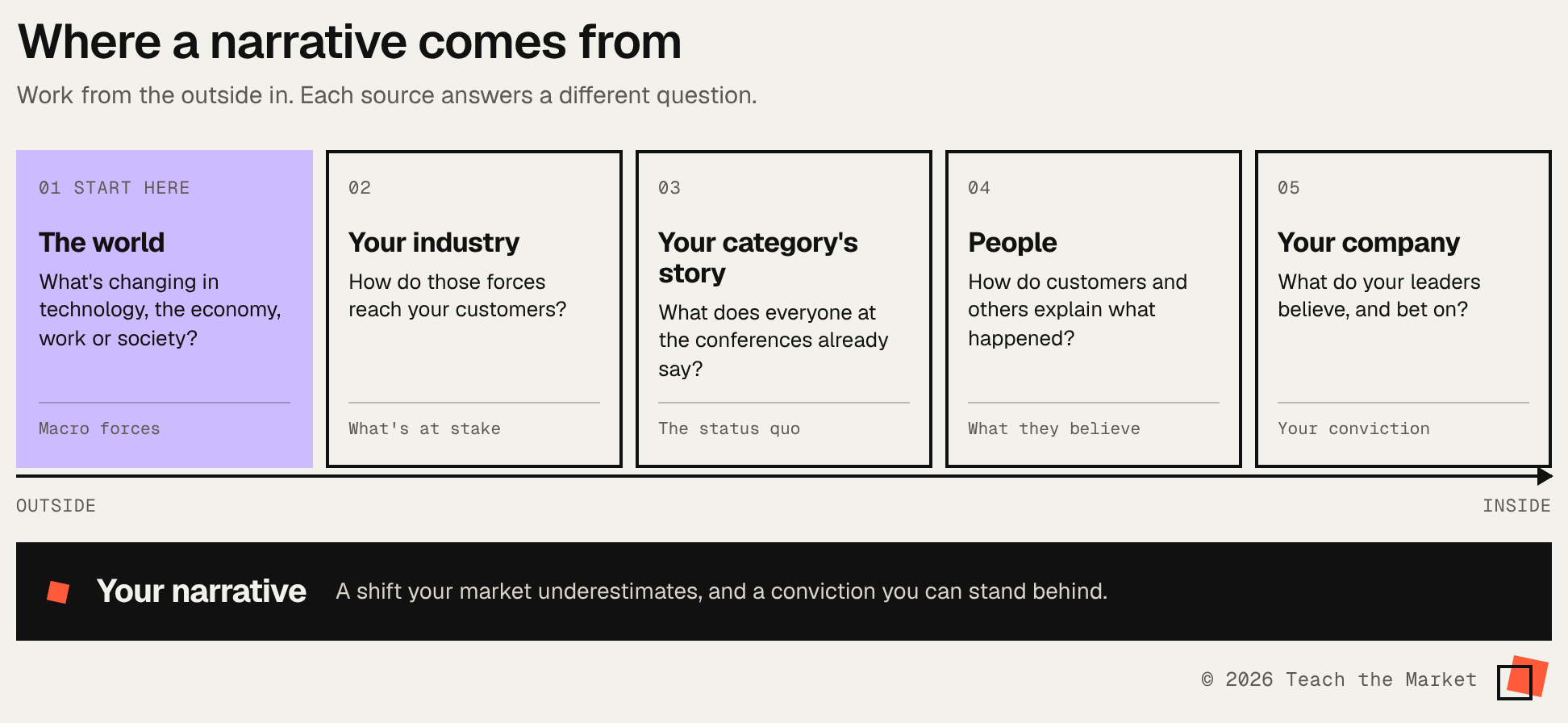
The short answer: Find your narrative by starting outside your industry. Look at the forces reshaping the world right now and ask why they matter to your market. Then read the story your category already tells, talk to people to hear how that story lives in their heads, and ask your leaders what the company genuinely believes. Your narrative sits where those meet: a shift your market underestimates, and a conviction you can stand behind.
This guide explains where a strategic narrative comes from and how to find yours, step by step. It's part of the practical guide to strategic narrative for B2B SaaS.
What does it mean to find your narrative?
Finding your narrative means working out how people should understand what's happening in your market, and what your company believes about it. It's part research and part judgment. You don't invent a narrative from nothing, and you can't simply discover it in customer feedback either. You gather what's true about the world, your category, and your company, then decide what argument you want the market to accept.
Why should you start outside your industry?
Because the story inside your industry is the one everyone already tells. Industry conferences, analyst reports, and competitor websites recycle the same handful of talking points. If you start there, you end up with a slightly better version of the category's narrative, not your own.
The more useful starting point is the world beyond your market. What's changing in technology, the economy, how people work, regulation, or society, and why does it matter to your industry? Narratives that land usually connect something big and widely felt to something specific about a market.
Three illustrative examples (made-up companies, real kinds of forces):
Customer service software: AI can now answer routine questions instantly. Outside the industry, that's a story about automation. Inside it, it means the conversations that still reach a person are the hard ones.
Construction software: an experienced generation of tradespeople is retiring. Outside the industry, that's a demographic shift. Inside it, it means decades of judgment walk out the door.
Finance software: the economy is harder to predict. Outside, that's a macro story. Inside, it means CFOs need earlier warning signals than a monthly close can give them.
Ask three questions about each force you find: What's happening? How does it reach our customers? What does our industry still underestimate about it?
How do you find your category's existing narrative?
It's usually the easiest part: go where your category talks to itself. Attend the industry's conferences, read the thought leadership in your space, sit in on analyst webinars, and look at how your competitors open their keynotes and homepages.
As you go, write down the three to five claims nearly everyone makes. That's your category's narrative status quo: the story the market already tells about the problem, whether or not you shaped it. Reputation research points the same way. RepTrak, which studies how companies are perceived, notes that when a company doesn't tell its own story, people fill the gap from whatever fragments they have.
Listen just as carefully for what nobody says. The gap in the category's story is often where your narrative fits. Once you've named the status quo, you'll need to decide whether to build on it or push against it.
Why do you need to talk to people?
Because narratives live in people's heads, not in documents or dashboards. Conference agendas tell you what the category says. Conversations tell you what people actually believe and how they explain it to each other.
Talk to customers, prospects, people who chose to do nothing, sellers, and partners. Interview them the way a journalist would, not a market researcher. Market research asks what people think ("How important is this to you?"), which tends to produce polite, consensus answers. A journalistic interview asks people to recount what happened:
"Take me back to when this first became a problem. What was happening?"
"How would you explain what changed to a colleague who wasn't there?"
"What did you expect that didn't happen?"
Write down their exact words, and notice what never comes up. One caution: win-loss analysis is a great positioning tool, but it's too narrow here. It explains why a buyer chose one vendor over another, not how they understand their world.
Why do you need to look inside the company?
Because a narrative is also a conviction, and that has to come from the company. Research can tell you what's changing and what the market believes. It can't tell you what you believe about it, or what role you're willing to play.
Ask your leaders a few direct questions:
What do we believe about our industry that most of our competitors don't?
What are we betting the company on over the next few years?
What would we refuse to do, even if it would win deals?
The answers have to be true to what the company actually does. A narrative that leaders don't believe, or that strategy contradicts, falls apart as soon as people compare what you say with what you do.
How do you turn what you found into a narrative?
Look for the tension between what's changing and what your market still believes, then state where you stand. Lay your notes side by side and work through four steps:
Pick the force that matters most. From your outside-in research, choose the one shift with the biggest consequences for your customers.
Name what the category gets wrong or misses. Compare that force with the status quo you heard at conferences and in interviews.
Check it against your company's conviction. Keep only the interpretation your leaders genuinely believe and your strategy supports.
Write it as three answers. What is changing? What do we believe about it? What role do we play?
Here's how that looks for the illustrative customer service company. The force: AI makes routine answers instant (outside in). The category story: AI is for deflecting contacts and cutting costs (heard at every conference). What people said: the conversations they remember are the hard ones, where they had to repeat themselves (interviews). The company's conviction: it's on the side of the service team, not the cost-cutters (leadership). Put together: "Most companies are using AI to make service cheaper. We think that's the wrong bet."
For the full walkthrough, see how to write a strategic narrative. To capture the result in one place, use the narrative source document template.
What are the most common mistakes?
Starting inside the category. You end up repeating the status quo with better adjectives.
Treating research as the answer. Research shows what's true. The narrative still requires a choice.
Relying on surveys and dashboards. They measure opinions and clicks, not what people believe.
Skipping the leaders. A narrative the leadership team doesn't believe won't survive its first keynote.
Choosing the most quotable story. One vivid anecdote isn't a narrative. Look for the shared pattern.
Key takeaways
Start outside your industry: find the forces reshaping the world and ask why they matter to your market.
Your category's narrative is easy to find at conferences and in thought leadership. Note what nobody says.
Narratives live in people's heads, so talk to people and ask what happened, not what they think.
The narrative comes from the tension between what's changing and what the market believes, filtered through what your company genuinely believes.
Frequently asked questions
Where should you look for the forces behind a narrative?
Look beyond your industry first: technology shifts, economic conditions, changes in how people work, regulation, and demographics. General business media, research on broad trends, and conversations with people outside your market are good sources. Then ask how each force reaches your customers and what your industry still underestimates about it. The forces that matter most change how your customers work, not just what they buy.
How do you find your category's narrative?
Go where your category talks to itself. Attend industry conferences, read the thought leadership in your space, follow analyst research, and study how competitors open their keynotes and homepages. Write down the few claims nearly everyone makes. That's the narrative status quo. Pay equal attention to what nobody is saying, because that gap is often where a distinctive narrative fits.
Can you find a narrative with surveys or data?
Not on its own. Data can show which forces are real and how big they are, and surveys can confirm a pattern you've already heard. But narratives live in people's heads, in how they explain what's changing to each other. You only hear that in open conversations where people recount what happened in their own words.
Who should be involved in finding a company's narrative?
The research can be led by communications, product marketing, or strategy, but the company's leaders must be involved. A narrative is a conviction about where the market is heading, so the leadership team has to believe it and be willing to act on it. Include people who see the market from different angles, such as sellers, partners, and customer-facing teams.
Your next step
Write down three forces reshaping the world right now, and for each one, how it reaches your customers. Then spend an hour with your category's last big conference agenda and list the claims everyone makes. Where your forces and the category's story don't match is where to start. For the full process, see the practical guide to strategic narrative.
About the author
Lara George spent eight years at a hypergrowth B2B SaaS company. She joined at Series B and rose from product marketing manager to VP of Product Marketing and GTM Enablement. She launched a product that now drives 40% of revenue, helped grow the portfolio from one product to more than six, and ran analyst relations from start to finish. She’s also a recognized voice in communications and a frequent speaker at communications and tech industry events. Teach the Market is where she shares what she learned. More about Lara
