

How to Manage a Strategic Narrative (and Where to Start)
The short answer: Managing a strategic narrative means keeping one shared interpretation of your company and market consistent across everyone who tells it. Start by reviewing your core narrative against three questions: what is changing, what you believe about it, and what role you play. Then research the story your company actually tells, and fix the places where it drifts most. After that, the ongoing work is to translate the narrative for each audience, keep one source document, and watch for drift, focusing first on the people who carry the narrative in person.
This guide covers where to start, how the narrative should cascade, how AI can speed up the work, and where you have the most control. It's part of the practical guide to strategic narrative for B2B SaaS.
What does managing a narrative involve?
Managing a narrative is the ongoing work of making sure everyone who speaks for your company makes the same argument about what's happening and why it matters, in words that fit their audience. It's broader than writing the company story once. It involves five jobs: defining the core narrative, building a narrative architecture, translating rather than distributing, keeping a single source of truth, and monitoring drift.
Seen all at once, that list is overwhelming. The good news is that you don't start with all five.
Where should you start?
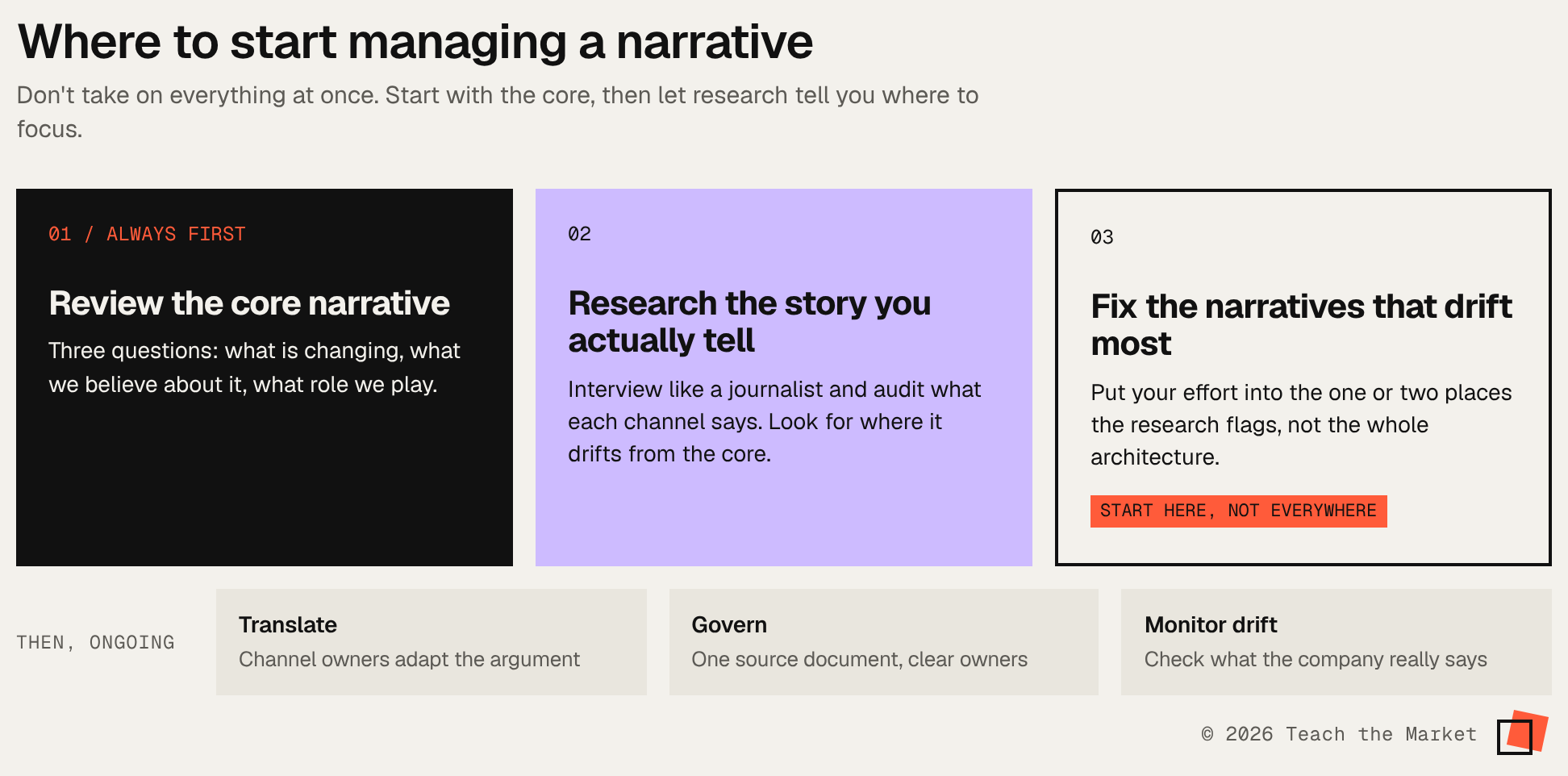
Always review the core narrative first. Check it against three questions: What is changing? What do we believe about it? What role do we play? If the answers don't fit on a few pages, they aren't clear yet. A great core narrative sits one level above your product: it's about your customers' world and where it's heading.
Research the story you actually tell. Interview people inside and outside the company the way a journalist would, and audit what each channel says today. Look for where the story drifts from the core.
Fix the one or two places that drift most. Research usually shows that most of the narrative holds and a few parts don't, such as the employer story or what the sales team says. Start there, not everywhere.
How should a narrative cascade across audiences?
One core narrative should cascade into a set of narratives for different audiences: strategic, market, investor, employee, customer, product, and employer. Each answers the core questions for its audience. Investors need to know why the strategy creates durable value; employees need to know what it means for their work.
These narratives shouldn't be identical. They should be logically compatible. What you're managing is shared logic, not identical language.
What does "translate, don't distribute" mean?
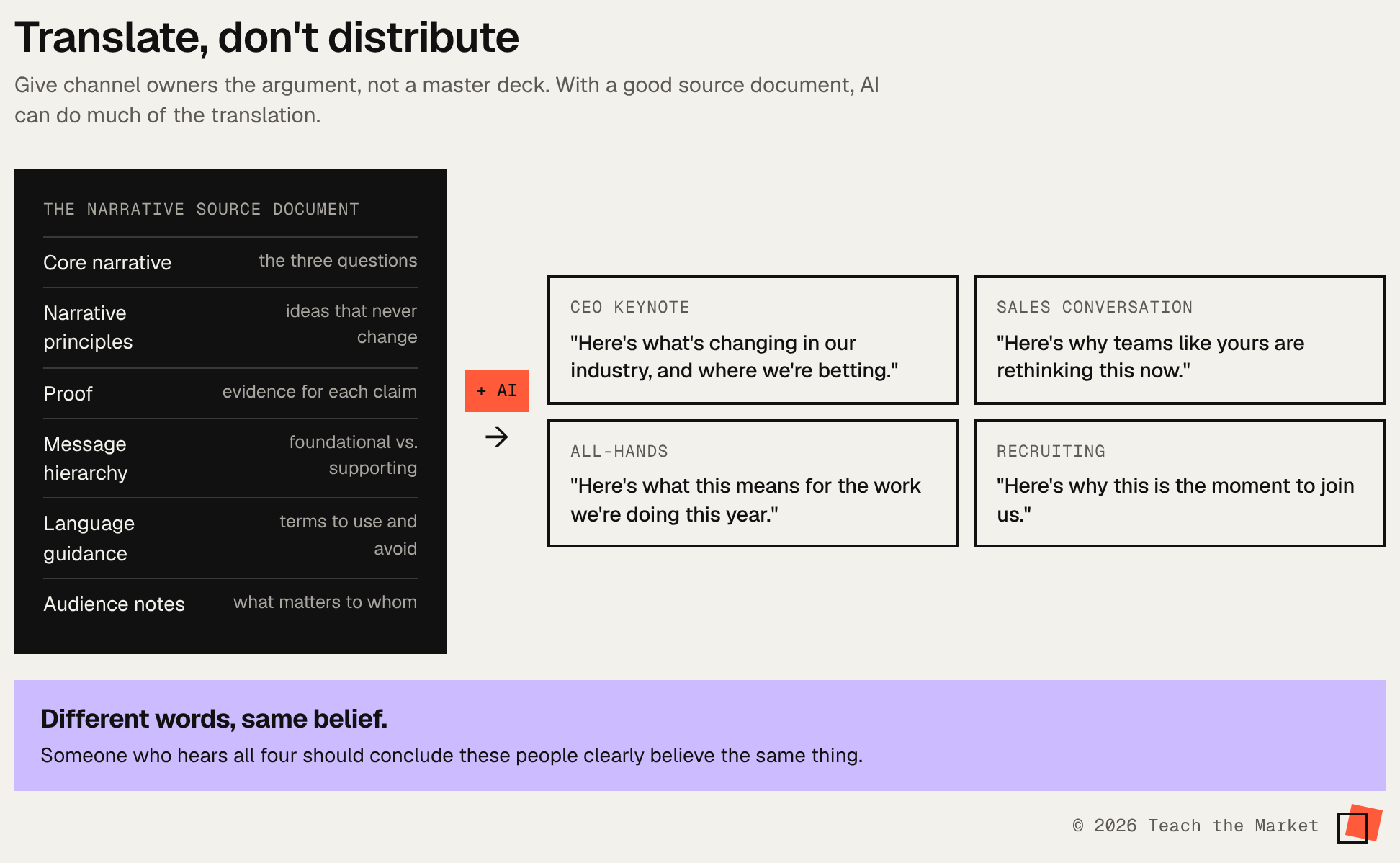
It means giving the people who own each channel the argument, and letting them adapt it, instead of handing out a master deck and asking everyone to use the same messages. The CEO shouldn't sound like the homepage. A salesperson shouldn't sound like the CEO. The all-hands shouldn't sound like the investor deck. But someone who hears all of them should conclude these people clearly believe the same thing.
In practice, that means working with the owners of each channel: communications, brand, product marketing, investor relations, analyst relations, sales, and people teams.
How can AI help manage a narrative?
AI is a powerful accelerator for translation, as long as it works from a good source document. If hundreds of people draft with AI, the narrative can become the context their tools work from. Without it, every tool fills the gaps with generic language.
A good narrative source document includes:
The core narrative: your answers to the three questions, plus the narrative in one paragraph and one sentence.
Narrative principles: the ideas that stay the same however the wording changes, and what each one rules out.
Proof: the evidence for each major claim, with gaps marked as missing rather than filled in.
Message hierarchy: which ideas are foundational and which are supporting.
Language guidance: the terms to use, the terms to avoid, and why.
Audience notes: what each audience most needs to understand, and the tone that fits.
Keep it to a few pages of plain text with clear headings, so people and AI tools can both read it. You can download a free narrative source document template to start.
How do you spot narrative drift?
Narrative drift is when different parts of the company start telling different stories. Check regularly what your company is actually saying across the website, CEO communications, investor materials, press, thought leadership, analyst briefings, campaigns, sales decks, product launches, employee communications, and recruiting. Then look for contradictions:
The CEO says the company is moving upmarket, while the homepage emphasizes ease and affordability.
Investor materials say AI is transforming the business, while product marketing treats AI as one more feature.
Recruiting talks about a new growth chapter, while internal communications emphasize efficiency and consolidation.
These aren't messaging problems. They're narrative coherence problems, and fixing the wording in one channel won't solve them.
Where do you have the most control over your narrative?
You have the most control where people carry your narrative in person, and the least in digital channels. Search results, AI-generated answers, social feeds, review sites, and media coverage are increasingly hard to monitor and impossible to control. Your people, in the room, are where your narrative is in your hands.
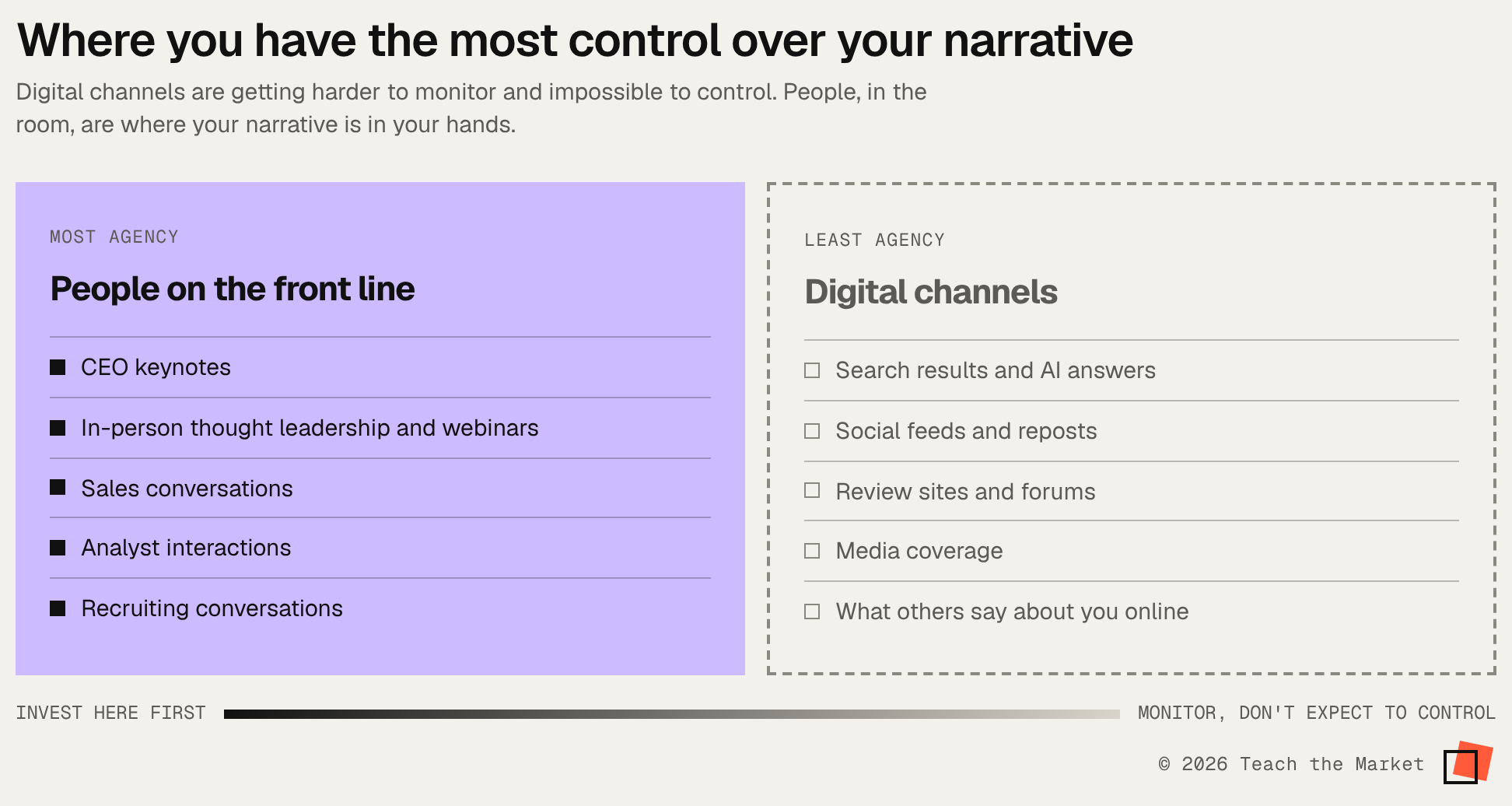
Invest first in the moments where people tell the story directly:
CEO keynotes and executive talks
In-person thought leadership and webinars
Sales conversations
Analyst interactions
Recruiting conversations
This matches what trust research shows. The 2026 Edelman Trust Barometer found that people trust those close to them, such as their employer, their CEO, and their coworkers, far more than distant institutions. A narrative carried by credible people travels further than one pushed through channels.
Who should own the narrative?
A strategic narrative should be led by company leadership and shaped with the right perspectives from across the business, not owned by one department. Positioning is primarily a go-to-market discipline. Narrative can be enterprise-wide: it explains where the company is, what's changing around it, what it believes, and where it's going, and that interpretation travels both inside and outside the company. Someone has to coordinate the work, often communications or product marketing, but the CEO and leadership team have to stand behind it.
Key takeaways
Always start by reviewing the core narrative against three questions.
Let research show where the story drifts, and fix those places first.
Manage shared logic, not identical language: translate the narrative, don't distribute it.
AI can accelerate translation if it works from a clear source document.
You have the most control over your narrative through people on the front line.
Frequently asked questions
What is a narrative source document?
A narrative source document is the single source of truth for a company's narrative. It contains the core narrative, narrative principles, proof for each claim, a message hierarchy, language guidance, and notes for each audience. It should fit in a few pages of plain text, so both people and AI tools can use it to translate the narrative for different channels.
What is narrative drift?
Narrative drift happens when different parts of a company start telling stories that contradict each other, for example when the CEO describes a move upmarket while the website emphasizes affordability. It usually builds slowly, as each team adapts the story on its own. Regular audits across channels catch it before customers, employees, or investors notice the contradictions.
How is narrative governance different from brand guidelines?
Brand guidelines control how a company looks and sounds: logos, colors, tone, and style. Narrative governance controls what the company argues: its interpretation of the market, its beliefs, and its role. Brand guidelines keep communications recognizable. Narrative governance keeps them coherent, so a keynote, a sales deck, and a recruiting pitch clearly make the same case.
Can AI write a company's narrative?
AI can help translate an existing narrative into many formats quickly, but it can't decide what the company believes or where it's going. Those are leadership decisions. AI works best with a clear source document that sets out the core narrative, principles, proof, and language guidance. Without one, AI tools fill the gaps with generic language.
Your next step
Answer your three core questions in plain sentences, on one page. Then pick two channels that rarely talk to each other, such as recruiting and investor relations, and compare what they say. If they don't sound like they believe the same thing, you've found your starting point. For the full process, see the practical guide to strategic narrative.
About the author
Lara George spent eight years at a hypergrowth B2B SaaS company. She joined at Series B and rose from product marketing manager to VP of Product Marketing and GTM Enablement. She launched a product that now drives 40% of revenue, helped grow the portfolio from one product to more than six, and ran analyst relations from start to finish. She’s also a recognized voice in communications and a frequent speaker at communications and tech industry events. Teach the Market is where she shares what she learned. More about Lara
