

How to Measure Communications in B2B SaaS: Engagement, Sentiment and Alignment
The short answer: Measure B2B SaaS communications with three measures, each answering a different question. Engagement tells you how a piece of content performed, which says a little about the topic and a lot about the delivery. Sentiment tells you how specific topics resonate. Alignment tells you whether, over time, people explain the world the way your narrative does, in their own words. Alignment matters most, and you can’t read it off a dashboard alone: you hear it when you talk to people.
This guide explains what each measure tells you, practical ways to gather it, and how AI makes qualitative measures workable at scale. It’s part of the practical guide to communications for B2B SaaS.
What does it mean to measure communications?
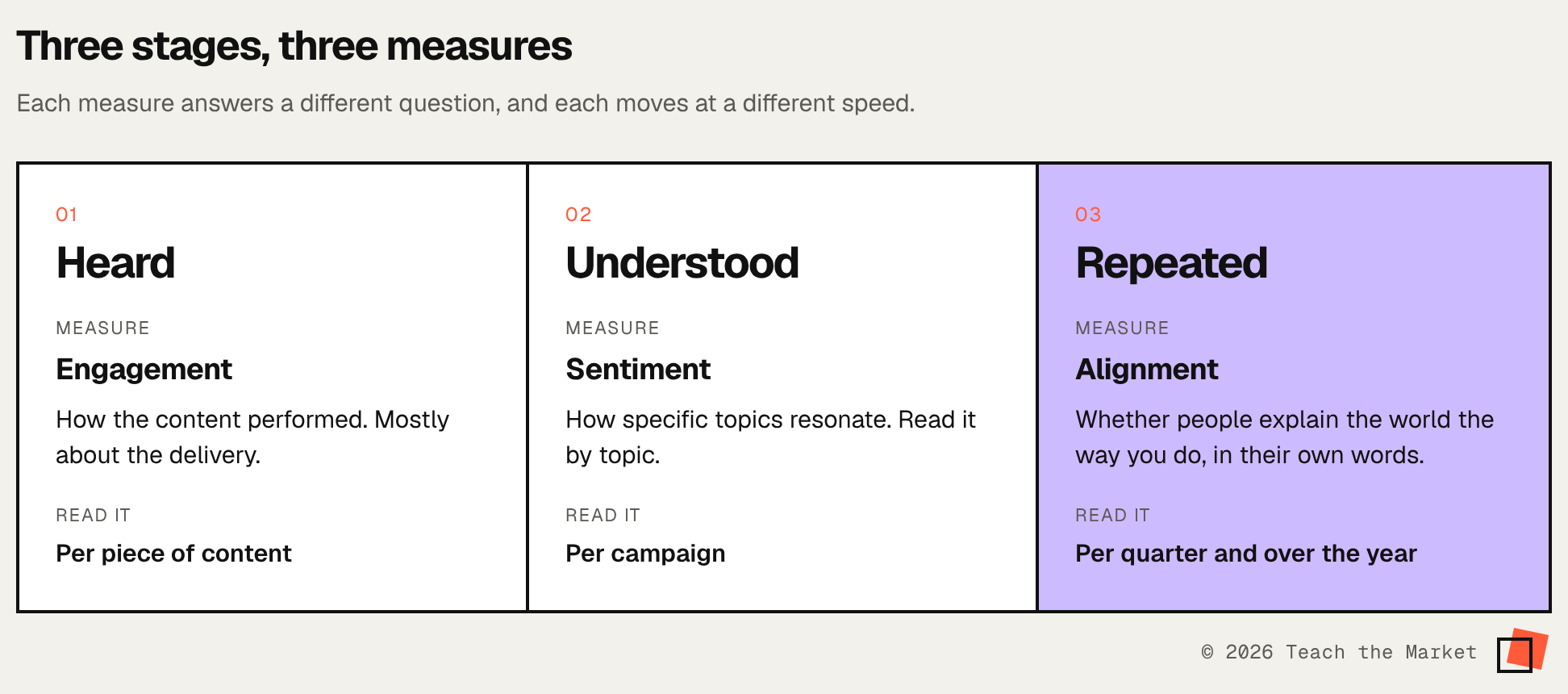
Measuring communications means checking whether your message was heard, understood and repeated, not just whether it was sent. Communications is how a company’s narrative reaches people, inside and outside the company. It works in three stages: people have to hear the message, understand the idea rather than just the words, and eventually repeat it in their own words.
Each stage has its own measure:
Heard → engagement. Did the content reach people, and did they pay attention?
Understood → sentiment. Do people react to the idea the way you intended, topic by topic?
Repeated → alignment. Over time, do people explain the world the way you do?
Most communications reporting stops at the first one. That’s the easiest to count and the least informative about whether the narrative is working.
What does engagement tell you?
Engagement tells you how a single piece of content performed: a little about the topic, and a lot about the delivery. High engagement usually means the format, timing, channel or headline worked. It doesn’t necessarily mean the idea landed, and low engagement doesn’t necessarily mean the idea is wrong. Use engagement to compare formats and channels, not to judge the narrative.
Ways to gather engagement:
Opens, clicks and reading time on internal email and internal news posts
Attendance, live questions and replay views for all-hands and town halls
Reactions, comments and shares on internal and external social posts
Press pickup and referral traffic after an announcement
The same message in two formats or channels, compared side by side
What does sentiment tell you?
Sentiment tells you how specific topics resonate: whether people react to each part of the story the way you intended. Read sentiment by topic, not as one overall score. A single score hides the useful information, which is which parts of the story are landing and which need work.
Ways to gather sentiment:
A short pulse survey after a campaign, with one or two topic questions such as “I understand why we’re making this change”
Questions from Q&As and town halls, tagged by topic
Recurring objections and questions in sales call notes
The tone of press coverage and social conversation on your topics
The questions analysts ask in briefings and inquiries
Questions are an underrated sentiment signal. When the same question keeps coming back, that part of the story isn’t clear yet.
What does alignment tell you?
Alignment tells you whether you’ve driven the narrative over time: whether customers, analysts, employees and candidates start explaining the world the way you do, in their own words. It’s the measure that matters most, because a narrative only works when it lives in other people’s heads. It also moves slowly. Expect to read alignment over months and quarters, not after one campaign.
Alignment is hard to read from numbers alone. Narratives live in people’s heads, so to know whether one is working you have to talk to people and listen for whether they describe what’s changing the way your narrative does. Ways to gather it:
Customer and prospect interviews. Ask them to describe what’s changing in their world, without prompting, and listen for your framing.
Win-loss conversations. Do buyers explain their decision the way your narrative would?
Analyst reports and inquiries. Is your view of the market showing up in theirs?
Explain-back. Ask managers and new hires to explain the strategy in their own words.
Press coverage and AI answers about your category. Check regularly whether they use your framing.
The signal to listen for isn’t your exact words coming back. It’s your idea coming back in theirs.
Where do B2B SaaS companies find these signals?
B2B SaaS companies already collect most of the raw material for sentiment and alignment; it’s just spread across teams. The most useful sources are usually:
Sales call recordings and CRM notes. What prospects ask, object to and repeat back.
Customer success conversations and business reviews. How existing customers describe what’s changing for them.
Win-loss interviews. How buyers explain their decision.
Support tickets and community forums. The questions customers ask after a launch or a change.
Analyst inquiries and reports. How the people who cover your category describe it.
Review sites and social conversation. The words customers use when you’re not in the room.
The work is less about collecting new data than about reading these sources against your narrative, regularly, and in one place.
Why is qualitative feedback measurable now?
Many communications measures are qualitative, and AI has made qualitative feedback much easier to aggregate and analyze at scale. Sentiment and alignment mostly live in words: questions people ask, comments, interview notes, call transcripts, the language analysts and journalists use. That used to make them hard to track beyond a handful of conversations.
With AI, you can:
Tag every town hall or Q&A question by topic, and see which topics keep coming up.
Summarize sentiment across hundreds of sales calls, topic by topic.
Compare how interviewees describe the market against your narrative, quarter after quarter, to see whether alignment is moving.
Qualitative doesn’t mean unmeasurable. It does mean you need to check the output: AI summaries are a starting point for reading the conversations, not a replacement for it. Spot-check the source material, and keep the categories stable over time so trends mean something.
How do you set up communications measurement?
Start from the narrative. Write down the few ideas you want people to understand and eventually repeat. These are what sentiment and alignment are measured against.
Choose one or two ways to gather each measure. You don’t need every method on the lists above. Pick ones you can repeat consistently.
Take a baseline. Before a campaign or a narrative change, record how people currently describe the topic. Without a baseline, you can’t see movement.
Read engagement per piece, sentiment per campaign, alignment per quarter. Each measure moves at a different speed.
Report the three together. High engagement with flat alignment means people are paying attention but not adopting the idea. That’s worth knowing.
Act on what you hear. If a topic keeps generating the same confused question, fix the story, not the dashboard.
What are the most common communications measurement mistakes?
Reporting only engagement, and calling it impact.
Judging an idea by one piece of content’s numbers, when engagement mostly reflects delivery.
One overall sentiment score instead of sentiment by topic.
No baseline, so there’s nothing to compare against.
Expecting alignment after one campaign. Narratives take time.
Trusting AI summaries without reading any of the source material.
Key takeaways
Measure communications at three levels: engagement (heard), sentiment (understood) and alignment (repeated).
Engagement says more about delivery than about the idea. Use it to compare formats and channels.
Read sentiment by topic, not as one score.
Alignment matters most. You hear it when you talk to people, and it moves over months.
AI makes qualitative feedback practical to analyze at scale, but check its output against the source.
Frequently asked questions
What are the most important communications KPIs?
The most important communications measure is alignment: whether, over time, people explain the world the way your narrative does. Sentiment by topic comes next, because it shows which parts of the story resonate. Engagement metrics like opens, attendance and shares are useful for improving delivery, but on their own they don’t show whether communications is working.
How do you measure internal communications?
Measure internal communications at the same three levels. Engagement covers opens, attendance and questions asked. Sentiment comes from pulse surveys and from questions in Q&As, tagged by topic. Alignment comes from explain-backs: asking managers and new hires to explain the strategy in their own words, and listening for where their version drifts from yours.
How long does it take to see results from communications?
Engagement shows up within days of a piece of content, and sentiment within a campaign. Alignment takes much longer: usually several months to a year before customers, analysts and employees consistently explain your market the way your narrative does. Measure each at its own pace, and don’t judge a narrative on a single quarter’s engagement numbers.
Can AI measure sentiment and alignment on its own?
AI can aggregate and analyze large amounts of qualitative feedback, such as Q&A questions, call notes and interview transcripts, and summarize sentiment and framing by topic. It shouldn’t be the only reader. Spot-check its summaries against the source material, keep categories consistent over time, and keep having the conversations yourself, because that’s where alignment is heard first.
Your next step
Pick the one idea from your narrative that matters most this year. Write down how customers, analysts and employees describe that topic today, from a handful of conversations, and save it as your baseline. Then decide how you’ll check it again in three months. For how measurement fits with campaigns, PR and analyst relations, see the practical guide to communications.
About the author
Lara George spent eight years at a hypergrowth B2B SaaS company. She joined at Series B and rose from product marketing manager to VP of Product Marketing and GTM Enablement. She launched a product that now drives 40% of revenue, helped grow the portfolio from one product to more than six, and ran analyst relations from start to finish. She’s also a recognized voice in communications and a frequent speaker at communications and tech industry events. Teach the Market is where she shares what she learned. More about Lara
