

Communications · A practical guide
How to get your narrative heard, understood and repeated.
For communicators, founders, and marketing people whose story gets announced once and then disappears.
The short answer
Communications is how your narrative, and to some extent your positioning, reaches people: inside and outside the company, online and in person. It works in three stages. People have to hear it, in the right order. They have to understand it, not just the words. And they have to repeat it, in their own words. Each stage has its own measure.
The test of communications is whether people explain the world the way you do, without you in the room.
First things first · AI and authenticity
Before you plan anything: decide what AI does, and what stays human.
Every principle on this page depends on one decision you should make first. In the age of AI, fluent words are cheap. What people trust is the sense that someone real means what they're saying. So let AI do the preparation, and keep the delivery human. The closer the relationship with an audience, the more that matters.
| Audience | Let AI help with | Keep it human |
|---|---|---|
| Employees | Drafting the long version and the FAQ from your source document; translating for regions and languages; tagging and summarizing the questions people ask | Leaders explaining the change in person, and answering the hard questions live |
| Customers | Adapting the narrative for each industry and segment; first drafts of customer communications; analyzing feedback and call notes | Conversations with the people they already know: their account team, their executive sponsor |
| Analysts | Rehearsing briefings with realistic questions; a first pass at mapping your story into the analyst's framework; summarizing past interactions | The briefing itself, and the judgment about which points to concede and which to defend |
| Press | Testing headlines against the “knew nothing about us” test; building rapid-fire question drills for spokespeople; monitoring coverage | The interview, and the relationship with the journalist |
| Executives on stage | Turning the source document into a cue sheet; rehearsal | The words on the day. There can be no script. |
| Social and thought leadership | Adapting one original idea into formats and channels; tracking sentiment by topic | The original thinking, the voice, and the replies when people start a conversation |
A useful rule: AI can help you get ready to talk to someone. It shouldn't do the talking where the relationship matters.
Heard
Get it to the right people, in the right order.
Measure: EngagementThink in campaigns, not announcements.
The biggest mistake in internal communications is treating strategy and change as one-off events: one all-hands, one email, done. People need to hear a message many times before it sticks. The old rule of thumb says seven.
So plan a sequence, not a moment. Decide who hears it first, what each group needs to understand, and how the message builds over the following weeks: the long version for managers, the questions people actually ask, a check-in once the dust settles.
And follow up afterwards. Most communication fails in the weeks after the announcement, not on the day. If nobody comes back to it, people assume it didn't matter.
Why internal communications needs campaigns, not announcements →
An announcement is a moment. A campaign is a sequence.
Illustrative six weeks of internal communications for one strategic change.
One announcement
Heard once
- Week 1All-hands
- …and then nothing
A campaign
Heard, understood, repeated
- Week 1All-hands
- Week 1Manager briefing
- Week 2FAQ and the long version
- Week 3Team Q&As
- Week 4Follow-up
- Week 6Check-in
Inside out. Insiders should feel like insiders.
Inside first.
A message should reach employees before it reaches anyone outside the company. Employees should feel like insiders. They shouldn't learn company news from a press release, a customer, or a social feed.
The same goes for launches and other big moments. Run them inside out: employees first, then customers, then analysts, then press, then social. Each circle hears it from you before it hears it from the next one out.
Nothing is ever only internal.
Inside first doesn't mean inside only. With sensitive information, the risk of a leak is real, so write every internal message as if it could be read outside.

Make the headline about the industry, not about you.
Unless you're one of the world's biggest brands, company-centric PR is wasted effort. The headline has to matter to the industry; the story about you comes second.
A simple test: if this were a headline and I knew nothing about our company, would it make sense? Would it feel relevant? Would it matter?
This is also where PR and thought leadership meet. Real thought leadership is newsworthy, because it says something about the industry that people haven't heard yet. A product update dressed up as news isn't.
The headline test: how to pitch PR when you're not a household name →
Understood
Make the idea land, not just the words.
Measure: SentimentThe long version inside, the short version outside.
Employees don't just need to know what's happening. They need to understand it well enough to explain it to someone else.
Give them the full reasoning: what's changing, why, and what it means for their work. The outside world gets the headline.
A keynote is a narrative tool, not a product pitch.
Build executive communications from the top-line story down: start with the narrative, then work forwards to the product. You can work backwards from the product, but only if you're using that work to discover your narrative.
A CEO keynote is one of the few moments when the whole market listens at once. Spend it on what's changing and what you believe about it. The product belongs in the story, as proof, not as the story.
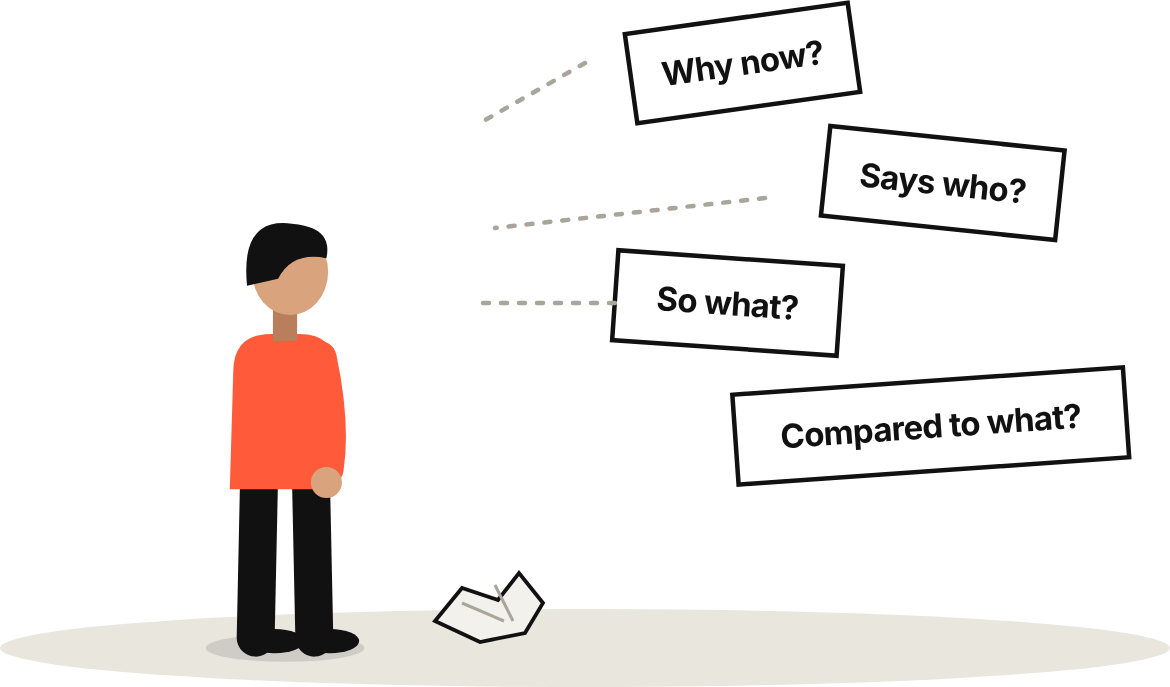
Rehearse out loud, never on paper.
Written briefings are rarely read and seldom internalized. Brief spokespeople in person, and practice with real interview questions, rapid fire.
It's the only way to find where someone's answers are strong and where they stumble, before a journalist finds it for them.
Rapid fire matters. A real interview doesn't wait for a considered answer, and the follow-up question is usually where a spokesperson goes off message. Practice the follow-ups as hard as the first questions.
AI can help here too. Give it a journalist's or an analyst's past coverage and have it fire questions at you. It's an approximation, not their actual thinking, but stumbling in practice shows you where the gaps are.
Analyst relations
Give analysts the depth the media never will.
Analysts cover a market in more depth than general media ever will, and they expect detail that high-level messaging doesn't reach. If PR and thought leadership work at the top of the funnel, analyst relations works in the middle and bottom. Treat analysts as people who understand and shape your market, not an audience for small talk.
Set the objective before the slides
Start with how the analyst sees you today: what they value, where they're skeptical, and what you want them to reinforce or reconsider.
Translate into their model
Your messaging is too shallow for an analyst. Map what you do into their framework of the market instead of repeating your slogan more forcefully.
Show where you start and stop
Vendors overestimate how central they are. Analysts see the whole ecosystem, so show what you do natively, where you integrate, and where you overlap.
Bring market observations, not logos
A big logo shows momentum. What that customer needed, and why they chose you, tells the analyst something. One deal isn't a trend.
Pick your battles
Concede legitimate points; it builds credibility. Defend what's fundamental to your strategy with conviction and evidence.
Meet challenges with curiosity
Ask what the analyst means and why. You'll learn how they see the market, and you'll sharpen your own explanation.
Keep each format for its job
Present your direction in a briefing. Ask for feedback in a follow-up inquiry. Keep briefings, inquiries, and advisory sessions distinct.
Prepare your executives
Brief them on the analyst's perspective, your history with them, how to explain your position, and what to avoid and why. They should understand the reasoning, not memorize forbidden phrases.
An illustrative example
A customer service platform calls itself the “front door” for every customer conversation. Analysts hear a claim to replace the systems agents already work in, and push back. Mapping the product into the analysts' own framework of the service stack, with what it does natively and where it integrates, replaces the slogan with a role they can evaluate.
Then bring what you hear back inside. Synthesize analyst feedback into the planning cycle rather than passing on isolated comments, and turn abstract recommendations into something leaders can assess. Analysts' recommendations are inputs; product leadership decides. Your framing for analysts can differ from your sales messaging, because their context is different, but it has to describe the same product and strategy, with no contradictory claims.
There can be no script.
Scripts are for messaging, and they focus on wording. Executives should understand the narrative well enough to tell it in their own words. In the age of AI, own words are what make it authentic.
If the story needs to flow a certain way, use a cue sheet instead: the key points to make, not the words to say. A good cue sheet fits on one page: what's changing, what we believe, why it matters to this audience, and one story that shows it.
The same applies to everyone who carries the narrative, not just executives. Give people the argument and the points, and let them say it their way.
Cue sheets, not scripts: how to prepare an executive keynote →
Repeated
Get other people telling it in their own words.
Measure: AlignmentA script
Words to say.
A cue sheet
- What's changing in our customers' world
- What we believe about it
- Why it matters to this audience
- One story that shows it
Points to make, in your own words.
Use AI to translate, not to invent.
AI can do much of the work of adapting your narrative for every channel and audience, if it has a good source document to work from: the core narrative, the principles that never change, the proof behind each claim, the language to use and avoid, and notes on each audience.
What it can't do is supply the point of view. Give it the argument you own, then check regularly for drift: contradictions between what your executives, your website, your sales team, and your investor materials are saying.
Thought leadership needs people with something to say.
Find people who genuinely understand the industry or the product. Others can adapt and amplify their ideas, but original thinking has to come from more than one person. No one is as creative as a team.
Take the topics from your narrative, and give specific people their own sub-narrative to carry. One person might own what's changing for frontline teams, another the shift in how buyers evaluate tools.
Their ideas can then be adapted and delivered by others for reach. But the original thinking has to exist first.
Aim for a conversation, not a sale.
Promotion sits close to go-to-market and usually has something to sell. Thought leadership is a vehicle for your narrative, and narratives live in people's heads.
Its job is to get people asking questions and thinking. A narrative doesn't land if nobody has thought about it.
Why most thought leadership programs start in the wrong place →
A tool you can use today
Before you announce anything
Nine questions to run through before a launch, a change, or a big moment. Any question you can't answer is where to start.
- 01Is it a campaign? What happens in the weeks after the announcement?
- 02Inside first? Will employees hear it before customers, analysts, press, and social?
- 03Could it survive a leak? Would the internal version hold up if it were read outside?
- 04Does the headline pass the test? Would it matter to someone who knows nothing about you?
- 05Is the long version ready? Can employees explain it to someone else?
- 06Has the spokesperson rehearsed out loud? In person, with real questions, rapid fire?
- 07Cue sheet, not script? Will the speaker tell it in their own words?
- 08Does AI have the source document? If AI is helping adapt the message, is it working from your argument, not guessing?
- 09How will you know it worked? Engagement now, sentiment soon, alignment over time.
Frequently asked questions about communications
-
Messaging is what you say to make your narrative and positioning clear and compelling. Communications is how you carry it to every audience and context: internal and external channels, digital and in person, over time. Messaging is about the words; communications is about getting the idea heard, understood, and repeated.
-
Yes. A message should reach employees before it reaches anyone outside the company, so they feel like insiders rather than learning news from a press release. Write that internal version as if it could leak, because sensitive information often does.
-
Most often because strategy and change are communicated as one-off events instead of campaigns. People need to hear a message many times before it sticks, and without follow-up the message fades. Employees also need the full reasoning, so they can explain it to someone else.
-
No. Scripts focus on wording; executives should understand the narrative well enough to tell it in their own words, which is what makes it sound authentic. If the story has to flow a certain way, give them a cue sheet: the key points to make, not the words to say.
-
PR and thought leadership overlap: real thought leadership is newsworthy, and good PR leads with what matters to the industry. Analyst relations is different. Analysts expect far more depth than the media, so it works in the middle and bottom of the funnel rather than the top.
-
Use three measures. Engagement shows how individual content performed, mostly about delivery. Sentiment shows how specific topics resonate. Alignment shows whether, over time, people explain the world the way your narrative does, and it matters most.
-
In three ways: translating your narrative for each audience from a good source document, rehearsing spokespeople and executives with realistic questions, and aggregating qualitative feedback such as Q&A questions, call notes, and interview transcripts. What it can't do is supply the point of view, or make an executive sound like themselves. That still takes their own words.
-
Analyst relations is substantive engagement with the people who understand and shape your market. Analysts expect more depth than the media and more than your messaging offers, so translate your argument into their model of the market, show where your product starts and stops, and bring real observations about what customers need.
-
Promotion is close to go-to-market and usually has something to sell. Thought leadership is aimed at a conversation: it's a vehicle for your narrative, and its job is to get people asking questions and thinking. A narrative doesn't land if nobody has thought about it.