

Internal Communications for B2B SaaS: How to Communicate Change to Employees
The short answer: To communicate change to employees at a B2B SaaS company, run a campaign, not an announcement. Tell employees before anyone outside the company, give them the full reasoning rather than the headline, and plan how the message builds over the following weeks: manager briefings, the long version, the questions people actually ask, and a check-in once the dust settles. A change has been communicated when employees can explain it to someone else, not when the all-hands is over.
This guide is for founders, communicators and marketing leaders at B2B SaaS and tech companies. It covers why one-off announcements fail, how to plan an internal communications campaign, and how to tell whether it worked. It’s part of the practical guide to communications for B2B SaaS.
What is an internal communications campaign?
An internal communications campaign is a planned sequence of messages that takes employees from hearing about a change to understanding it well enough to explain it. Instead of one all-hands and one email, it spreads the message across several moments, formats and messengers over a few weeks, and each step builds on the one before.
The difference from an announcement is the goal. An announcement aims to inform: people know something happened. A campaign aims at understanding: people know what’s changing, why, and what it means for their work, and they can say it in their own words.
Why does internal communications matter so much at a B2B SaaS company?
B2B SaaS companies change direction often, and their employees have to explain every change to customers. Pricing and packaging changes, a repositioning, a new AI strategy, a reorganization, a major product launch: in a growing SaaS company, several of these can land in the same year. Each one changes what sellers, customer success managers and support teams say to customers the next day.
That makes internal communications a go-to-market issue, not just an HR one. If account teams don’t understand why packaging changed, customers hear a confused explanation. If engineers and product managers don’t understand a new strategy, the roadmap drifts from the story the company is telling the market. Communicating a change well inside the company is how it reaches customers in a form you’d recognize.
Why do one-off announcements fail?
One-off announcements fail because people need to hear a message many times before it sticks, and an announcement only says it once. The common rule of thumb says seven times. Treat the number as a heuristic, not research, but the pattern behind it is familiar to anyone who has run a reorganization or a strategy change: the all-hands goes well, and three weeks later half the company is still asking what it means.
Announcements also tend to stop at the moment they should be starting. The biggest mistake in internal communications is treating strategy and change as events instead of sequences, and not following up afterwards. Most of the real work happens in the weeks after the announcement:
Managers get questions they can’t answer, because they heard the news at the same time as their teams.
Rumors fill the gaps that the announcement left open.
People assume it didn’t matter, because nobody came back to it.
If a change is important enough to announce, it’s important enough to repeat.
Who should hear it first?
Employees should hear about a change before anyone outside the company. They should feel like insiders. Few things undermine trust faster than an employee learning company news from a press release, a customer or a social feed.
For launches and other big moments, run the sequence inside out: employees first, then customers, then analysts, then press, then social. Each circle hears it from you before it hears it from the next one out.
Within the company, managers usually need to hear it shortly before their teams. A manager who is surprised in the same meeting as everyone else can’t help anyone make sense of it.
Inside first doesn’t mean inside only. With sensitive information, the risk of a leak is real, so write every internal message as if it could be read outside. That doesn’t mean writing it vaguely. It means making sure nothing in it would embarrass the company, contradict what you’ll say publicly, or surprise a customer who happened to see it.
What should employees get that the outside world doesn’t?
Employees should get the long version: the full reasoning behind the change, not just the headline. The outside world gets the short version. A useful way to think about it: the long version inside, the short version outside.
The long version answers the questions people actually have:
What’s changing, and what isn’t?
Why now? What’s happening in the market or the business that made this necessary?
What does it mean for my team and my work?
What do we need from people, and by when?
Where do I go with questions?
The test is simple. Could an employee explain the change to a customer or a candidate, in their own words? If not, they’ve heard it, but they haven’t understood it.
How do you plan an internal communications campaign?
Write the long version first. Before you plan any channel, write the full reasoning in one document: what’s changing, why, what it means for each group, and what you need from people. Everything else in the campaign is drawn from it, which keeps every message consistent.
Decide the order. List who needs to hear it and in what sequence: leadership, then managers, then all employees, then the outside world. Give managers enough lead time to digest it and prepare for their teams’ questions.
Plan the first moment for understanding, not just news. An all-hands or town hall should explain the reasoning, not only the decision, and leave real time for questions.
Equip managers. Brief them in person on the long version and the hard questions they’re likely to get. Managers are where most employees actually make sense of a change.
Publish the long version and an FAQ. Make the full reasoning easy to find, and build the FAQ from questions people really ask, not the ones you’d like them to ask.
Follow up in smaller settings. Team Q&As, skip-levels and short updates in the weeks after the announcement give people a second and third chance to understand it.
Check in once the dust settles. A few weeks later, come back to it: what’s happened since, what you’ve heard, and what’s still open. This is the step most campaigns skip, and the one that tells people it mattered.
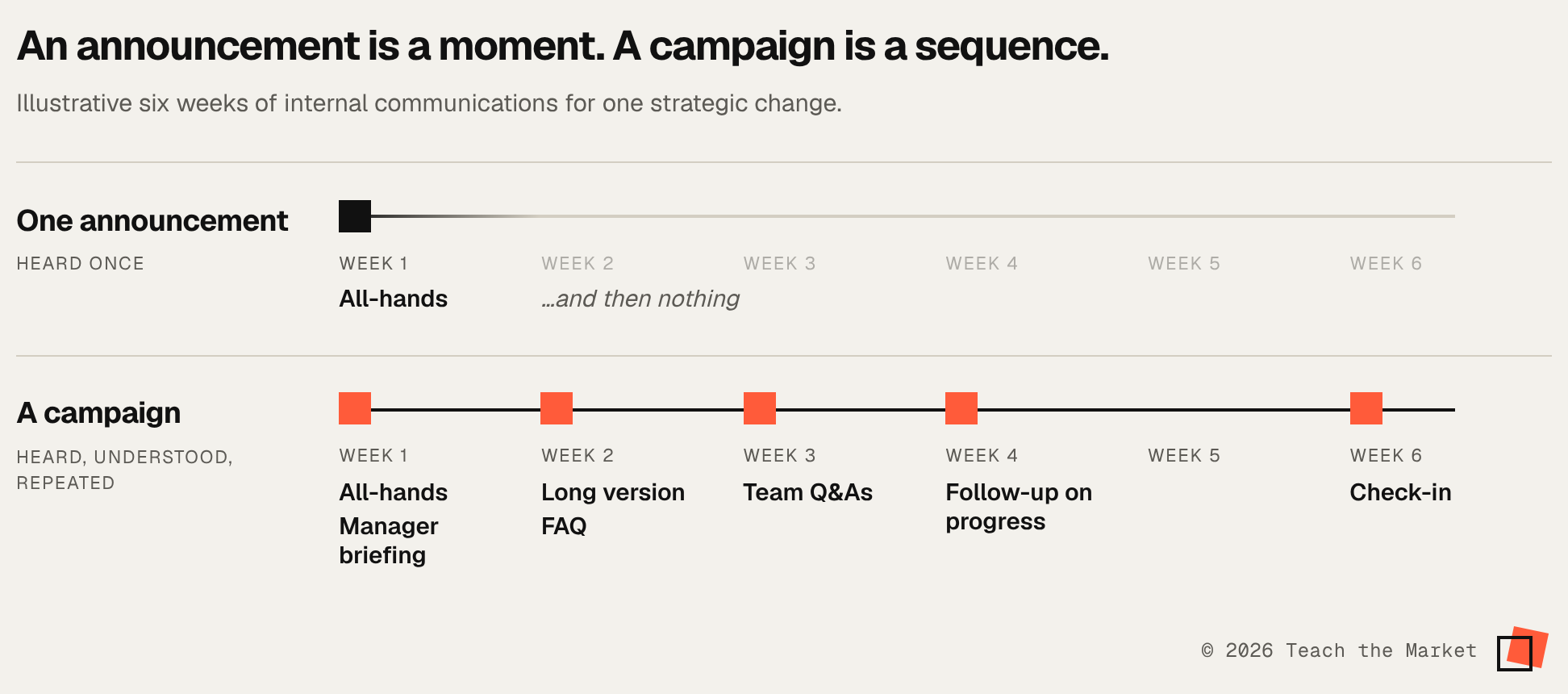
A six-week campaign for a strategy change might look like this, as an illustration: an all-hands and a manager briefing in week one, the long version and the FAQ in week two, team Q&As in week three, a follow-up on progress in week four, and a check-in in week six.
Where can AI help with internal communications?
AI can help with much of the preparation, but the delivery of a change should stay human. Given a good source document, AI can draft the FAQ and adapted versions for different teams, translate for regions and languages, and tag and summarize the questions people ask in Q&As and surveys, which makes it far easier to see what isn’t landing.
What employees need from leaders is the sense that someone real means what they’re saying. Leaders explaining the change in person, and answering the hard questions live, is the part AI shouldn’t do. A useful rule: AI can help you get ready to talk to someone. It shouldn’t do the talking where the relationship matters.
How do you know whether the campaign worked?
A campaign worked when employees can explain the change in their own words, not when people opened the email. Engagement numbers tell you whether the delivery worked: open rates, attendance, questions asked. They tell you much less about whether the idea landed.
To check understanding, listen:
Tag the questions from Q&As by topic. If the same question keeps coming back, that part of the story isn’t clear.
Run a short pulse survey after the campaign with one or two topic questions, such as “I understand why we’re making this change.”
Ask for an explain-back. Ask a few managers and new hires to explain the change in their own words, and listen for where their version drifts from yours.
For the full picture, see how to measure communications.
What are the most common internal communications mistakes?
Announcing and moving on. One moment, no follow-up.
Telling the outside world first, or at the same time.
Surprising managers in the same meeting as their teams.
Sharing the decision but not the reasoning, so people can repeat what happened but not why.
Writing internal messages that wouldn’t survive a leak.
Measuring opens and attendance and calling it understanding.
Key takeaways
Communicate change as a campaign, not a one-off announcement. People need to hear a message many times before it sticks.
Inside first: employees should hear news before customers, analysts, press and social.
Give employees the long version, with the full reasoning. The outside world gets the short version.
Write internal messages as if they could be read outside.
The campaign worked when employees can explain the change to someone else.
Frequently asked questions
How long should an internal communications campaign run?
An internal communications campaign for a significant change usually runs for several weeks rather than days. Four to eight weeks is a reasonable starting point for a strategy change or reorganization: long enough for an announcement, manager briefings, follow-up Q&As and a check-in. Smaller changes need shorter campaigns, but they still need more than one moment.
Who should deliver internal communications about a change?
The leader who owns the change should explain it first, in person where possible, because employees want to hear the reasoning from someone accountable for it. Managers then carry it into their teams, which is why they need to hear it first and get the long version. Communications teams plan and support the campaign, but they shouldn’t be the only voice.
What if the news leaks before employees hear it?
If news leaks before an internal announcement, tell employees as quickly as you can, acknowledge that they may have already heard it, and give them the full reasoning. Then review why it leaked. Writing internal messages as if they could be read outside reduces the damage, because a leaked message that holds up publicly is far less harmful than one that doesn’t.
Should internal and external messages say the same thing?
Internal and external messages should never contradict each other, but they don’t need to be the same length. Employees get the long version, with the full reasoning and what it means for their work. Customers, press and the market get the short version. Both have to describe the same change, the same reasons and the same direction.
Your next step
Take the next change you need to announce and write the long version before anything else: what’s changing, why, what it means for each team, and what you need from people. Then map who hears it in what order, and put the check-in in the calendar now, so it actually happens. For how this fits with launches, PR and analyst relations, see the practical guide to communications.
About the author
Lara George spent eight years at a hypergrowth B2B SaaS company. She joined at Series B and rose from product marketing manager to VP of Product Marketing and GTM Enablement. She launched a product that now drives 40% of revenue, helped grow the portfolio from one product to more than six, and ran analyst relations from start to finish. She’s also a recognized voice in communications and a frequent speaker at communications and tech industry events. Teach the Market is where she shares what she learned. More about Lara
