

B2B SaaS PR: How to Write a Press Release Headline When You're Not a Household Name
The short answer: Unless your B2B SaaS company is one of the world’s biggest brands, write the press release headline about the industry, not about your company. Before you pitch anything, run the headline test: if this were a headline and I knew nothing about our company, would it make sense, would it feel relevant, and would it matter? If the answer is no, the story isn’t ready. Lead with the shift, the finding or the problem your market cares about, and let your company be the source of the story rather than its subject.
This guide explains why company-centric PR rarely works for B2B SaaS companies, how to use the headline test, and how to turn an announcement into a story a journalist can use. It’s part of the practical guide to communications for B2B SaaS.
What is the headline test?
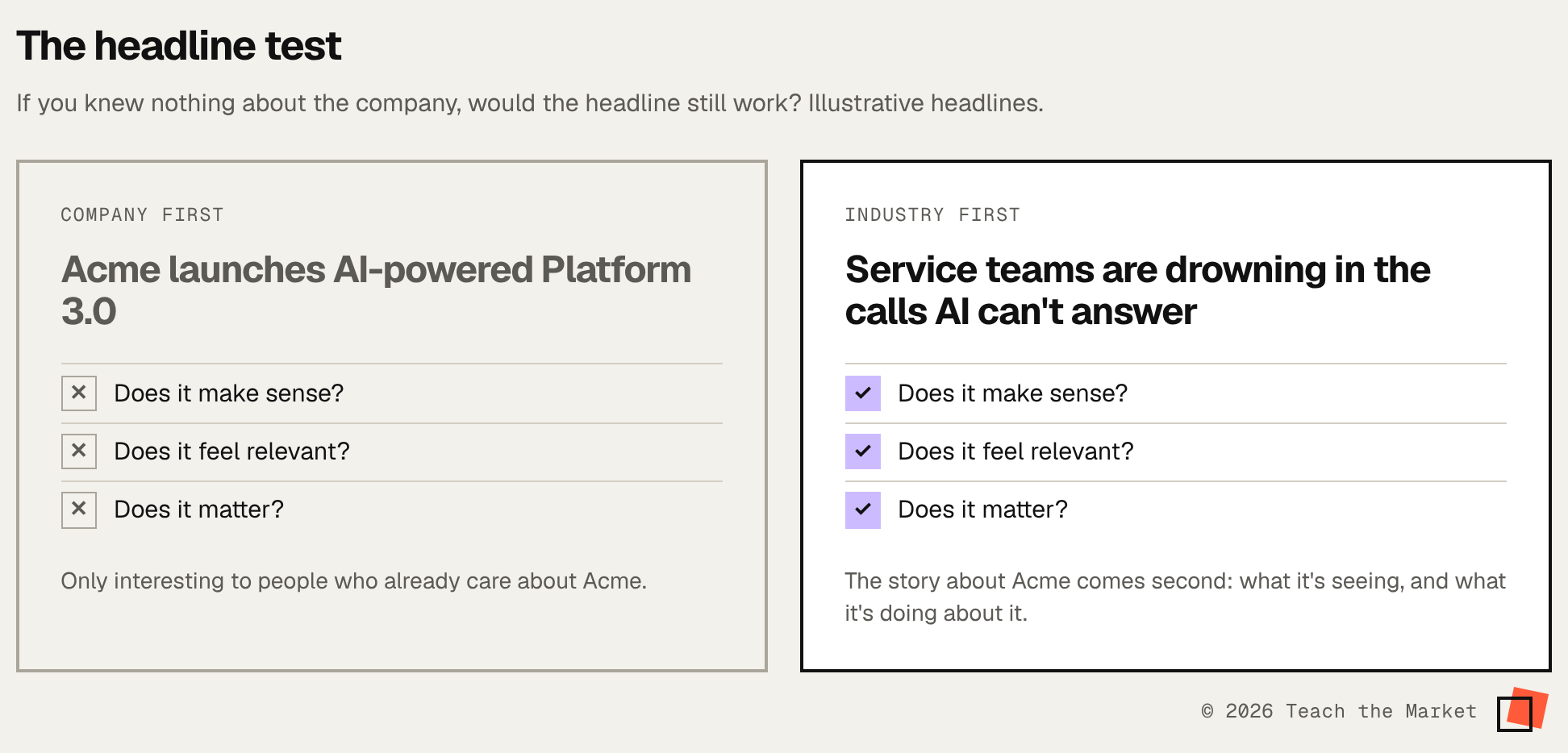
The headline test is a quick check of whether a PR story matters to anyone outside your company. Read the headline as if you’d never heard of the company and ask three questions:
Would it make sense? Can someone with no context understand what it’s about?
Would it feel relevant? Does it touch something the reader already cares about in their industry or job?
Would it matter? Does it tell them something new, or change how they see a problem?
A headline that only works if you already know and care about the company fails the test. Most product announcements do.
Why doesn’t company-centric PR work for B2B SaaS companies?
Company-centric PR doesn’t work for most B2B SaaS companies because journalists and readers care about their industry, not about your company. A Fortune 100 brand can make news by launching a product, because its moves affect a whole market. The vast majority of B2B SaaS companies can’t. For them, a headline like “Company X launches version 4.0” is wasted effort: it means nothing to a reader who doesn’t already follow the company, and those readers aren’t the ones you need to reach.
This is especially true in B2B tech. Trade and business journalists receive a steady stream of near-identical SaaS announcements: new AI features, new integrations, new versions, new partnerships. “AI-powered” in a headline no longer distinguishes anyone. What gets a SaaS company covered is having something to say about the industry its customers work in.
The story about you still matters. It just comes second. The industry story earns the attention; your company earns its place in that story by being the one with the data, the customer evidence or the point of view.
What makes a story relevant to the industry?
A story is relevant to the industry when it says something about a shift, a problem or a pattern that people in that industry recognize. The strongest PR stories usually have one of these at their core:
A shift in the market. Something is changing for buyers, teams or customers, and you can explain what and why.
New evidence. Data from your platform, a survey or your customers that shows a pattern nobody has quantified yet.
A point of view worth arguing with. A clear position on a question the industry is debating.
A customer story with a wider lesson. Not “customer chose us”, but what that customer learned that others can use.
This is where PR and thought leadership meet. Real thought leadership is newsworthy, because it says something about the industry that people haven’t heard yet. If your company has a strategic narrative, the best PR stories usually come straight out of it: the narrative names what’s changing in your market, and each story adds a piece of evidence.
How do you rewrite a company-centric headline?
Rewrite a company-centric headline by finding the industry problem the announcement responds to, and putting that first. Take an illustrative customer service software company, Acme, announcing a new version of its platform with AI features.
Company-centric: “Acme launches AI-powered Platform 3.0”
Industry first: “Service teams are drowning in the calls AI can’t answer”
With evidence: “[X]% of service calls are ones AI can’t resolve, new data from [number] service teams shows” (fill in your own data; a real number is what makes this version work)
The product doesn’t disappear. It becomes the proof in the story: the journalist writes about what’s changing for service teams, and Acme comes second, as the source with the data and what it’s doing about it.
Here’s a simple process for any announcement:
Write the company-centric headline first, so you know what you’re tempted to say.
Ask what problem it responds to. What’s happening in the market that made this worth building or doing?
Ask who else cares about that problem. Buyers, practitioners, investors, the trade press?
Find the evidence. Data, customer stories or a clear point of view that makes the industry story credible.
Rewrite the headline about the problem or the shift, and run the headline test again.
Put the company second, in the body, as the source of the evidence.
Where does PR fit in a launch?
PR comes late in a launch sequence, after the people closest to you have heard the news. Run launches inside out: employees first, then customers, then analysts, then press, then social. Insiders should feel like insiders, and no employee or customer should learn the news from a journalist.
Analysts are different from press. Analysts cover a market in far more depth than general media, and they expect detail that a press release won’t reach. If PR and thought leadership work at the top of the funnel, analyst relations works in the middle and bottom. Brief them separately, with the depth they need.
Can AI help with PR headlines?
AI is useful for testing headlines, as long as you give it the context it lacks. Ask it to read a headline as someone who knows nothing about your company and explain what the story is about and why it matters. If its answer is vague or wrong, the headline probably is too. AI can also help draft variations, summarize coverage and spot which angles a publication tends to pick up.
What AI can’t supply is the story itself. The shift you’re describing, the evidence behind it and the point of view have to come from you.
What are the most common PR mistakes for B2B SaaS companies?
Announcing features as news. A feature is rarely a story on its own.
Leading with the company name. Unless the name is news, it’s the least interesting part.
Claims without evidence. “Leading” and “revolutionary” don’t make a story credible. Data and customers do.
Pitching press before employees and customers know.
Treating analysts like press. Analysts need depth, not a press release.
Key takeaways
Unless you’re one of the biggest brands in the world, write the headline about the industry, not about you.
Use the headline test: if you knew nothing about the company, would it make sense, feel relevant and matter?
The best PR stories come from a shift, new evidence, a point of view or a customer lesson.
Make your company the source of the story, not its subject.
In a launch, press comes after employees, customers and analysts.
Frequently asked questions
Should a press release ever lead with the company name?
A press release can lead with the company name when the company itself is the news: a major brand, an acquisition, a funding round that matters to the market, or a leadership change. For most B2B SaaS announcements, the name isn’t what earns attention. Lead with what’s changing in the industry and introduce the company as the source.
Are product launches newsworthy?
Product launches are newsworthy when they reflect something bigger than the product: a shift in how a market works, a problem many companies share, or evidence nobody had before. A launch framed as “we released new features” rarely interests journalists. The same launch framed around the problem it responds to, with data or customer evidence, often does.
How is PR different from analyst relations?
PR aims at broad attention through the media, so it needs stories that matter to a whole industry and can be told briefly. Analyst relations is deeper and more substantive: analysts evaluate how a market is evolving and expect far more detail than a press release. PR and thought leadership work at the top of the funnel; analyst relations works in the middle and bottom.
Where do good PR story ideas come from?
Good PR story ideas usually come from your strategic narrative: what’s changing in your market and what you believe about it. Each story then adds evidence to that argument, through platform data, customer lessons or a clear point of view. Sales calls, support conversations and analyst questions are also good sources, because they show which problems people already care about.
Your next step
Take your last three press releases and run the headline test on each: would they make sense, feel relevant and matter to someone who knew nothing about your company? For any that fail, write down the industry problem the announcement responded to, and rewrite the headline around it. For how PR fits with internal communications, analysts and thought leadership, see the practical guide to communications.
About the author
Lara George spent eight years at a hypergrowth B2B SaaS company. She joined at Series B and rose from product marketing manager to VP of Product Marketing and GTM Enablement. She launched a product that now drives 40% of revenue, helped grow the portfolio from one product to more than six, and ran analyst relations from start to finish. She’s also a recognized voice in communications and a frequent speaker at communications and tech industry events. Teach the Market is where she shares what she learned. More about Lara
