

How to Prepare a B2B SaaS Spokesperson for a Media Interview
The short answer: Prepare a B2B SaaS spokesperson, whether that’s the founder, the CEO or a product leader, in person, out loud, with real questions fired at them rapid fire. Don’t rely on a written briefing: briefings are rarely read and seldom internalized. Brief them on the story and the few points that matter, then practice the questions they’re likely to get, the follow-ups, and the questions they’d rather not get. Rapid-fire practice is the only way to find where their answers are strong and where they stumble, before a journalist does.
This guide covers why written briefings fail, how to run a spokesperson rehearsal, and how AI can help you prepare. The same approach works for analyst briefings and panel appearances. It’s part of the practical guide to communications for B2B SaaS.
What does spokesperson preparation involve?
Spokesperson preparation is the work of getting someone ready to represent the company in an interview: understanding the story, knowing the points to make, and practicing the answers under realistic pressure. It’s often called media training, but for a specific interview it’s less about general technique and more about rehearsal: this story, this journalist, these questions.
Good preparation has two parts. The briefing makes sure the spokesperson understands the story well enough to tell it in their own words. The rehearsal tests whether they can do it when someone is asking questions they didn’t expect.
Who usually speaks for a B2B SaaS company?
At most B2B SaaS companies, the spokespeople are the founder or CEO, a few senior leaders, and product or subject-matter experts. They speak to trade and business press, on podcasts and webinars, at industry events and in analyst briefings, often alongside a full-time job that has nothing to do with media.
That shapes how they need to be prepared. Tech spokespeople are usually expert in the product and close to the detail, which is a strength in an interview and also a risk: it’s easy to answer with features when the journalist asked about the market. And the questions SaaS spokespeople get are predictable enough to practice: what AI changes in your category, how you compare with larger competitors, what your customers are doing differently, and what your funding or growth says about the market.
Why don’t written briefings work?
Written briefings don’t work because spokespeople rarely read them closely, and reading a briefing isn’t the same as being able to answer a question. Busy executives skim a briefing document on the way to the interview, if they open it at all. Even a careful reader only learns what the answers are. They don’t find out whether they can give those answers, in their own words, under pressure.
The gaps only show up when someone speaks. A spokesperson who has read that the company “is the conversation layer of the service stack” may not be able to explain what that means when a journalist asks, and they won’t know it until the question comes. That’s why preparation has to happen out loud.
A short written summary is still useful as a reference after the rehearsal. It just can’t replace the rehearsal.
How do you brief a spokesperson?
Brief a spokesperson in person, and focus on the story and its reasoning rather than on phrases to memorize. Cover:
The story. What’s changing in the industry, what the company believes about it, and where this announcement or topic fits.
The few points that matter. Two or three things the spokesperson should make sure come across, whatever they’re asked.
The proof. The data, customer examples and facts behind each point.
The journalist and the outlet. What they’ve covered recently, how they tend to approach a story, and who reads them.
The difficult territory. Topics to expect questions on: competitors, recent news, numbers you can’t share, and what to say when you can’t answer.
What not to say, and why. Explain the reasoning, so the spokesperson can make judgment calls rather than avoid a list of forbidden words.
The goal is understanding, not memorization. A spokesperson who understands the story can handle a question nobody predicted. One who memorized lines can only recite them.
How do you run a rapid-fire rehearsal?
Run a rehearsal by firing realistic questions at the spokesperson, quickly and without warning, the way a real interview works. A real interview doesn’t wait for a considered answer, and the follow-up question is usually where a spokesperson goes off message.
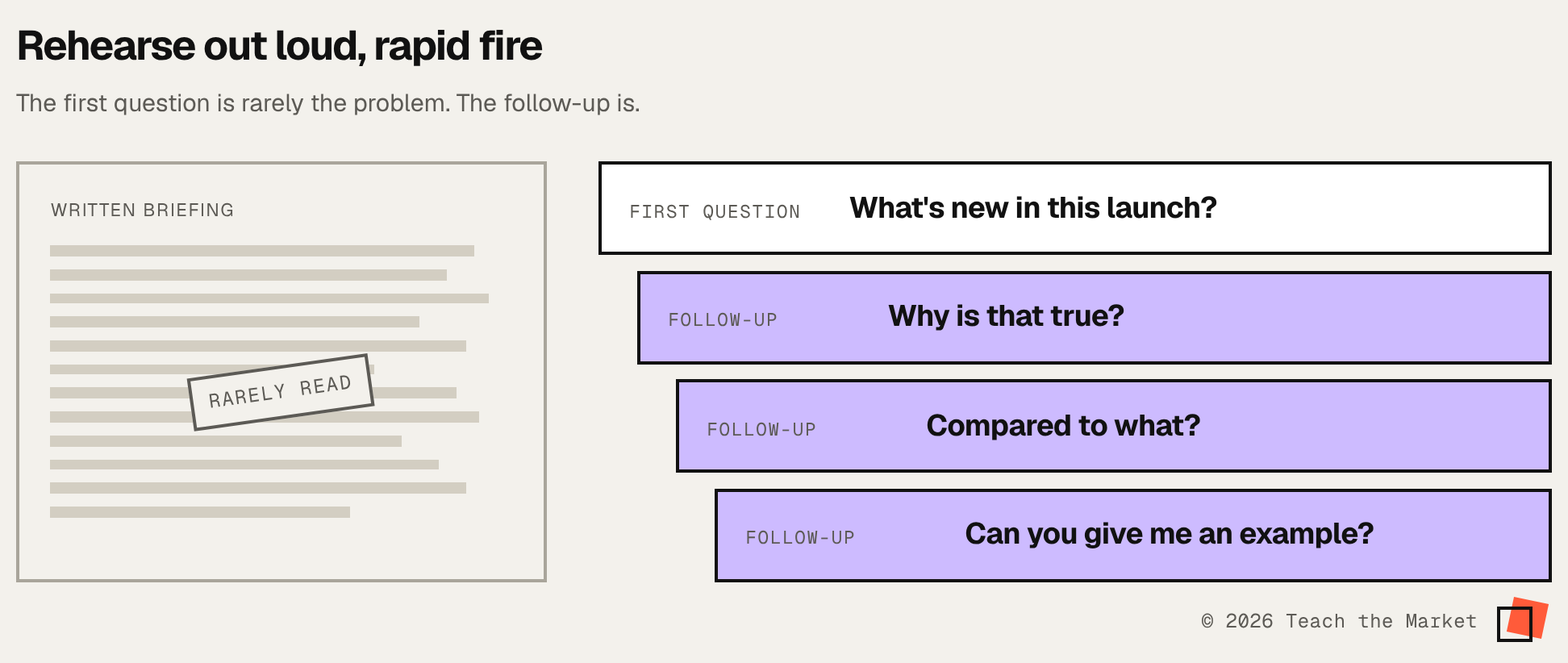
Write the question list. Start with the obvious questions, then add the ones the spokesperson would rather not get. Include questions that aren’t about the announcement at all: the market, competitors, recent news.
Write the follow-ups. For each answer they’re likely to give, add the next question: “Why is that true?”, “Compared to what?”, “Can you give me an example?”, “What does that mean in practice?”
Rehearse in person, rapid fire. Ask the questions quickly, mix up the order, interrupt occasionally, and don’t accept a vague answer. Have someone play the journalist who doesn’t know the company.
Stop at the stumbles. When an answer goes wrong, pause and work out why: a gap in understanding, a missing proof point, or a question with no good answer yet. Fix the substance, not just the wording.
Run it again. Repeat the hardest questions until the answers come easily and sound like the spokesperson, not like a briefing document.
Practice the bridge back. When a question goes somewhere unhelpful, the spokesperson should answer it honestly and then connect back to a point that matters. Practice it, because a clumsy bridge sounds evasive.
Plan for at least one full rehearsal for an important interview, and a short warm-up on the day if you can.
How can AI help prepare a spokesperson?
AI can help you prepare more realistic questions and give the spokesperson extra practice, but it can’t replace a person in the rehearsal. Useful ways to use it:
Generate questions from past coverage. Give AI a journalist’s or an analyst’s recent articles and ask it to draft the questions they’d likely ask about your story. It’s an approximation, not their actual thinking, but it often surfaces angles you hadn’t considered.
Drill follow-ups. Ask AI to play an interviewer who pushes back on every answer with “why?” or “compared to what?” A spokesperson can practice alone between rehearsals.
Find the weak points. Paste in the rehearsal answers and ask where they’re vague, unsupported or inconsistent.
What stays human is the rehearsal partner who knows the company, the judgment about what to fix, and the interview itself.
What are the most common spokesperson preparation mistakes?
Sending a briefing document instead of rehearsing.
Practicing only the easy questions. The difficult ones are where interviews go wrong.
Skipping the follow-ups. First answers are usually fine. The second and third questions are where spokespeople drift.
Scripting answers. Memorized lines sound memorized, and they break as soon as the question changes.
Rehearsing too late. Leave time to fix gaps in the substance, not just the delivery.
No debrief. After the interview, note which questions came up and how the answers landed, so the next preparation is better.
Key takeaways
Don’t rely on written briefings. Prepare spokespeople in person and out loud.
Brief the story and its reasoning, so the spokesperson can answer in their own words.
Rehearse with real questions, rapid fire, including the follow-ups and the questions they’d rather not get.
Fix the substance behind a stumble, not just the wording.
Use AI to draft questions and drill follow-ups, but keep a person in the rehearsal.
Frequently asked questions
How long does it take to prepare a spokesperson for an interview?
For an important interview, plan for an in-person briefing and at least one full rehearsal, which together often take an hour or two, plus a short warm-up on the day. The time depends on how familiar the spokesperson is with the story. Leave a few days between rehearsal and interview, so you can fix gaps in the substance.
Should a spokesperson memorize key messages?
A spokesperson should know the two or three points that must come across, but not memorize phrases. Memorized lines sound rehearsed, and they break down as soon as a question comes from an unexpected angle. A spokesperson who understands the reasoning behind each point can make it in their own words, whatever the question.
Who should play the journalist in a rehearsal?
The best rehearsal partner is someone who knows the story and the company well enough to ask hard questions, but who can play a journalist who doesn’t. Communications or PR leads often take this role. A colleague the spokesperson doesn’t report to is useful, because they’re more likely to push back on a vague answer.
Does the same preparation work for analyst briefings?
The same principles work for analyst briefings: brief in person, rehearse out loud, and practice the follow-ups. Analyst conversations go deeper than most interviews, though. Analysts expect detail about how the product fits their model of the market, where it starts and stops, and what customers need, so preparation should cover that depth.
Your next step
Before your next interview, replace the briefing document with a 45-minute rehearsal. Write ten questions, including three your spokesperson would rather not get, add a follow-up to each, and fire them rapid fire. Note every stumble and fix what’s behind it. For how spokesperson prep fits with PR, keynotes and analyst relations, see the practical guide to communications.
About the author
Lara George spent eight years at a hypergrowth B2B SaaS company. She joined at Series B and rose from product marketing manager to VP of Product Marketing and GTM Enablement. She launched a product that now drives 40% of revenue, helped grow the portfolio from one product to more than six, and ran analyst relations from start to finish. She’s also a recognized voice in communications and a frequent speaker at communications and tech industry events. Teach the Market is where she shares what she learned. More about Lara
