

How to Prepare a B2B SaaS Keynote: Cue Sheets, Not Scripts
The short answer: Build a B2B SaaS executive keynote from the narrative down, not from the product up, and don’t write a script. Scripts focus on wording; an executive should understand the story well enough to tell it in their own words, which is what makes it sound authentic. If the talk needs to flow a certain way, give the speaker a cue sheet instead: one page with the key points to make, in order, and the proof behind each, not the words to say.
This guide covers how to structure a CEO or executive keynote, why scripts work against you, and how to build and rehearse with a cue sheet. It’s part of the practical guide to communications for B2B SaaS.
What is a cue sheet?
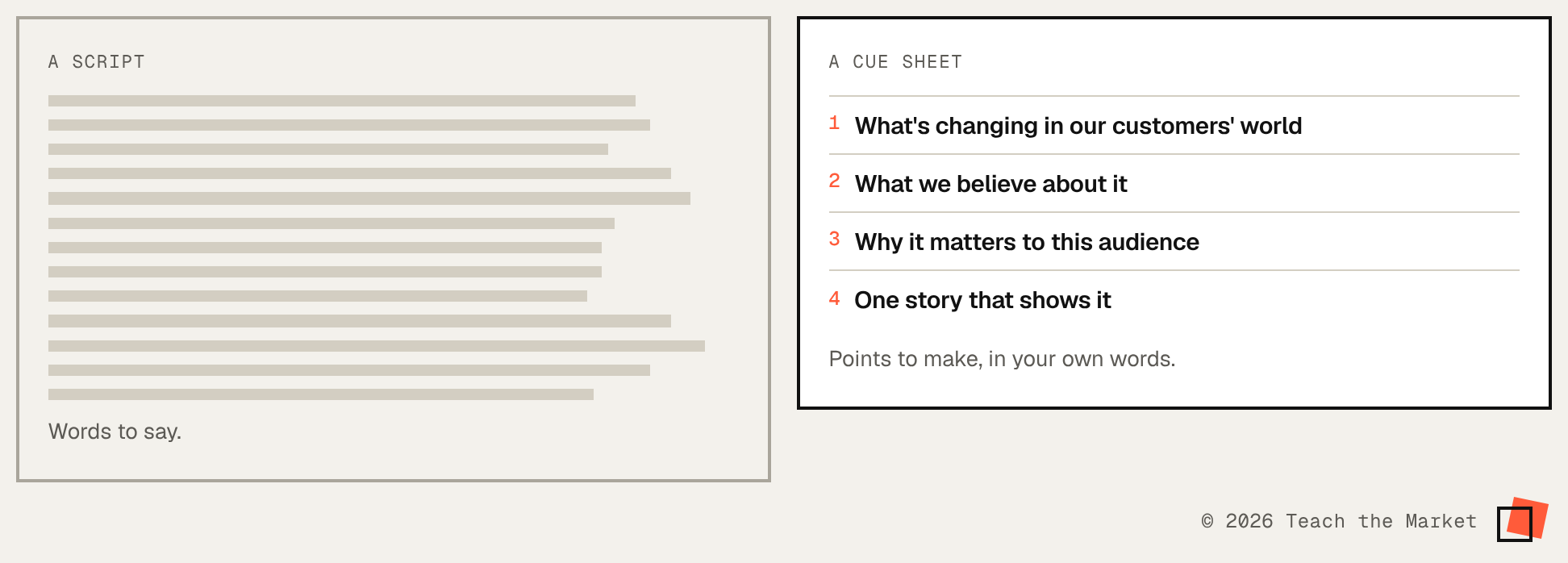
A cue sheet is a one-page outline of the points a speaker needs to make, in the order they need to make them, without the words they’ll use. Each cue is a short prompt: the idea, the proof, the story that illustrates it, and the transition to the next point. The speaker supplies the language.
A script tells someone what to say. A cue sheet tells them what to get across. That difference is the point: an executive working from a cue sheet sounds like themselves, because they’re explaining something they understand rather than reading something someone else wrote.
What is an executive keynote for?
An executive keynote is a narrative tool, not a product pitch. In B2B SaaS, the big keynote moments are usually the CEO keynote at the annual user conference, a product launch event, a major industry conference talk and the sales or company kickoff. Each is one of the few moments when a whole market, or a whole company, listens at once. SaaS keynotes are especially prone to turning into product tours, because there’s always a new release to show. Spend that moment on what’s changing in the industry and what you believe about it.
The product belongs in the story, as proof, not as the story. Audiences remember a point of view they can repeat. They rarely remember a feature tour, and they can get one from a demo anyway.
Should you build a keynote from the narrative or from the product?
Build a keynote from the top-line story down: start with the narrative, then work forwards to the product. There are two ways to build executive communications:
Narrative first (forwards). Start with what’s changing in the market, what you believe about it and why it matters to this audience. Then bring in the product as evidence that you’re acting on that belief.
Product first (backwards). Start with what you’re launching and work back to why it matters.
Working backwards only really works if you’re using that work to discover your narrative: asking what all your recent launches have in common, and what that says about where the market is going. If the narrative already exists, start from it. If it doesn’t, working backwards from the product can help you find it, but the talk you give should still run forwards.
Why shouldn’t executives use a script?
Executives shouldn’t use a script because scripts focus on wording, and wording is the least convincing part of a keynote. Scripts are for messaging, where exact phrasing matters. A keynote is a narrative moment, where what matters is that the speaker clearly believes and understands what they’re saying.
Scripts cause three problems:
They sound read. Even well-delivered scripted lines lose the natural rhythm of someone thinking out loud.
They’re fragile. A speaker who loses their place in a script, or gets an unexpected question afterwards, has nothing to fall back on.
They aren’t authentic. In the age of AI, fluent words are cheap. What audiences trust is the sense that a real person means what they’re saying, in their own words.
There can be no script. If the executive doesn’t understand the narrative well enough to tell it without one, that’s the problem to fix, and a script only hides it until the day.
How do you build a keynote cue sheet?
Start from the narrative. Write down, in a sentence each, what’s changing in the market, what you believe about it, and why it matters to this audience. These are the spine of the talk.
Choose three to five points. Each point is one thing the audience should understand by the end. Fewer is usually better.
Add the proof for each point. A customer story, a piece of data, a demonstration or a decision the company has made. This is where the product appears.
Pick one story that shows the whole argument. A single concrete example often does more than all the points together. Put it where it will land hardest, often near the opening or just before the close.
Write the transitions as cues, not sentences. A few words that remind the speaker how one point leads to the next.
Fit it on one page. If it doesn’t fit, there are too many points. A one-page cue sheet is something a speaker can actually hold in their head.
A good cue sheet usually covers: what’s changing, what we believe, why it matters to this audience, the proof, and one story that shows it.
How do you rehearse a keynote without a script?
Rehearse a keynote by having the executive talk through the cue sheet out loud, several times, until the story comes naturally. The first run will be rough. That’s the point: it shows where they understand the story and where they’re unsure.
Talk it through early. Have the executive explain the narrative in conversation before anyone works on slides. It’s the fastest way to find gaps.
Run it out loud, end to end. Several times, ideally in front of a small audience.
Fix understanding, not wording. When the speaker stumbles, work out what they’re unsure about and talk it through, rather than giving them a better sentence.
Keep the slides secondary. Slides should support the cues, not replace them. If the speaker needs the slides to remember what comes next, the cue sheet isn’t working yet.
Expect each run to sound a little different. That’s a good sign. It means they’re telling the story, not reciting it.
Where does AI help with keynotes, and where doesn’t it?
AI can help turn your narrative source document into a first cue sheet and help the executive rehearse, but the words on the day should be theirs. Useful jobs for AI include drafting the cue sheet from your narrative and proof points, suggesting stories and examples to consider, and acting as a rehearsal audience that asks questions afterwards.
What AI shouldn’t do is write the talk. A keynote written by AI and delivered by an executive is exactly the kind of fluent, generic communication audiences have learned to tune out. A useful rule: AI can help you get ready to talk to someone. It shouldn’t do the talking where the relationship matters.
What are the most common keynote mistakes?
Turning the keynote into a product tour.
Starting from the product without ever arriving at a narrative.
Writing a script, then rehearsing the script instead of the story.
Too many points. If the audience can’t repeat the argument afterwards, there was too much of it.
Building the slides first, and the story around them.
Rehearsing late, so there’s no time to fix gaps in understanding.
Key takeaways
An executive keynote is a narrative tool, not a product pitch. The product is the proof.
Build from the narrative down, not from the product up.
There can be no script. Executives should tell the story in their own words, which is what makes it authentic.
Use a one-page cue sheet: the points to make, the proof and one story, not the words to say.
Rehearse out loud until the story comes naturally, and fix understanding rather than wording.
Frequently asked questions
Can an executive read from a teleprompter?
An executive can use a teleprompter for cues, but reading a full script from one usually sounds read, and audiences notice. If a teleprompter is part of the setup, put the cue sheet on it: short prompts for each point and transition, not full sentences. The speaker then glances at the cue and tells that part of the story in their own words.
How long should a keynote cue sheet be?
A keynote cue sheet should fit on one page, whatever the length of the talk. For a 20 to 30 minute keynote, that usually means three to five points, each with its proof and a short transition, plus one central story. If the cue sheet runs longer, the talk probably has too many points for the audience to remember.
Who should write an executive keynote?
The executive should shape the keynote, because they have to own and defend the point of view. Communications or product marketing usually builds the cue sheet from the narrative, gathers the proof and runs the rehearsals. The executive then tells the story in their own words. A talk the executive didn’t help shape rarely sounds like them, however well it’s written.
What’s the difference between a script and a cue sheet?
A script contains the exact words a speaker should say, so it focuses on wording. A cue sheet contains only the points to make, the order and the proof, so it focuses on meaning, and the speaker supplies the words. Scripts suit messaging, where phrasing matters. Cue sheets suit narrative moments like keynotes, where authenticity matters more.
Your next step
Before the next keynote, ask the executive to explain the talk to you in five minutes, without slides. Write down what they say as cues, not sentences: what’s changing, what you believe, why it matters, the proof and one story. That’s the first draft of the cue sheet. For how keynotes fit with internal communications, PR and analyst relations, see the practical guide to communications.
About the author
Lara George spent eight years at a hypergrowth B2B SaaS company. She joined at Series B and rose from product marketing manager to VP of Product Marketing and GTM Enablement. She launched a product that now drives 40% of revenue, helped grow the portfolio from one product to more than six, and ran analyst relations from start to finish. She’s also a recognized voice in communications and a frequent speaker at communications and tech industry events. Teach the Market is where she shares what she learned. More about Lara
