

The short answer: Positioning starts with a perspective: a clear view of how the problem your B2B SaaS product solves should be solved. That perspective explains the choices behind your product, and those choices produce specific focus areas and specific gaps. Good positioning connects all of it, so your strengths read as the point of your approach and your gaps read as tradeoffs you chose for a reason. That’s what makes a position defensible when a buyer starts asking questions.
This guide explains what a positioning perspective is, how it links product choices to the way buyers see you, and how to build one that holds up in a competitive deal. It’s part of the practical guide to B2B SaaS positioning.
What does it mean that positioning is about perspective?
Positioning is about perspective because a position is only as strong as the reasoning behind it. Every B2B SaaS product is the result of choices: which problem to prioritize, which users to serve best, what to build deeply and what to leave out. A perspective is the belief that ties those choices together: how you think the problem should be solved, and why.
Without a perspective, a product is a list of features, some strong and some missing, and buyers compare it line by line against everyone else’s list. With one, the same product becomes an argument: we solve this problem this way, for these reasons, which is why we’re strong here and deliberately lighter there.
Why does perspective matter more when products converge?
When B2B SaaS products converge, features stop being a reliable way to stand out, and the strategic approach becomes the differentiator. In many software categories, competitors ship similar capabilities within months of each other, and AI has made that cycle faster. If your positioning rests on a feature, it has a short shelf life.
A perspective lasts longer, because it’s harder to copy than a feature. Competitors can match what your product does. It’s much harder for them to adopt the reasoning behind it, especially if their own product reflects different choices.
Consider an illustrative customer service software company. Its messaging-first support platform competes with CRM suites whose service modules go much deeper on traditional case management. Feature by feature, it loses on breadth. Its perspective, that overlapping tools confuse agents and customers, and that conversational support deserves a focused tool, turns that breadth gap into a choice. The argument only works because the company really is stronger in conversational support. That condition matters, and we’ll come back to it.
How do product choices become focus areas and gaps?
Every product choice creates a focus area and, usually, a gap. Choosing to build deeply for one workflow means building less for another. Choosing one buyer means serving another less well. That’s not a flaw in the product; it’s what a strategy looks like.
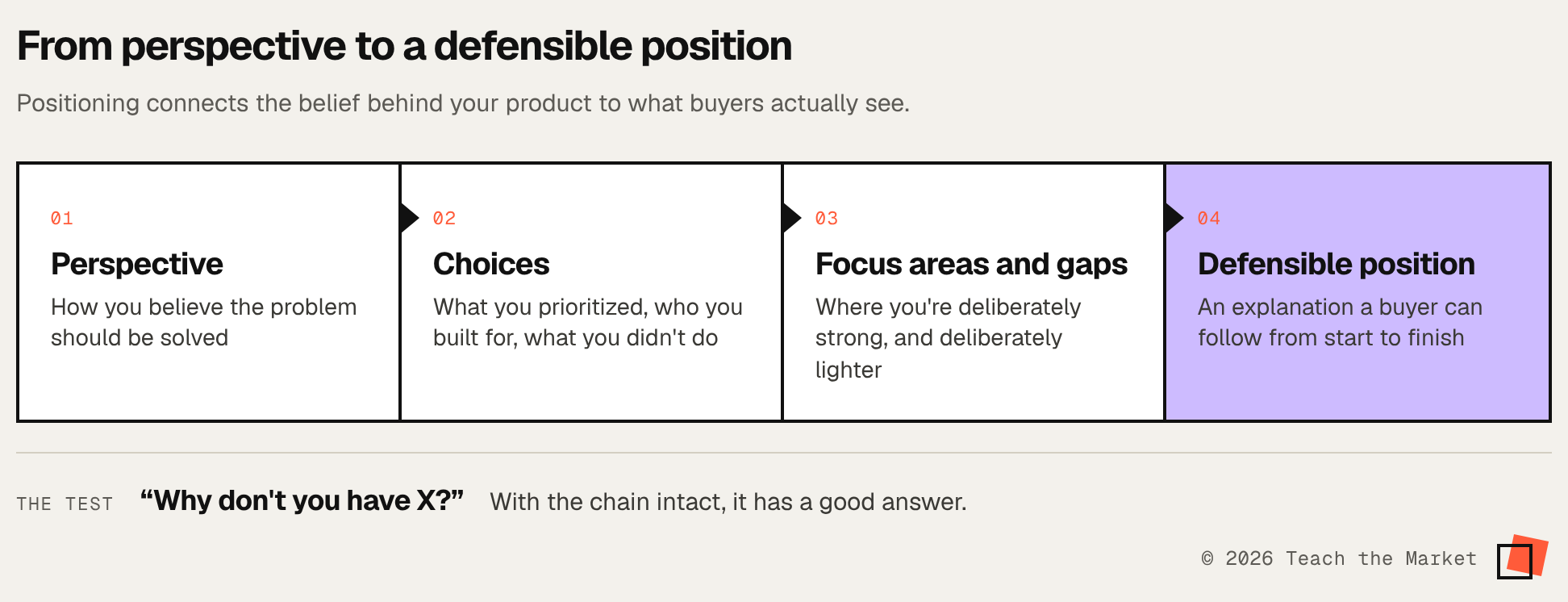
The chain runs like this:
Perspective: how you believe the problem should be solved.
Choices: what you prioritized, who you built for, and what you decided not to do.
Focus areas and gaps: where the product is deliberately strong, and where it’s deliberately lighter.
Defensible position: an explanation buyers can follow from the first link to the last.
When the chain is intact, a buyer’s hardest question, “Why don’t you have X?”, has a good answer. When it’s broken, the same question exposes a gap with no reason behind it.
What makes a positioning perspective defensible?
A positioning perspective is defensible when it’s true to the product, consistent with your choices, and backed by real strength where you say you’re focused. Four tests help:
It explains your strengths. Your best capabilities should follow naturally from your perspective. If they don’t, the perspective is probably borrowed from the category, not derived from your product.
It explains your gaps. A buyer should be able to see why you’re lighter in certain areas. If a gap has no connection to your perspective, don’t pretend it does.
You’re genuinely strong where you focus. Reframing a gap as a choice only works if you double down on a real strength. Being lighter in one area and merely adequate in your focus areas won’t sustain the argument.
It survives a follow-up question. Ask “Why is that true?”, “Compared to what?” and “Show me.” A perspective that collapses under the second question isn’t ready for the market.
One honest caveat: not every gap is a strategic choice. Some features are simply missing because you haven’t built them yet. Positioning makes real choices defensible. It shouldn’t be used to dress up every missing feature as intentional, because buyers can tell, and it costs trust.
How do you build a positioning perspective for a B2B SaaS product?
Start from the market. Map the competitive alternatives buyers actually consider, including doing nothing, and how much the products in your category really differ. See competitive alternatives for how.
Write down how you believe the problem should be solved. One or two sentences. If your team can’t agree on it, that’s the first problem to fix.
List the choices behind your product. What did you prioritize? Who did you build for first? What did you decide not to do, and why?
Map your focus areas and gaps. Be honest about both. Ask sales and customer success where buyers push back.
Connect each focus area and gap to the perspective. Where a connection is real, write the explanation. Where it isn’t, treat the gap as a product question, not a positioning one.
Prove the focus. Gather the evidence that you’re genuinely strong where you say you’re focused: customer outcomes, depth of capability, roadmap commitment.
Test it in a real conversation. Have sellers use it with buyers and listen for where it holds and where it breaks.
What happens to positioning when the product changes?
When your product choices change, your positioning perspective has to change with them. If you expand into new use cases, add products or serve a new buyer, the old perspective may no longer explain your focus areas, and the gaps it used to justify may have closed. That’s often one of the clearest signals that it’s time to revisit your positioning. Treat the perspective as a living explanation of your strategy, not a slogan written once.
What are the most common mistakes?
Positioning on features alone, so the position expires when a competitor catches up.
A perspective that doesn’t match the product, borrowed from a competitor, an analyst or the category’s usual talking points.
Calling every gap a choice. Buyers notice, and it undermines the gaps that really are choices.
Focus without strength. Claiming to be focused on an area where you’re only average.
Keeping it in the deck. A perspective nobody on the front line can explain won’t survive a sales conversation.
Key takeaways
Positioning starts with a perspective: how you believe the problem should be solved.
That perspective explains your product choices, and those choices create specific focus areas and gaps.
Good positioning makes those choices defensible, so strengths and gaps both make sense to a buyer.
Reframing a gap only works if you’re genuinely strong where you’ve chosen to focus.
Not every gap is a choice. Don’t pretend it is.
Frequently asked questions
What is the difference between a positioning perspective and a mission statement?
A mission statement describes why a company exists and what it hopes to achieve. A positioning perspective is narrower and more practical: it explains how you believe a specific problem should be solved, and why your product’s choices follow from that belief. A buyer can use a positioning perspective to make a decision. A mission statement rarely helps them choose.
How do you explain a product gap without sounding defensive?
Explain a product gap by connecting it to the choice behind it, then to the strength that choice made possible: “We focused on X, which is why we’re deeper there, and we integrate with Y for that need.” Keep it factual and specific. If the gap isn’t connected to a choice, say so plainly and explain what the buyer can do instead.
Who should define the positioning perspective in a B2B SaaS company?
A positioning perspective needs input from product leadership, who understand the choices behind the product, and from go-to-market leaders, who know how buyers see the alternatives. Product marketing often brings these perspectives together and tests the result with sales. The perspective only works if the leadership team agrees with it and the product reflects it.
Can a positioning perspective be too narrow?
A positioning perspective can be too narrow if it excludes buyers you depend on or describes a focus your product has outgrown. The test is whether it explains the choices you’ve actually made and the market you actually serve. If you find yourself explaining away large parts of your own product, the perspective probably needs updating.
Your next step
Write one sentence on how your company believes the problem it solves should be solved. Then list your three biggest strengths and your three gaps buyers ask about most. For each one, write how it connects to that sentence. Where you can’t, you’ve found either a positioning problem or a product question. For the full process, see the practical guide to B2B SaaS positioning.
About the author
Lara George spent eight years at a hypergrowth B2B SaaS company. She joined at Series B and rose from product marketing manager to VP of Product Marketing and GTM Enablement. She launched a product that now drives 40% of revenue, helped grow the portfolio from one product to more than six, and ran analyst relations from start to finish. She’s also a recognized voice in communications and a frequent speaker at communications and tech industry events. Teach the Market is where she shares what she learned. More about Lara
