

The short answer: AI can write fluent B2B SaaS messaging in seconds, but it can’t decide what your company believes, what it should argue, or where its claims should stop. That’s the point of view, and it has to come from you. As polished language gets cheaper, the advantage moves to companies with a clear argument that holds up under buyer scrutiny. Use AI to express, test and scale that argument, not to invent it.
This guide explains what AI does well in messaging, what it can’t supply, and how B2B SaaS teams should prepare before they hand the writing to AI. It’s part of the practical guide to B2B SaaS positioning.
What is a point of view in B2B SaaS marketing?
A point of view is the argument underneath your messaging: what you believe about the problem, how it should be solved, and why your approach is the better choice. It’s the thing your messaging expresses. “There are a million nice ways to say something” is a useful way to think about it. Having something to say is the hard part.
Messaging is how you say it. Positioning is what you say. A point of view is the conviction that makes the positioning worth saying, and it’s what buyers, analysts and competitors test when they push back.
What can AI do well in messaging?
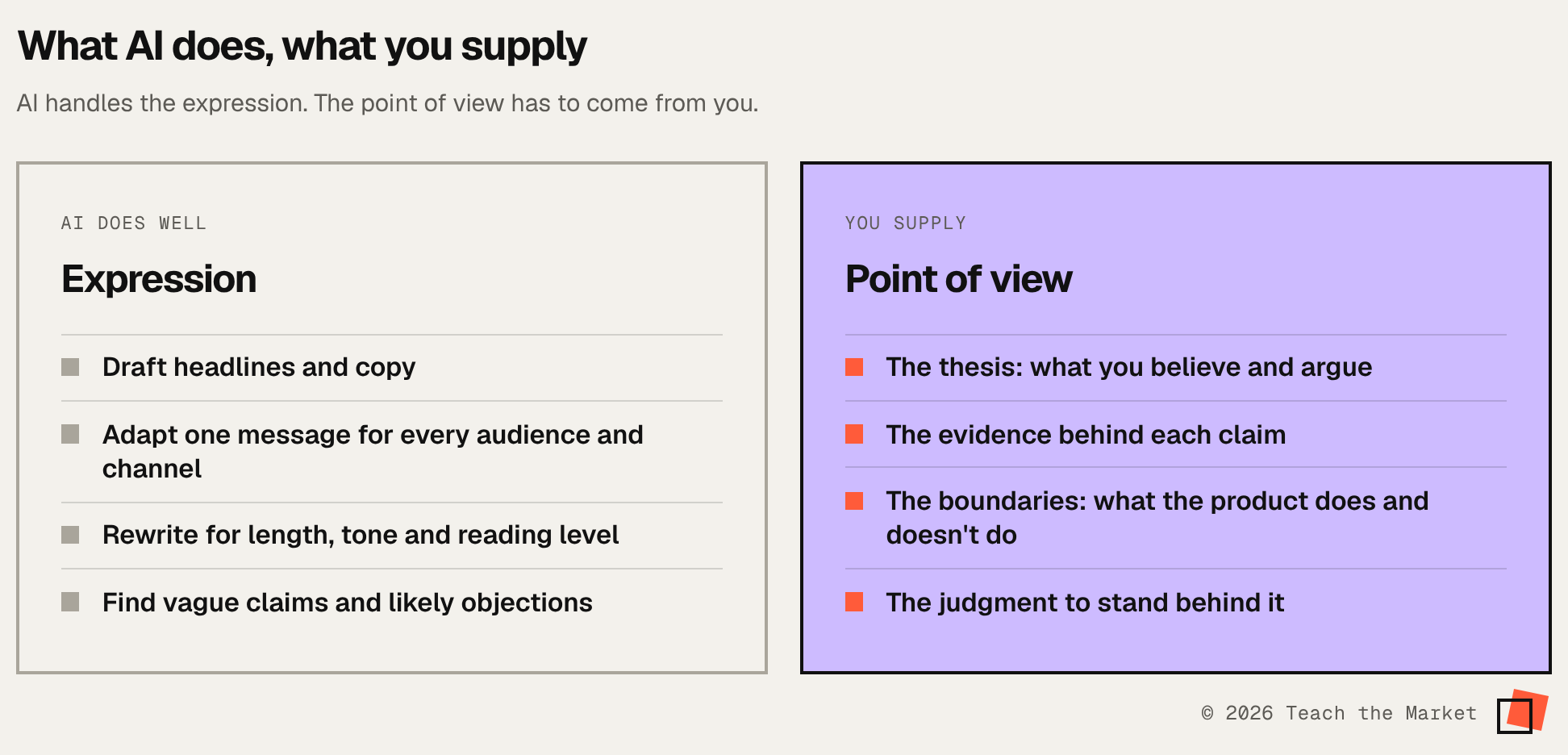
AI is genuinely good at expression. Given a clear argument, it can:
Draft headlines, copy and variations quickly
Adapt one message for different audiences, industries and channels
Rewrite for length, tone and reading level
Act as a critic: find vague claims, missing evidence and likely objections
Help you interrogate your own argument by asking the follow-up questions a buyer would ask
More B2B marketers should use AI for this work. The question isn’t whether to use it, but what to give it.
What can’t AI supply?
AI can’t supply the judgment, context and responsibility that a point of view requires. It can generate a hundred plausible arguments, but it can’t decide which one your company actually believes, which one your product can back up, or which one your leadership will defend on stage.
Specifically, AI can’t:
Choose your thesis. It can propose options, but it can’t commit you to one.
Know your strategic choices. It doesn’t know why you built what you built, or what you decided not to do, unless you tell it.
Judge what’s true about your product. A plausible extrapolation can quietly expand a product claim into something you can’t deliver.
Take responsibility. When a buyer challenges a claim, someone at your company has to stand behind it.
There’s a revealing pattern here. Teams often start with AI expecting to speed up messaging work, and end up spending more time on it, because the process exposes that they were never clear about what they wanted to argue. That isn’t AI failing. It’s AI showing you where the thinking is missing.
Why does a point of view matter more now that AI writes so well?
When fluent language is cheap, a nice-sounding message stops being an advantage. Every B2B SaaS company now has access to the same models and the same frameworks, so polished copy is easy to produce and easy to imitate. Many category websites already sound alike.
The advantage moves to legitimate argument: a thesis with enough substance to withstand scrutiny from buyers, competitors and analysts. Fluent language doesn’t repair a weak thesis. It can make the weakness harder to notice, until a buyer asks the second follow-up question.
How should B2B SaaS teams prepare before using AI for messaging?
Invest in the argument and its boundaries first, then let AI handle the variations. Don’t spend most of your effort writing fifteen hooks or a menu of sample headlines. AI can generate those. Spend it on the thinking AI can’t safely invent:
Write the thesis. In a few sentences: what’s changing for your buyers, what you believe about it, and why your approach is the better answer.
Write the supporting arguments. The three to five claims a skeptical buyer would need to accept, each with its reasoning.
Attach the evidence. For each claim, the proof: customer outcomes, product capabilities, data.
Define the boundaries. What the product does and doesn’t do, the approved use cases, and the claims you won’t make. This matters most around functionality, where AI is most likely to overreach.
Add the context. Who the buyers are, which alternatives they compare you to, and the objections sellers hear most.
Then use AI. Have it draft, adapt and stress-test the messaging from that source, and review what it produces against the boundaries.
The result looks less like a classic messaging matrix and more like a point-of-view document: an argument with reasons and limits. That’s the document that makes AI-assisted messaging useful.
What does it look like when AI oversteps?
AI oversteps when it fills a gap in your brief with a plausible but unsupported claim. Consider an illustrative customer service platform with a customer-notification feature. Asked to tailor messaging for internet providers, AI might write about alerting customers to a regional outage. That’s a fair example of the use case. But it can easily drift into implying the product monitors networks or triggers alerts automatically, which it doesn’t.
Adapting an example to an industry is fine, as long as the underlying capability stays intact. The fix isn’t to avoid AI. It’s to tell it explicitly where the product’s capabilities stop, and to check its output against that list.
What are the most common mistakes?
Asking AI for positioning before you have a point of view. You’ll get the category average.
Spending the effort on variations instead of the argument behind them.
No boundaries in the brief, so product claims expand quietly.
Judging copy by how it sounds, not by whether it survives a follow-up question.
Treating AI’s first draft as the thesis. A draft is something to react to, not something to adopt.
Key takeaways
AI can write fluent messaging, but it can’t decide what your company believes or should argue.
As polished language gets cheaper, the advantage moves to a clear argument that survives scrutiny.
Invest in the thesis, the evidence and the boundaries before using AI.
Use AI to express, adapt and interrogate the argument, not to invent it.
Tell AI where your product’s capabilities stop, and check its output against that list.
Frequently asked questions
Can AI write B2B SaaS positioning?
AI can draft positioning statements, but it can’t choose the strategy behind them. It doesn’t know which choices your company made, which claims your product can support, or which argument your leadership will defend. Use AI to generate options and test them, then decide on the position yourself, based on your market, your product and your evidence.
What should you give AI before asking it to write messaging?
Give AI your thesis, your three to five supporting arguments with the reasoning and evidence behind each, the buyer context and competitive alternatives, and clear boundaries: approved capabilities, use cases and claims to avoid. With that source, AI can produce useful variations. Without it, AI fills the gaps with generic category language and plausible but unsupported claims.
How do you know if your messaging has a point of view?
Your messaging has a point of view if a skeptical buyer could disagree with it. Generic messaging is hard to argue with because it says nothing specific. A point of view takes a position on how the problem should be solved, and it holds up when someone asks “Why is that true?” or “Compared to what?”
Will AI make B2B messaging all sound the same?
AI makes it easier for companies to sound alike, because many teams use the same tools in the same way and get the category average back. Companies that start from a distinct point of view and give AI their own argument and evidence can still sound different, because the substance behind the language is different.
Your next step
Before your next AI messaging session, write half a page: your thesis, three supporting arguments with one piece of evidence each, and a short list of claims you won’t make. Give that to the AI first, then ask it to find the weakest argument. For how positioning comes together, see the practical guide to B2B SaaS positioning.
About the author
Lara George spent eight years at a hypergrowth B2B SaaS company. She joined at Series B and rose from product marketing manager to VP of Product Marketing and GTM Enablement. She launched a product that now drives 40% of revenue, helped grow the portfolio from one product to more than six, and ran analyst relations from start to finish. She’s also a recognized voice in communications and a frequent speaker at communications and tech industry events. Teach the Market is where she shares what she learned. More about Lara
