

The short answer: Communications that aren’t built on a narrative turn into a series of disconnected announcements: every launch, keynote, press release and all-hands tells a slightly different story, and none of them add up. A strategic narrative gives every communication the same job, which is to make one interpretation of your market more convincing over time. For B2B SaaS companies, that’s what turns a busy communications calendar into a story people actually remember and repeat.
This guide explains why communications need a narrative underneath them, what changes when you have one, and how to build your communications on it. It’s part of the practical guide to communications for B2B SaaS.
What does it mean to build communications on a narrative?
Building communications on a narrative means every message, campaign and channel starts from the same interpretation of what’s happening in your market, what you believe about it, and what role your company plays. The narrative is the argument. Communications is how you carry that argument to employees, customers, analysts, press and the wider market, over and over, in forms that fit each audience.
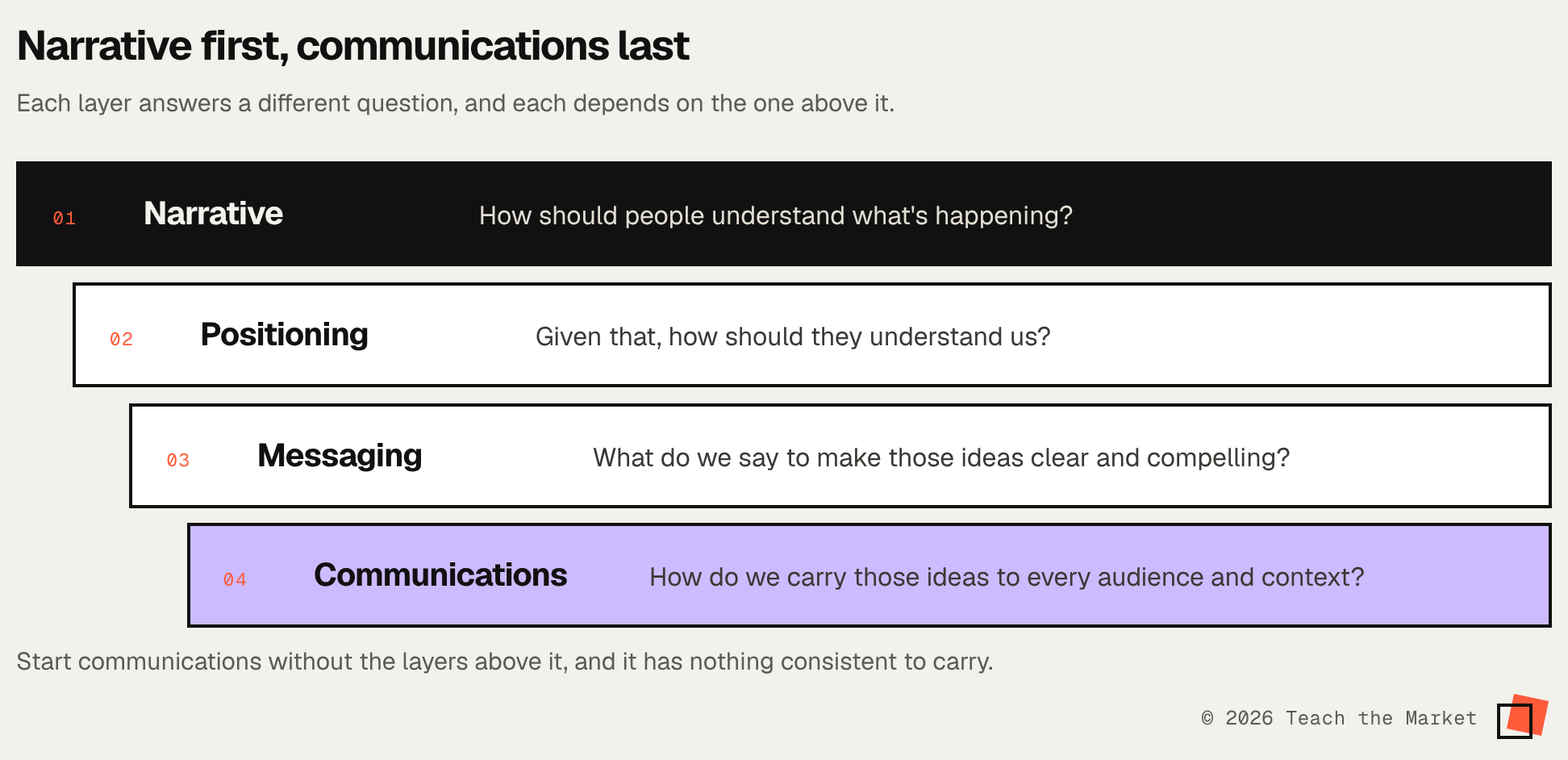
It helps to see the order. Each layer answers a different question, and each depends on the one before it:
Narrative: How should people understand what’s happening?
Positioning: Given that, how should they understand us?
Messaging: What do we say to make those ideas clear and compelling?
Communications: How do we carry those ideas consistently to every audience and context?
Communications is the last layer, not the first. When it starts without the layers above it, it has nothing consistent to carry.
What happens when communications aren’t built on a narrative?
Without a narrative, communications default to announcements, and announcements don’t add up. Each team optimizes its own moment. Product marketing launches features, PR pitches news, the CEO gives a keynote, internal communications explains the reorg, and each one makes sense on its own. Taken together, they tell several different stories.
The symptoms are familiar in growing B2B SaaS companies:
Every launch introduces a new story. The company sounds different each quarter.
The CEO and the homepage disagree. The keynote says the company is moving upmarket; the website still sells to small teams.
Campaigns don’t accumulate. Each one starts from zero, so the market never builds a lasting impression.
Employees can’t explain the strategy. They’ve heard the announcements, but they can’t connect them.
Analysts and press describe you in their own terms, because you never gave them a consistent one.
These look like messaging problems, but they’re narrative problems. Better wording won’t fix them, because the issue is that the company hasn’t decided what story it’s telling.
What changes when communications start from a narrative?
When communications start from a narrative, each piece becomes another piece of evidence for the same argument. A launch is no longer just “what’s new.” It’s proof of what the company believes about where the market is going. A keynote becomes the moment the whole market hears that argument at once. Internal communications explain changes as steps in a direction people already understand.
In practice, a narrative changes the communications work in a few ways:
Campaigns build instead of restarting. Each one extends the same idea, so the market remembers more each time.
Channels translate rather than repeat. The CEO shouldn’t sound like the homepage, but someone who hears both should conclude they believe the same thing.
The calendar has a filter. If a story doesn’t advance the narrative, it may still be worth telling, but it shouldn’t take the biggest moments.
Internal and external stay aligned. Employees get the long version of the same story the market gets in short form.
You have something to measure against. You can check whether people start explaining your market the way your narrative does.
Why does this matter so much for B2B SaaS companies?
B2B SaaS companies communicate constantly, so they’re especially exposed to sounding inconsistent. Frequent releases, new products, pricing changes, funding announcements, analyst evaluations, user conferences and AI strategy updates all compete for attention. Each one is a chance to reinforce one story, or to add another.
Buying decisions also take time and involve many people. A buyer might see a social post in January, hear a webinar in March and read an analyst report in May. If those moments tell the same story, it compounds. If they don’t, the buyer is left with fragments.
How do you build communications on a narrative?
Start with the core narrative. Make sure it answers three questions in plain language: what is changing, what do you believe about it, and what role does your company play? If it can’t, fix that before planning communications.
Write a source document. Capture the narrative, the principles that stay constant when wording changes, the evidence behind each major claim, language to use and avoid, and notes for each audience. Teams, and the AI tools they use, can then translate from one source. Our narrative source document template is a starting point.
Map your big moments to the narrative. For each launch, keynote, campaign and announcement in the next year, write one sentence on how it advances the narrative.
Plan campaigns, not announcements. Sequence each important moment inside out: employees first, then customers, analysts, press and social.
Translate, don’t distribute. Give channel owners the argument, not a master deck, and let them adapt it for their audiences.
Check for drift regularly. Compare what your website, executives, sales decks, press coverage and employee communications actually say. Contradictions are a narrative problem, not a copy problem.
Measure alignment over time. Listen for whether customers, analysts and employees start describing your market the way your narrative does.
What are the most common mistakes?
Starting with the calendar and looking for something to say.
Treating the narrative as a slogan instead of an argument with reasons.
Handing out a master deck and expecting every channel to repeat it.
Letting every launch introduce a new story.
Telling the outside world before employees.
Measuring reach and assuming the narrative landed.
Key takeaways
Communications without a narrative becomes a series of disconnected announcements.
A narrative gives every communication the same job: making one interpretation of your market more convincing.
The order is narrative, positioning, messaging, then communications.
Translate the narrative for each audience instead of distributing identical messages.
Check for drift, and measure whether people start telling your story in their own words.
Frequently asked questions
What is the difference between a narrative and communications?
A narrative is the argument: how people should understand what’s happening in your market, what you believe about it, and what role you play. Communications is how that argument reaches people, through internal and external channels, digital and in person, over time. The narrative decides what the story is; communications decides how, when and to whom it’s told.
Can you do good communications without a strategic narrative?
You can produce good individual communications without a narrative: a clear announcement, a well-run event, a strong press release. What’s hard is making them add up. Without a narrative, each piece stands alone, so the market and your employees don’t build a consistent understanding of where the company is going.
Who should own the narrative that communications is built on?
No single function should own the narrative. It needs leadership input, because executives have to believe it and act on it, plus product, market and communications expertise. Communications teams are often well placed to coordinate the work and keep it consistent across channels, but the narrative has to belong to the leadership team.
How often should B2B SaaS communications refer back to the narrative?
Every significant communication should connect to the narrative, even if it doesn’t restate it. A launch, a keynote or an internal update doesn’t need to repeat the whole story, but it should be clear how it fits. Review the narrative itself less often, typically when the market, the strategy or the company’s direction changes.
Your next step
List the five biggest communications moments on your calendar for the next six months. For each one, write a sentence on how it advances your narrative. If you can’t write those sentences, start with the narrative. If you can, you have the outline of a year of communications that adds up. For more on campaigns, PR, keynotes and measurement, see the practical guide to communications.
About the author
Lara George spent eight years at a hypergrowth B2B SaaS company. She joined at Series B and rose from product marketing manager to VP of Product Marketing and GTM Enablement. She launched a product that now drives 40% of revenue, helped grow the portfolio from one product to more than six, and ran analyst relations from start to finish. She’s also a recognized voice in communications and a frequent speaker at communications and tech industry events. Teach the Market is where she shares what she learned. More about Lara
