

If you're about to start a messaging project, the usual first step is to open a messaging framework template and start filling in the boxes: value proposition, pillars, proof points, a row for each persona. It feels like progress. It usually isn't.
Build the messaging framework last. A messaging framework is a tool for scaling a message that already works. It helps other marketers (and, increasingly, AI tools) apply that message consistently. It is not a good tool for discovering what the message should be. Find the message first by developing it in a concrete selling context, usually a pitch deck, test it with people who hear buyer objections every day, and codify it only when other people need to use it.
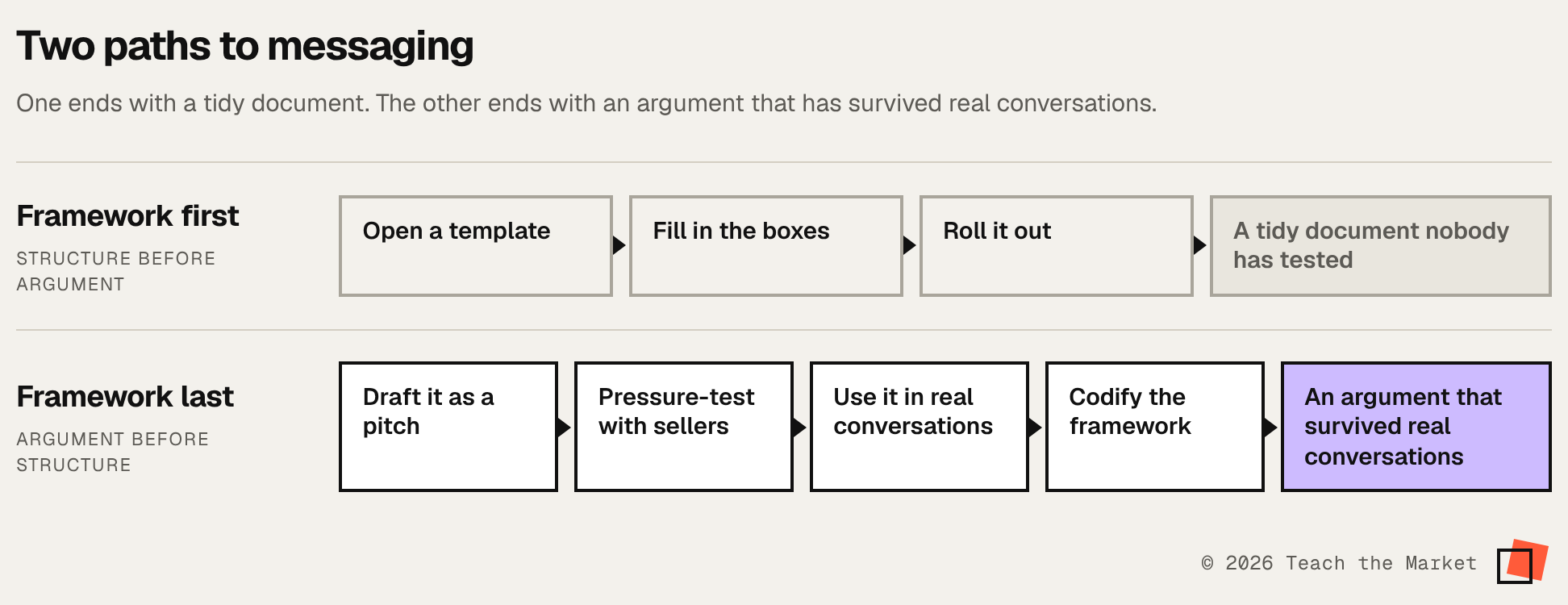
This article explains why the order matters, how to develop messaging without starting from a framework, and how to tell when it's time to write one. It's one part of building a strategic narrative for a B2B SaaS company.
Why does starting with a messaging framework go wrong?
Starting with the framework puts the structure ahead of the argument. Three problems follow.
The boxes get filled with untested statements. A blank framework asks for three pillars and supporting proof points, so the team produces three pillars and supporting proof points. Every box gets something plausible in it. Nothing in the process asks whether a buyer would find the argument convincing, or whether a seller could defend it when the buyer asks a follow-up question.
It's built for the wrong audience. Salespeople rarely use the messaging framework. They use the pitch, the demo story, and the sales materials. The framework's real users are other marketers, agencies, and writers who need to produce consistent content. When a team treats the framework as the main deliverable, it can end up with a document that is tidy internally and does little to improve actual selling.
AI makes the filled-in grid even less valuable. AI tools can now produce headline variants, persona-specific value propositions, and proof-point phrasing in seconds. If your framework is mostly a menu of phrasings, you've spent your time on the part AI can do for you, and skipped the part it can't: deciding what the argument is.
A useful working distinction here: positioning is what you say; messaging is how you say it. A framework records both, but it can't create either. The thinking has to happen somewhere else first.
How do you develop messaging without starting from a framework?
Develop the message in the place it has to work. The steps below move from diagnosis to a codified framework.
1. Work out what the buyer needs to be convinced of first
Before writing anything, find out where deals are getting stuck. Look at win-loss patterns ([how to diagnose why messaging isn't working](PLANNED: nar-06)). If formal win-loss research isn't practical, talk to sellers and sales managers: sellers hear objections directly, and managers can see which objections repeat across deals.
What you're looking for is the buyer's first obstacle, because that decides how the message should open:
If buyers already understand the solution, have urgency, and are comparing similar vendors, the message has to establish the strategic difference in your approach.
If buyers see the need but can't secure budget or priority, the message has to establish why the problem deserves investment now.
If the main competitor is doing nothing, the message has to establish the cost and consequences of the status quo.
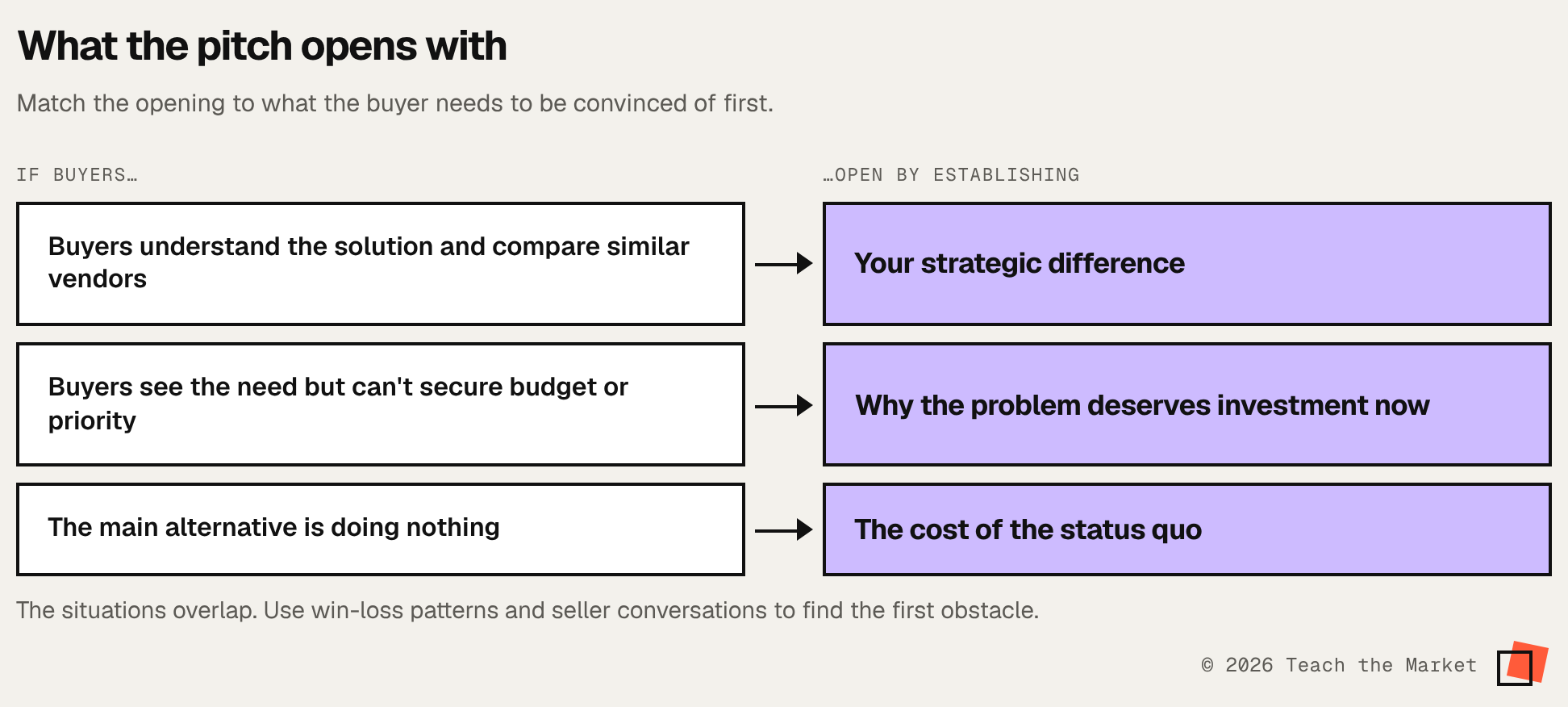
These situations overlap, and loss reasons point to questions to investigate rather than proven causes. A deal that slipped for budget reasons isn't automatically a messaging problem. But this diagnosis keeps you from writing a beautiful differentiation story for buyers who haven't yet agreed the problem is worth solving.
2. Draft the message as a pitch
A pitch deck is the best default environment for developing messaging, because it forces the decisions a framework lets you postpone:
Sequence. What does the buyer need to understand first, second, and third for the argument to land?
Proof. What can you show, not just claim, at each step?
Objections. Where will a buyer push back, and what's the answer?
A homepage or key web page can do the same job. What matters is that the message lives in a concrete application with a real reader, rather than in a grid of abstractions.
3. Pressure-test it with experienced sellers
Walk your strongest sellers through the draft and ask them to attack it. Experienced sellers can anticipate how a buyer will respond, which claims will invite a follow-up question, and where the argument has no answer. This is the fastest way to find out whether your message can survive live buyer scrutiny.
Partners who are close to your customers can also give useful early feedback, without the risk of setting expectations in a customer conversation.
Treat both as early signals. Seller buy-in is promising, but it isn't proof that buyers find the message convincing. Don't describe partner or seller feedback as customer validation.
4. Use it in real conversations and fix what breaks
Get the pitch into the field. Start with a few influential sellers whose peers pay attention to what they do. Involve them early, earn their buy-in, and help them use the material in actual deals. Other sellers adopt new messaging faster when they see respected colleagues using it successfully than when they sit through a rollout presentation.
In my own experience leading product marketing at a B2B SaaS company, our messaging rollouts became more successful once we identified influential sellers, brought them in earlier, and gained their support. Their use of the material in the field did more to encourage adoption than the enablement session alone.
Listen for where the message breaks: the slide sellers skip, the claim that keeps needing a caveat, the objection with no good answer. Revise the pitch, not the framework, until the argument holds.
5. Codify it when other people need to apply it
Now write the framework. You're no longer guessing what goes in the boxes. You're recording an argument that has been through real conversations.
When should you build the messaging framework?
Build the framework when the message needs to scale beyond the people who developed it. Signs you've reached that point:
Other marketers, agencies, or freelance writers are producing content from the message.
You're using AI tools to generate copy and need them to stay within the argument.
You're seeing inconsistency: different teams describing the product in conflicting ways.
New hires need to learn the message without sitting in on the deals where it was developed.
If none of these apply, you may not need a formal framework yet. A small team that develops and delivers its own messaging can work from a strong pitch and a short written summary of the argument.
What should the framework contain when you do write it?
Invest in the thinking and the limits, not in phrasing variants. A framework that will be used by other marketers and by AI tools should include:
The thesis: the core argument, in one or two plain sentences.
The supporting arguments and the reasoning behind each one: why it's true and why it matters to the buyer.
Context: the market situation, the buyer's starting point, and the alternatives they're weighing.
Approved scope: the capabilities, use cases, and proof you can actually claim.
Boundaries: what not to say, which claims need qualification, and where people (or AI) shouldn't infer beyond what's approved.
Answers to anticipated questions, especially the objections you found in steps 3 and 4.
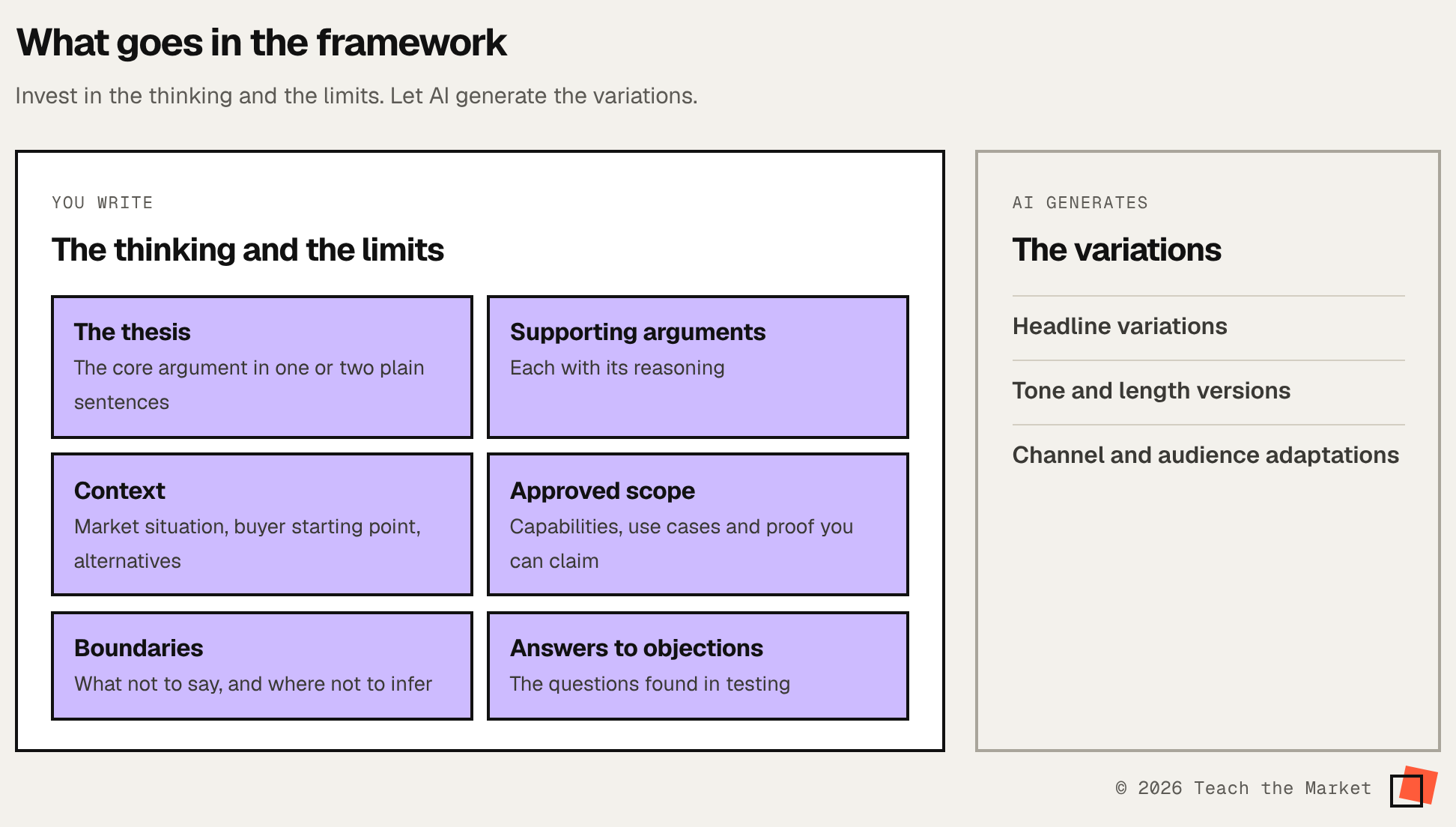
Skip the fifteen alternative headlines. Anyone with an AI tool can generate those from a good thesis. The document ends up closer to a point-of-view brief than a classic messaging matrix, and that's what makes it useful.
Frequently asked questions
Is a messaging framework the same as positioning?
No. Positioning is what you say: how buyers should understand your product and why it’s the better choice. Messaging is how you say it. A messaging framework records both so others can apply them consistently, but it can’t create either. Settle the positioning first, develop the messaging in a pitch, then codify it.
Do small B2B SaaS teams need a messaging framework?
Often not yet. A small team that works on the same deals can usually run on a strong pitch and a short written summary. A framework becomes worth building when the message has to scale beyond the people who created it: new marketers, agencies, freelance writers, AI tools, or teams that describe the product in conflicting ways.
How long should you test messaging before codifying it?
Long enough for the message to survive real sales conversations: sellers using it on live calls, the claims holding up without constant caveats, and the common objections having good answers. There’s no fixed number of weeks. The signal is that the pitch has stopped changing much between conversations.
Common mistakes
Treating the framework workshop as the strategy work. Agreeing on wording in a room is not the same as finding an argument that works with buyers.
Building the framework for sellers. Give sellers a pitch they can use. Give the framework to the people who need to scale the message.
Codifying too early. If the message hasn't survived real sales conversations, codifying it locks in untested claims.
Mistaking internal enthusiasm for market validation. Seller and partner feedback helps, but neither is the same as buyers responding to the message.
Leaving out the boundaries. A framework without limits invites overclaiming, especially when AI tools are extrapolating from it.
A quick check for your current messaging
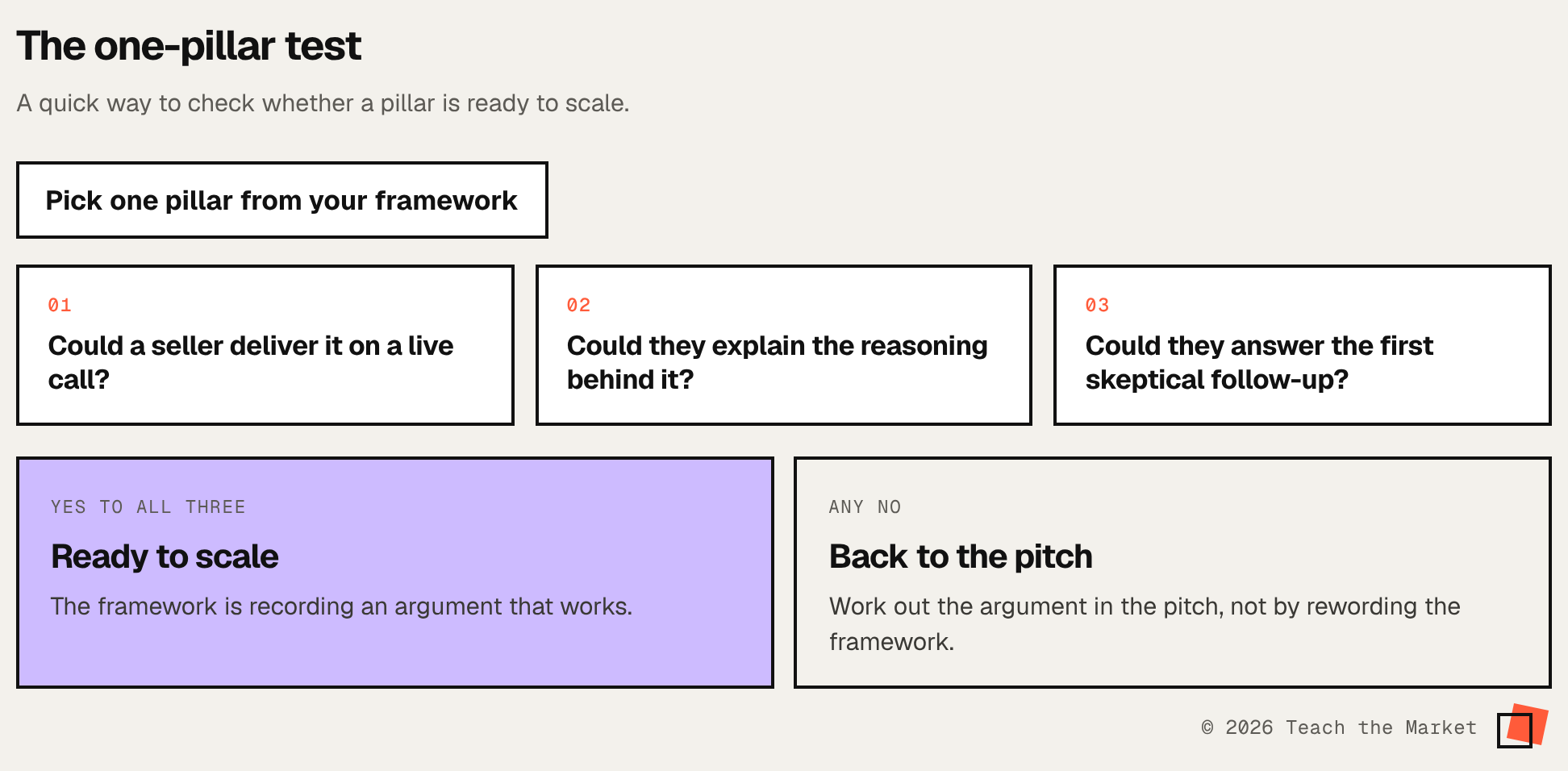
Pick one pillar from your existing framework. Could a seller deliver it in a live call, give the reasoning behind it, and answer the first follow-up question a skeptical buyer would ask? If not, the problem isn't the framework's wording. Go back to the pitch and work out the argument.
For the broader process of building an argument your market will repeat, see the guide to strategic narrative for B2B SaaS.
About the author
Lara George spent eight years at a hypergrowth B2B SaaS company. She joined at Series B and rose from product marketing manager to VP of Product Marketing and GTM Enablement. She launched a product that now drives 40% of revenue, helped grow the portfolio from one product to more than six, and ran analyst relations from start to finish. She’s also a recognized voice in communications and a frequent speaker at communications and tech industry events. Teach the Market is where she shares what she learned. More about Lara
